

The God of the Living (20:27-40)
The Sadducees arrive at the temple with a trap disguised as a theological question. Levirate marriage law states that a man must marry his brother’s widow (Deut 25:5–10). So: seven brothers, one woman, all dead. Whose wife will she be at the resurrection?
The scenario is not invented from scratch. Second Maccabees 7 describes seven brothers who are martyred sequentially under Antiochus IV, each refusing to renounce their faith, and several explicitly affirm bodily resurrection as they die (2 Macc 7:9, 11, 14, 23, 29).1 That tradition almost certainly influences this exchange. If so, the Sadducees aren’t just asking an abstract philosophical question; they are challenging a type of resurrection hope that is already deeply rooted in Jewish history and imagination.
Jesus dismantles their trap in two moves.
The first is conceptual. The Sadducees construct their reductio ad absurdum scenario on an unstated assumption: that if resurrection were real, it would simply be a resumption of our present earthly life with our present social structures and all. The absurdity that follows is supposed to prove the point that resurrection isn’t real. Jesus pulls the assumption apart. Those who attain the resurrection are ἰσάγγελοι, “like angels,” a word that appears nowhere else in the New Testament. The levirate institution exists because people die; where death no longer holds, the institution is beside the point. The trap collapses before the scriptural argument even begins.
Luke offers another distinctive phrase here: those who reach the resurrection are υἱοὶ τῆς ἀναστάσεως, “sons of the resurrection” (Luke 20:36), a phrase also not found elsewhere in the New Testament. The language of sonship in Luke is important: it symbolizes identity and inheritance. The heirs of the resurrection are not merely its beneficiaries; they are defined by it.
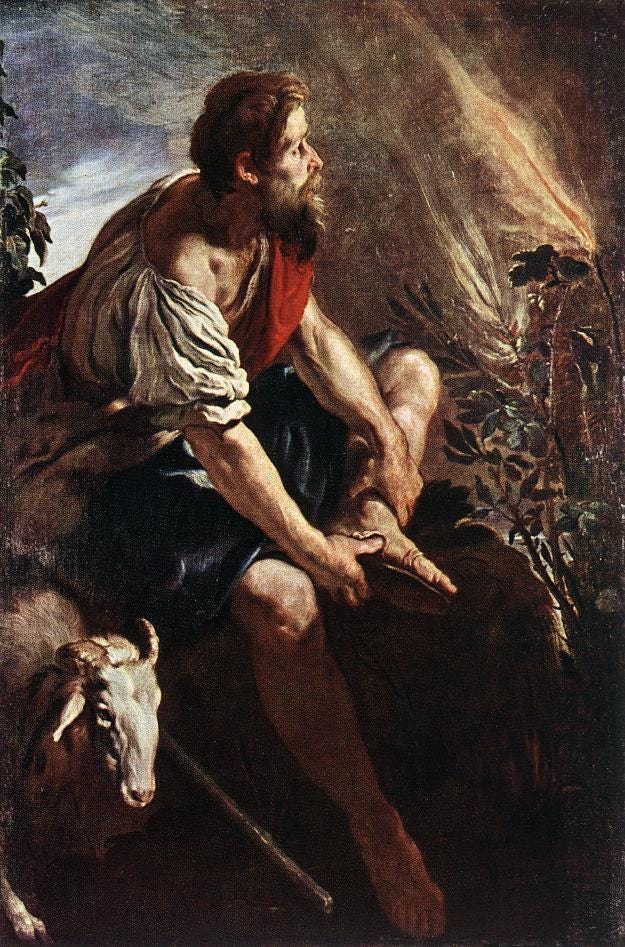
The second move is scriptural and even more surprising than the first. Jesus does not cite a resurrection proof-text but instead quotes Exod 3:6, God’s self-identification at the burning bush: “I am the God of Abraham, and the God of Isaac, and the God of Jacob.” The verb is in the present tense. God does not say he was their God; he is their God. The argument is based on God’s character: the one who enters into covenant does not abandon his covenant partners to non-existence. Jesus presents his case using the terms of the Torah that they accept.
Luke then adds what Matthew and Mark omit: “for all live to him” (Luke 20:38b). Heard against the Maccabean background, the claim is a vindication of the martyrs. Abraham, Isaac, Jacob, and those seven brothers all live to God, held in the presence of the one who made promises and kept them, and they will live again bodily on the last day.
Luke closes the scene with one more detail his Gospel sources do not include: some of the scribes respond, “Teacher, you have spoken well” (Luke 20:39). In a chapter of unrelenting hostility, the approval is small, but Luke notices it. Opposition is not the whole story.
If you haven’t read 2 Maccabees 7 before, you should: A Link to 2 Macc 7.
I read the 2 Maccabees 7 and I’m not sure what significance it has to this reading today. Maybe you can enlighten me.