

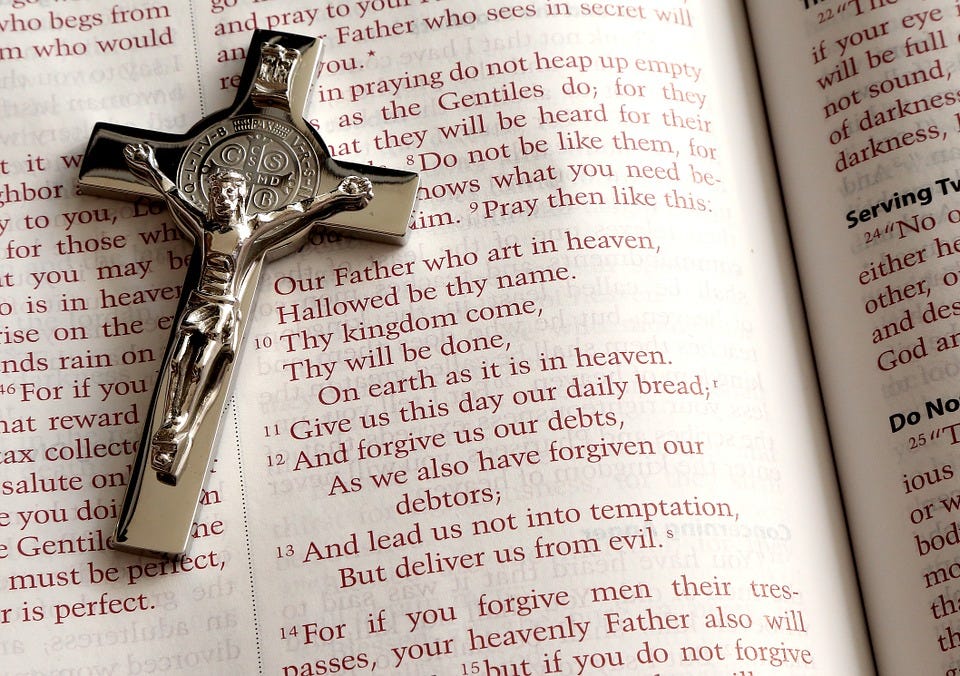
Praying as Jesus Taught (Jan 29, 2026)
When Jesus’s disciples asked him to teach them to pray, he gave them what we now call the Lord’s Prayer. It’s a prayer most of us know by heart, one we’ve recited countless times in worship. But familiarity can sometimes dull our attention to what we’re actually saying.
The prayer starts by directing us toward God—recognizing his holiness, yearning for his kingdom to arrive, and submitting to his will. Then it moves to our everyday needs: bread for today,1 forgiveness for our debts, deliverance from evil. What’s striking is how Jesus links the vertical aspect of our relationship with God to the horizontal aspect of our relationships with others.
“Forgive us our debts, as we also have forgiven our debtors” (Matt 6:12).
That little word “as” creates a direct link between God’s forgiveness of us and our forgiveness of those who wrong us. And just in case we missed it, Jesus immediately adds commentary after the prayer ends:
“For if you forgive others their trespasses, your heavenly Father will also forgive you, but if you do not forgive others their trespasses, neither will your Father forgive your trespasses” (Matt 6:14-15).
This teaching isn’t easy. We might prefer to keep our relationship with God separate from our messy human relationships. We might want God’s forgiveness without having to extend forgiveness to the family member who hurt us, the friend who betrayed us, or the person who never apologized. But Jesus won’t let us have it both ways.
The vertical and horizontal aspects of forgiveness are deeply connected. You can’t have one without the other. When we refuse to forgive others while claiming God’s forgiveness for ourselves, we’re cutting off the very branch we’re standing on. We’re acting as if the cross never happened, as if Christ’s great work of reconciliation does not influence how we treat those who have wronged us.
The Lord’s Prayer isn’t just a beautiful liturgy to recite—it’s a radical shift in our hearts. Each time we pray it, we ask God to forgive us as we forgive others. That should make us think. It should move us to our knees, both in confession and in the hard work of offering others the same grace God gives us.
Is there someone you need to forgive today? What would it be like to truly pray this prayer with that person in your thoughts?
“Daily bread” is the standard translation, but it’s only a guess. In Greek, the phrase is τὸν ἄρτον ἡμῶν τὸν ἐπιούσιον δὸς ἡμῖν σήμερον, “give to us today our ἐπιούσιον bread.” The problem is that ἐπιούσιον is a hapax legomenon, meaning it is used only once (and in passages clearly referring to that original text) in known Greek literature. It consists of the ἐπὶ, which could mean aboard or above, and the participial form of εἰμί, the common verb for existence. There are many options for what the word could mean, but that would require another post.
Forgiving others and receiving forgiveness from others has been such a powerful, life changing dynamic in my life and the life of my family. In my 50 years of adulthood, I have noticed that when a person seems unable to truly receive God’s offer of forgiveness, further conversation often reveals he/she is unwilling to forgive another who has sinned against them. Usually that unwillingness to forgive another is accompanied by an unwillingness to acknowledge and turn from their own specific, sinful actions.
It seems so easy to prefer living life as a perpetual victim rather than stepping into the freedom Christ offers, into the responsibility to see ourselves as God sees us and to receive and give forgiveness. It is the hard, hard work of love to see ourselves and others as God sees us, but God’s Holy Spirit will help us when we ask.