

With God All Things Are Possible (19:23–29)
The rich young man has gone away sorrowful, and Jesus turns to his disciples:
Truly, I say to you, only with difficulty will a rich person enter the kingdom of heaven. Again I tell you, it is easier for a camel to go through the eye of a needle than for a rich person to enter the kingdom of God (19:23–24).
Jesus pairs the largest animal in Palestine with the smallest opening anyone had ever seen. The later legend of a low Jerusalem gate called “the Needle’s Eye” has no ancient evidence. The image describes something impossible.
The disciples are “greatly astonished” and ask, “Who then can be saved?” (19:25). Their shock assumes that wealth signals God’s favor. Deuteronomy promised abundance to the obedient (Deut 28:1–14), and the young man had both: he kept the commandments and had great possessions. If he can’t enter, nobody can.
Jesus doesn’t soften the point:
But Jesus looked at them and said, “With man this is impossible, but with God all things are possible” (19:26).
His answer echoes the LORD’s question to Abraham after Sarah laughed at the promise of a son: “Is anything too hard for the LORD?” (Gen 18:14). The Greek Old Testament reads, literally, “Is any word impossible (ἀδυνατεῖ, adynatei) with God (παρὰ τῷ θεῷ, para tō theō)?” Matthew’s “impossible” (ἀδύνατον, adynaton) and “with God” (παρὰ θεῷ, para theō) follow it closely. Salvation comes the way Isaac came, by God creating possibility where there was none before.
Peter then asks what the disciples will receive (19:27), and Jesus answers:
Truly, I say to you, in the new world, when the Son of Man will sit on his glorious throne, you who have followed me will also sit on twelve thrones, judging the twelve tribes of Israel (19:28).
“The new world” translates παλιγγενεσία (palingenesia), a word found in the New Testament only here and in Titus 3:5. It means “genesis again.” Josephus used it for the nation’s rebirth after the Babylonian exile (Ant. 11.66). Matthew opened his Gospel with “the book of the genealogy (γένεσις, genesis) of Jesus Christ” (1:1); here Jesus promises the genesis of everything else.
The thrones come from Daniel. “Thrones were placed,” the Ancient of Days took his seat (Dan 7:9), the son of man received dominion (7:13–14), and “the saints possessed the kingdom” (7:22). Twelve disciples for twelve tribes means Israel restored, with Jesus’ followers ruling alongside the enthroned Son of Man.
Then the promise widens: everyone who has left “houses or brothers or sisters or father or mother or children or lands” will “receive a hundredfold and will inherit eternal life” (19:29). The young man had asked how to “have eternal life” (19:16). Jesus now gives the answer. Eternal life is an inheritance in a renewed world, and that renewed world has houses and lands.
Earning our way into that promised land is impossible except for the work of the same God who gave a child to Sarah in her old age. With that God, all things are possible.
From the Beginning (19:3–9)
Pharisees come to test Jesus with a question that appears to have been a matter of contemporary rabbinic dispute.
“Is it lawful to divorce one’s wife for any cause?” (19:3)
The rabbinic schools of the day disagreed sharply over the grounds for divorce. The school of Shammai permitted it only for unchastity; the school of Hillel permitted it for almost any grievance, down to a ruined meal. The Pharisees want Jesus to choose a side. He declines the terms of the question and answers instead from Genesis.
Have you not read that he who created them from the beginning made them male and female, and said, “Therefore a man shall leave his father and his mother and hold fast to his wife, and the two shall become one flesh”? So they are no longer two but one flesh. What therefore God has joined together, let not man separate (19:4–6, quoting Gen 1:27; 2:24).
Jesus refuses to argue on their terms. Rather than citing grounds for divorce, he cites the text that defines what marriage is. Genesis 1:27 establishes that God made humanity male and female by design; Genesis 2:24 describes what that design accomplishes in marriage. One detail is worth noting here. The Hebrew of Genesis 2:24 says only that the couple “will become one flesh,” without an explicit “two.” Both the Septuagint and Matthew add it: οἱ δύο (hoi duo), “the two.” The addition sharpens the point Jesus is making. Two distinct people become a single, undivided reality, and what God has joined at creation, no human court has standing to divide.
The Pharisees answer with their own text:
“Why then did Moses command one to give a certificate of divorce and to send her away?” (19:7).
Their word for what Moses did is ἐντέλλομαι (entellomai), “command,” as though Deuteronomy 24 states God’s preference for marriage. Jesus corrects the verb before he answers the charge.
“Because of your hardness of heart Moses allowed you to divorce your wives, but from the beginning it was not so” (19:8).
The verb here is ἐπιτρέπω (epitrepō), “permitted.” Moses permitted; he did not command. Deuteronomy 24 regulates an already broken practice among a hard-hearted people. Deuteronomy 24 was never commentary on Genesis 1–2. It was triage. Jesus then names the one legitimate exception, sexual immorality (πορνεία, porneia), which breaks the one-flesh union from within (19:9).
This manner of theological thinking, i.e., going back to creation, is something that Paul does as well. Along with the death and resurrection of Jesus, it would seem the creation is one of the two tentpoles in all genuinely Christian theological and ethical reflection. What we should always be asking is “What did God purpose in creation?” and “What did God do in the death and resurrection of Jesus Christ?” If we could all think through issues on those terms, it’s not hard to imagine a world where permission for divorce might never be necessary.
If You Would Be Perfect (19:16–22)
A young man approaches Jesus and asks what good deed he must do to have eternal life. Jesus directs him to the commandments: the second table of the Decalogue (Exod 20:12–16; Deut 5:16–20) and the summary command from Leviticus (19:18):
“You shall not murder, You shall not commit adultery, You shall not steal, You shall not bear false witness, Honor your father and mother, and, You shall love your neighbor as yourself” (19:18–19).
The man claims to have kept all of them, and then asks, “What do I still lack?” Jesus answers:
“If you would be perfect (τέλειος), go, sell what you possess and give to the poor, and you will have treasure in heaven; and come, follow me” (19:21).
Mark's parallel (10:21) simply states "you lack one thing." Matthew's use of τέλειος is a deliberate addition. In the Septuagint, τέλειος occasionally renders the Hebrew tamim, which means “complete”. Israel is called, for example, to be tamim:
“You shall be tamim before the Lord your God, for these nations, which you are about to dispossess, listen to fortune-tellers and to diviners. But as for you, the Lord your God has not allowed you to do this” (Deut 18:13–14).
Israel was to listen to God alone and not have divided loyalty. They were to be whole with Yahweh.
The tamim background potentially shifts the reading of τέλειος away from moral achievement toward something more fundamental: wholeness of person, an undivided giving of oneself. Matthew has already used this word at the end of the Sermon on the Mount's antitheses:
“Be perfect (τέλειος), therefore, as your heavenly Father is perfect (τέλειος)” (5:48).
In this section, Jesus is pressing beneath the surface of law-keeping toward the condition of the heart. τέλειος in Matthew, I think, has more to do with the wholeness of an undivided heart than perfectly keeping rules.
The young man has kept every commandment. Jesus does not deny that. The issue is not a lack of adherence but a split in his loyalty. His wealth divides his heart, and a divided heart cannot be tamim. The commandments he has obeyed are about restraint; the one he cannot fulfill demands that he give himself completely.
He goes away sorrowful, and Jesus does not call after him. The sorrow confirms he understood. He was being asked to be tamim: complete, whole, with nothing held back. The commandments can be kept from a distance. Following cannot. Following requires tamim.
Eunuchs and the Kingdom of Heaven (19:10–12)
Jesus has just given a challenging teaching on marriage and divorce (Matt 19:3–9). The disciples’ reaction is revealing and somewhat unsettling.
The disciples said to him, “If such is the case of a man with his wife, it is better not to marry” (Matt 19:10).
Their reasoning reveals a deeply cynical perspective on marriage. They have become used to a culture where men can divorce their wives for minor reasons, leaving women vulnerable and abandoned. The concept of lifelong commitment is so unfamiliar, so restrictive, that they would prefer to avoid marriage altogether rather than accept such binding terms. Their complaint shows they view marriage mainly as an arrangement they can leave at any time.
Jesus doesn’t directly rebuke them but instead redefines the entire conversation. He talks about eunuchs.
But he said to them, “Not everyone can receive this saying, but only those to whom it is given. For there are eunuchs who have been so from birth, and there are eunuchs who have been made eunuchs by men, and there are eunuchs who have made themselves eunuchs for the sake of the kingdom of heaven. Let the one who is able to receive this receive it” (Matt 19:10–12).
In the ancient world, eunuchs held a complex social position. Deuteronomy 23:1 clearly excluded them from the Lord’s assembly. The law was straightforward.
No one whose testicles are crushed or whose male organ is cut off shall enter the assembly of the Lord.
But consider the context in Matthew 19. Earlier in this same conversation, Jesus explained that Moses allowed divorce “because of your hardness of heart, but from the beginning it was not so” (Matt. 19:8). If the permission for divorce was a concession to Israel’s spiritual state rather than God’s original plan, then some other laws, like the exclusion of eunuchs, might also have been accommodations that can be reconsidered.
The prophet Isaiah seems to think so.
Let not the foreigner who has joined himself to the Lord say, “The Lord will surely separate me from his people”; and let not the eunuch say, “Behold, I am a dry tree.” For thus says the Lord: “To the eunuchs who keep my Sabbaths, who choose the things that please me and hold fast my covenant, I will give in my house and within my walls a monument and a name better than sons and daughters; I will give them an everlasting name that shall not be cut off (Isa 56:3–5).
The eunuch is told not to say, “I am a dry tree” because God promises to give faithful eunuchs “a monument and a name better than sons and daughters.”1 What Moses excluded, Isaiah envisions God embracing.
Jesus takes this trajectory to its fulfillment. He identifies three categories of eunuchs, but the third is revolutionary. These are the “eunuchs” who have made themselves so for the sake of the kingdom of heaven. This phrase appears nowhere else in Scripture and is unique to Matthew’s Gospel. Jesus is not merely reversing an old exclusion or affirming a prophetic promise. He is reframing social categories entirely in terms of kingdom purpose. Voluntary celibacy becomes an honored vocation when undertaken for God’s reign. The kingdom does not simply tolerate those who cannot marry. The kingdom elevates renunciation itself to the level of devotion.
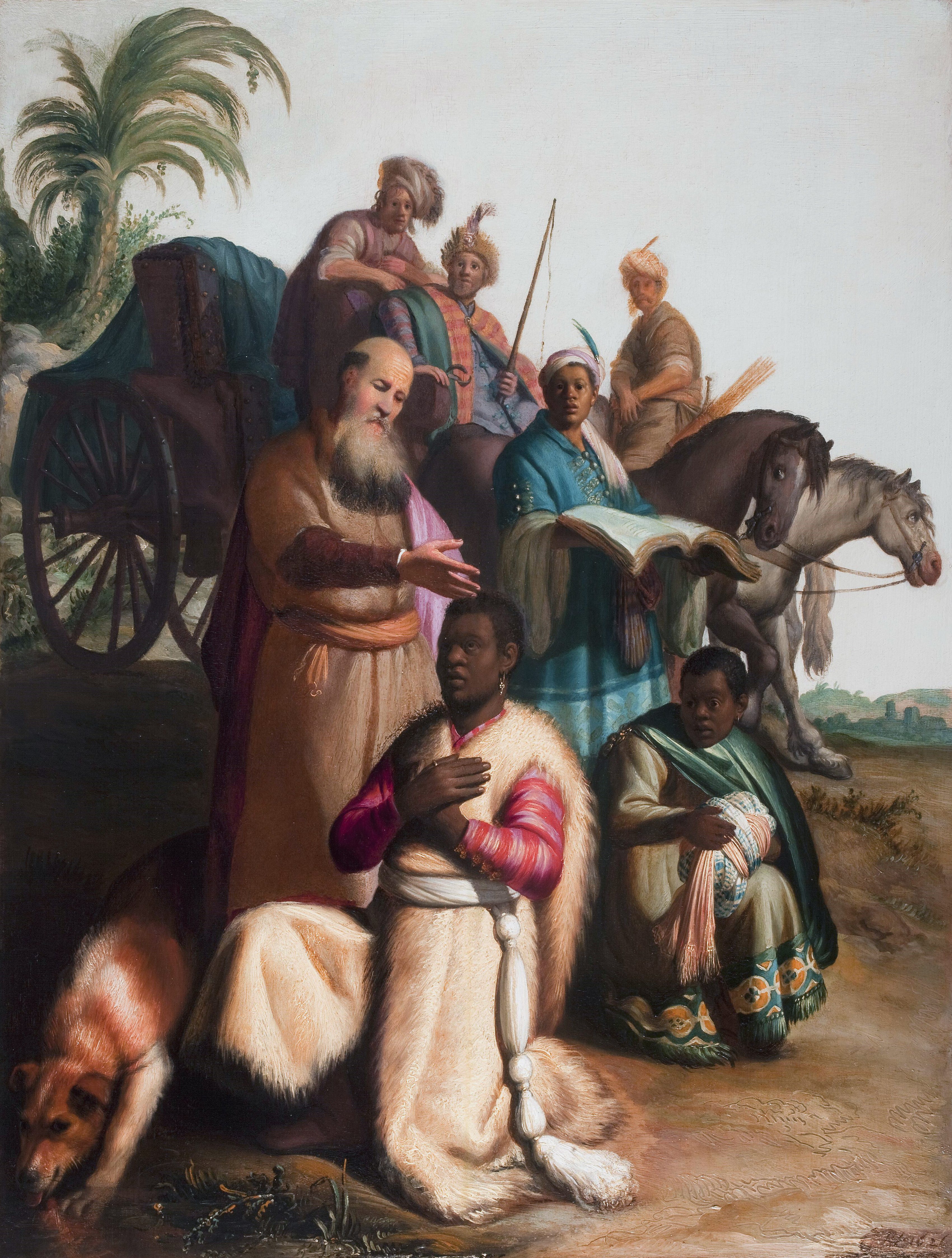
This teaching finds its narrative fulfillment in Acts 8:26–40, when Philip encounters an Ethiopian eunuch reading Isaiah. The man is baptized without hesitation. The one whom Deuteronomy excluded is welcomed into the messianic community. Isaiah’s promise of a name better than sons and daughters is realized in the name of Jesus.
Jesus concludes with a warning. Not everyone can receive this saying. But for those who can, the kingdom opens a path the world considers barren and finds it fruitful beyond measure.
The Hebrew word for “monument” is often used euphemistically. Isaiah is making a pun. Those who had lost their yad would be given a “monument” (yad) in the Temple to preserve their name.
I think your writing on Matthew 19:16-22 has been some of your best yet!
As I read this today, I was reminded of Jesus saying “It is finished” — which is the point of this passage as well, in a sense. We need nothing else but Jesus — following Him wholeheartedly. My heart breaks for those who are looking to politics to give them a “voice;” that means their hearts are divided and they don’t believe God is enough.
I would appreciate your interpretation of the verses on divorce.