

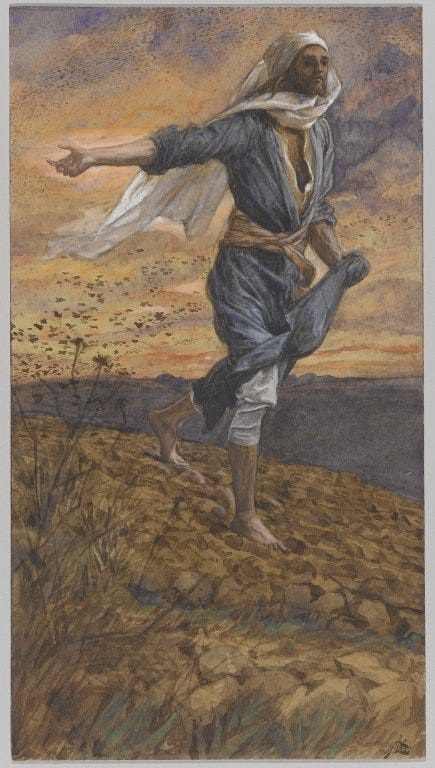
The Mystery of the Sower (Feb. 25, 2026)
When Jesus shares the Parable of the Sower, he is not giving a timeless lesson about spiritual openness. He is describing a crisis. In Mark 3, the religious leaders accuse him of casting out demons by the power of Beelzebul (Mark 3:22), and his own family thinks he is out of his mind (Mark 3:21). The message is spreading, but the rejection in ch. 3 shows it faces hard soil. Why?
The weight Mark places on this parable is unmistakable. It is the first substantive parable in all three Synoptic Gospels, and in Mark’s Gospel, which contains only one major parable section (here in ch. 4) and then only one other significant parable (the Wicked Tenants in chapter 12), it is nothing less than load-bearing for the whole Gospel and ministry of Jesus. When Jesus asks his disciples, “Do you not understand this parable? How then will you understand all the parables?” (Mark 4:13), he means it. This parable, like the others, explains what is happening in the ministry of Jesus.
To make sense of this parable, Jesus reaches for a word his disciples would have recognized immediately. He says:
“To you has been given the mystery of the kingdom of God” (Mark 4:11, author’s own translation).1
The Greek word translated as “mystery” here is μυστήριον, the same word the Septuagint uses in Daniel 2 when Nebuchadnezzar has a dream no one can interpret, and Daniel alone receives its meaning from God (Dan 2:18–19, 27–30). Mark signals that this parable is apocalyptic. Like Nebuchadnezzar’s dream, it is a vision whose meaning must be revealed from outside, and it explains real events that are happening or will happen in human history. And just as Daniel’s mystery concerned the coming kingdom that would one day fill the whole earth (Dan 2:44), so Jesus’ mystery concerns the kingdom that is arriving now — silently, against all appearances, like seed falling on the ground.
The seed, Jesus explains, is the word (Mark 4:14). This takes us straight to Isaiah 55, where God promises that his word, like rain and snow falling on the earth, will give “seed to the sower” and will not return to him empty, but will accomplish its purpose. That purpose is the New Exodus, the end of Israel’s long exile, and the return of Yahweh to Zion (Isa 55:10–11). The teaching of Jesus is doing precisely this: scattering the word of return across the landscape of human hearts.
But the harvest is uneven, and this is the parable’s great burden. The problem is not the seed or the sower. The word will not return empty. The problem is the soil. John the Baptist had come before Jesus with one message: “Prepare the way of the Lord” (Mark 1:3, citing Isa 40:3). To prepare the way was to prepare the soil — to repent, to clear the ground of whatever would keep the word from taking root. Many in Israel had not done this. And so when the sower arrived and began to scatter the word, he found paths and rocks and thorns where there should have been good earth.
The parable invites us to ask a hard question — not simply which of the four soils describes us, but what has hardened us. What love, what fear, what idol has compacted the ground so that the word cannot go as deep as it should? John’s ancient call has not expired. We must prepare the way of the Lord.
The ESV uses the word “secret” here. That is, frankly, a bad translation.