

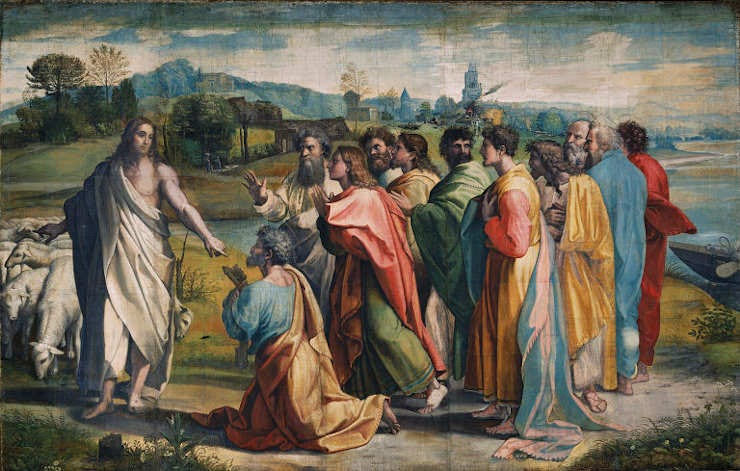
January 23, 2026 - “Simon, do you love me?”
We started the Gospel of John with “In the beginning” (John 1:1), and now we have reached the end. John 21 is the final chapter of John’s Gospel, and some people call it an epilogue because John 20:30–31 feels like a natural way to conclude the Gospel.
Now Jesus did many other signs in the presence of the disciples, which are not written in this book; but these are written so that you may believe that Jesus is the Christ, the Son of God, and that by believing you may have life in his name (John 20:30–31).
The exchange between Jesus and Peter in this chapter is well-known. Peter denied Jesus three times, and now Jesus asks him three questions. Peter replies three times.
In the exchange, Peter and Jesus switch between different Greek words for the term “love.” Some emphasize this difference heavily. Based on this passage, many Christians have been taught that ἀγαπάω signifies divine, sacrificial, unconditional love, while φιλέω refers to affection or friendship.
On that reading, Jesus asks, “Peter, do you love me with unconditional love (ἀγαπάω)?”
And Peter replies, “Lord, you know that I love you as a friend (φιλέω).”
The whole exchange goes like this:
15When they had finished breakfast, Jesus said to Simon Peter, “Simon, son of John, do you love (ἀγαπᾷς) me more than these?” He said to him, “Yes, Lord; you know that I love (φιλῶ) you.” He said to him, “Feed my lambs.”
16He said to him a second time, “Simon, son of John, do you love (ἀγαπᾷς) me?” He said to him, “Yes, Lord; you know that I love (φιλῶ) you.” He said to him, “Tend my sheep.”
17He said to him the third time, “Simon, son of John, do you love me?” Peter was grieved because he said to him the third time, “Do you love (φιλεῖς) me?” and he said to him, “Lord, you know everything; you know that I love (φιλῶ) you.” Jesus said to him, “Feed my sheep.
Whatever is happening here, it’s a matter of translation. Jesus and Peter almost certainly spoke Aramaic, not Greek, and Aramaic does not have two different words for the verb “love” like Greek does.
I don’t think the difference between ἀγαπάω and φιλέω should be exaggerated because both words are used interchangeably throughout John’s Gospel, and both are used to translate the Hebrew אהב (ahab) in the Septuagint.1 Nevertheless, I do think there is some distinction here; otherwise, the change at the end in Jesus’ last question would be unnecessary. Maybe John is trying to convey in Greek a distinction he perceived in the sound of their voices. After all, capturing the tone of someone’s words is always tricky in written text.
Jesus seems to want more from Peter than Peter is willing to give at this moment. But the beauty of this scene is that, rather than demanding like an imperial Lord that Peter give Jesus the love he deserves, Jesus instead lowers himself to Peter’s level and essentially says, “You φιλέω me? Okay. That is enough, Peter. You are restored. I still have ministry for you to do.”
Jesus’ description of how Peter will die is not a punishment for Peter’s denial or his failure to love as Jesus desires. Instead, it is a gift. Peter’s death will bring glory to God because he will follow Jesus into the same kind of death he experienced.
This scene serves as a good reminder that Jesus will always be there to lift us when we stumble and fall, but it also reminds us that following him always comes with a cost. That cost may be high, but the path Jesus took is the only one that leads to eternal life. What Jesus said to Peter, he says to all of us: “Follow me” (21:19).
The Greek translation of the Hebrew Bible.
I also had never noticed that Jesus restores Peter at a campfire. Warming himself at a campfire is where we see Peter deny Jesus three times. I don’t understand the significance but have NO doubt that Jesus chose the location of the restoration with purpose and intention! It gives me hope that I can be restored in the “place” of my greatest failing — and that Jesus does it with such love and intimacy to draw us in to himself. Rarely do we experience such agape love in life. I’m filled with such longing this morning to experience His self-sacrificing love
I found it intriguing that after Jesus resurrection, these disciples go back to way they knew: fishing! Maybe it’s a necessity or maybe a comfort that they can engage in something they feel a certainty about. They had to be puzzled and perhaps discouraged that Jesus has told them he will no longer be with them physically. I love that Jesus is there in their midst watching from shore and they don’t recognize his presence at first. It’s a great reminder to me that even in my mundane, even when I go back to the familiar and comfortable in my uncertainty, he is there — perhaps preparing a “meal” of which I have no clue its nourishment and the intimacy he provides until I sit with him and eat!