

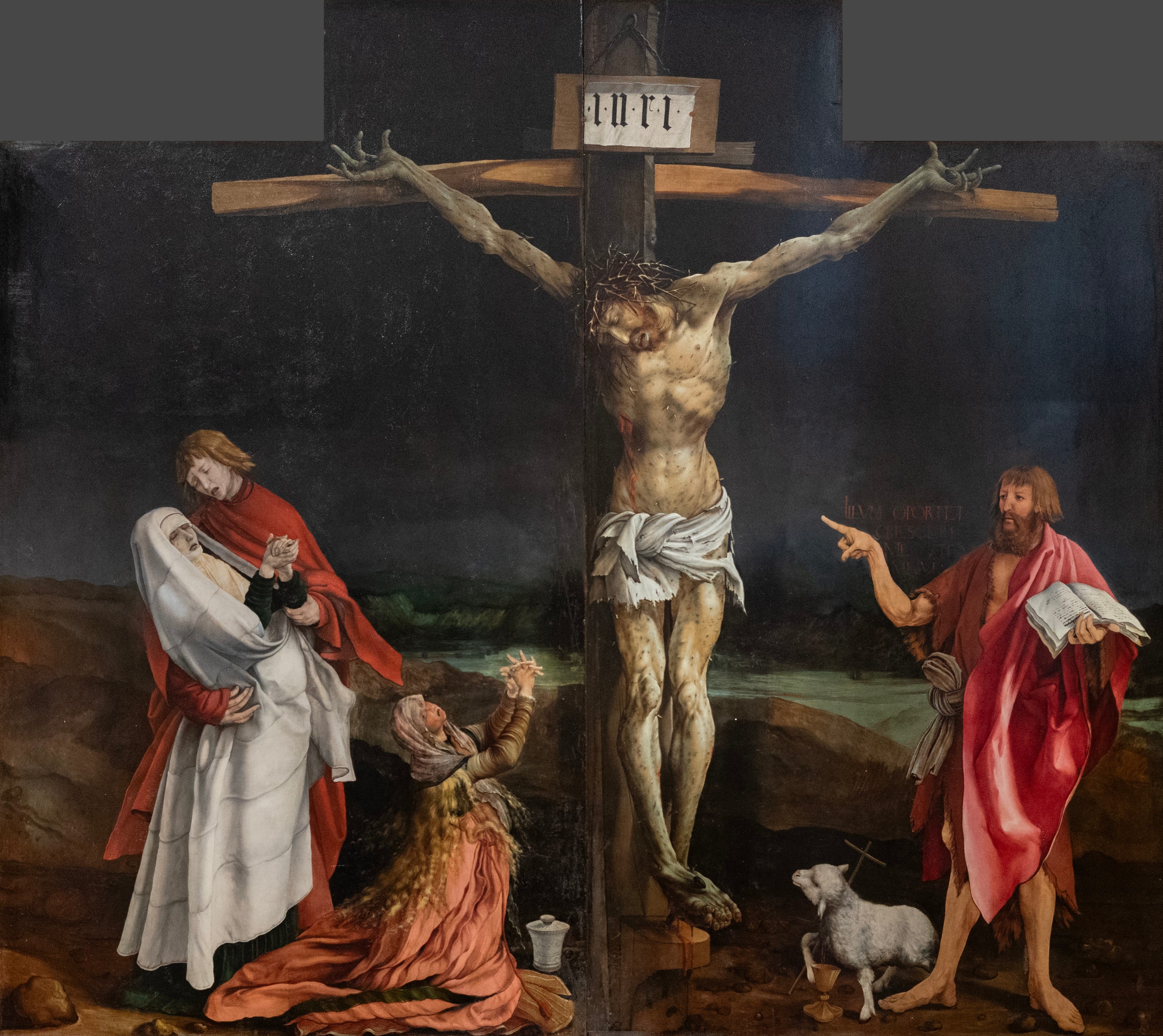
The Hyssop and the Lamb (19:28–30) – Good Friday
Every Passover, Israel rehearsed the same story. A lamb was slaughtered; its blood was applied to the doorposts with a branch of hyssop; the destroyer passed over; a people were freed (Exod 12:22). The hyssop was a simple, shrubby plant, but it carried the blood that meant life. On a Friday afternoon in Jerusalem, it appears again.
John carefully marks the moment. Jesus, knowing “that all was now finished” (John 19:28), speaks: “I thirst.” John adds that he said this “to fulfill the Scripture” — a signal to the reader that something specific is in view. The psalm behind the words is not hard to identify. The righteous sufferer of Ps 69 cries out: “for my thirst they gave me sour wine to drink” (Ps 69:21). Jesus does not improvis at the cross. He inhabits the script that Scripture prepared for him, right down to his final thirst.
A jar of sour wine sits nearby. Someone raises a sponge soaked in it on a branch of hyssop (ὑσσώπῳ) and holds it to his lips. The hyssop isn't just a small detail. John has been connecting the Passover symbols throughout his account of Jesus' passion: Jesus is crucified on the Day of Preparation, the afternoon when the temple lambs are slaughtered (John 19:14). Now, at the moment of death, the hyssop appears again. The evangelist shows us what is happening. Jesus dies as the true Passover lamb, and what Israel has been practicing for generations reaches its final point.
He drinks the sour wine and says:
“It is finished” (John 19:30).
τετέλεσται is not a cry of defeat. The verb τελέω conveys the sense of a task completed and brought to its destination. Jesus has used this language before. “My food is to do the will of him who sent me and to accomplish his work,” he says at the well (John 4:34). In the Upper Room, John notes that Jesus loved his own “to the end” (John 13:1). In his prayer the night before: “I glorified you on earth, having accomplished the work that you gave me to do” (John 17:4). The cross is not an interruption of that mission. It is the mission, arrived and fulfilled.
The hyssop that once bore Passover blood now touches the lips of the Passover Lamb himself. The psalm that voiced the righteous sufferer finds its final speaker. What Israel rehearsed for centuries, Jesus completes once and for all.
“We have a law!” (19:1–11)
“We have a law!” I hear phrases like this often these days—usually to explain why Christians can't (or won't) challenge laws that cause human suffering. After all, we're supposed to “be subject to governing authorities” (Rom 13:1), right? But does that biblical command really mean “If it's the law, it's the law,” and therefore “all good Christians” must comply without question?
The appeal “We have a law!” was often used against Jesus. “We have a law about the Sabbath!” “We have a law about ritual purity!” “We have a law about associating with the wicked!”
Now, that same language is used to condemn Jesus to death.
The Jews answered him, “We have a law, and according to that law he ought to die because he has made himself the Son of God”(John 19:7).
What happens when our laws oppress the innocent and even condemn them to death?1 How are we “good Christians” to respond to such laws? Should we obey? Should we assert Caesar’s right to bear the sword and the Christian’s duty to submit to governing authorities, regardless of the impact on human dignity, flourishing, and life?
And he said to them, “The Sabbath was made for man, not man for the Sabbath” (Mark 2:27).
To insist “We have a law!” while humans suffer and die because of that law is to align with those who condemned Jesus to death. It is to align with Caesar, Pilate, and the empires from this world in opposition to the kingdom of God that Jesus was establishing through his death and resurrection. It is to loudly and clearly declare, when faced with the true King who sacrifices himself so that others might live, “We have no king but Caesar” (John 19:15).
Please note that “innocent” here is in no way defined by compliance with civil laws.
I could barely get through the beginning parts of this chapter where the people appeal to political leadership (rather than God) to get their way to crucify a man they believed was a threat to their way of life. I’m reminded that Gamaliel in the book of Acts tells the Sanhedrin if the followers of Jesus were of God, nothing could stop them!
I found myself disheartened that the Jews told Pilate, “We have no king but Caesar!” because I’m witnessing similar sentiments in our country today.
By and large, it's not always as easy as knowing that a law requiring the crucifixion of the Son of God is bad and does not command obedience, particularly when the law has been weaponized first by one side then the other. Sometimes the same law (FACE act)