

Peter and the Charcoal Fire (18:15–18, 25–27)
“Simon Peter followed Jesus, and so did another disciple” (18:15).
At this point in the story, 'following' no longer means what it did in earlier chapters. Following in this case means staying outside the door and waiting to see what will happen. The other disciple has connections in the high priest’s household and gets Peter through the gate, but Peter himself has nothing to offer the servant girl who questions him except a lie.
“You also are not one of this man’s disciples, are you?” she asks him, and Peter answers, “I am not” (18:17).
Two words in Greek, οὔκ εἰμι (ouk eimi). A few verses earlier, in the garden, Jesus gave the arresting party his own two-word response to almost the same question. When asked if he was Jesus of Nazareth, he said, “ἐγώ εἰμι” (egō eimi), I am he, and repeated it twice (18:5, 8). John intentionally places the two confessions side by side. Jesus plainly identifies himself to armed men who have come to kill him. Peter, on the other hand, denies himself to an unarmed servant girl who has done nothing but ask a question. The chapter is constructed so that the contrast is unmistakable.
Then comes a detail that seems minor until it isn’t.
“The servants and officers had made a charcoal fire, because it was cold, and they were standing and warming themselves. Peter also was with them, standing and warming himself” (18:18).
The word for that fire, ἀνθρακιά (anthrakia), appears in the New Testament in just one other location, three chapters later, on the beach where the risen Jesus cooks breakfast for these same disciples (21:9). John wants us to see both scenes as connected. Peter fails by a charcoal fire, and he is restored by a charcoal fire.
While Peter stands at the first fire, John moves inside to Jesus before Annas, answering every question without flinching, then steps back outside. By the time the account resumes, Peter has already been asked twice more, “You also are not one of his disciples, are you?” and then, from a relative of the man whose ear he cut off in the garden, “Did I not see you in the garden with him?” Each time, his answer is the same two words. After the third question, a rooster crows (18:25–27).
We know this scene well. It presents the temptation to blend in, to match our answer to whoever is asking, and to prefer the warmth of the group we happen to be standing in to the cold of the conviction we actually hold. We deny Christ most often not under torture but under a doorkeeper’s mild curiosity, not with a raised fist but with a shrug, a vague answer, and silence when we should speak plainly.
Choosing Barabbas (18:38b–40)
Now it was the day of Preparation of the Passover (John 18:28).
The timing is significant. John places the trial of Jesus against the calendar with precision. The Passover lamb is about to be selected.
The feast required a spotless animal. Exodus 12 is explicit on this point:
Your lamb shall be without blemish, a male a year old. You may take it from the sheep or from the goats (Exod 12:5).
The criterion is “without blemish.” So when Pilate steps outside and says to the crowd, “I find no guilt in him” (John 18:38), the reader familiar with the Passover story hears something more than just a legal judgment. Pilate has just certified that the Passover lamb is “without blemish.”
Pilate then adopts the Passover tradition: one prisoner is released to the crowd during the feast. He presents the offer in a manner reminiscent of kingship.
“Do you want me to release to you the King of the Jews?” (John 18:39).
The crowd refuses. Instead, they ask for Barabbas, a λῃστής, a term used for violent revolutionaries. Mark confirms this, stating that Barabbas had committed murder in an uprising. His name, when read in Aramaic, carries its own irony. Bar means “son.” Abba means “father.” The crowd was faced with a choice. Was the Father to be seen in a violent revolutionary or in a spotless Passover lamb? The people chose the insurrectionist.
John is telling the story of the Passover, and in that story, it is not the lamb that gets released, but the people—and only by the blood of the lamb.
The blood shall be a sign for you, on the houses where you are. And when I see the blood, I will pass over you (Exod 12:13).
The people don’t want a lamb. They want a warrior. They want violence. They want an insurrectionist, and so they choose Barabbas over Jesus and reveal that they actually don’t know what the Father looks like or what he’s doing.
The chapter does not pause to interpret itself. John does not delve into the Passover typology. He does not need to. The calendar has been stated. The lamb has been certified. The crowd has made its choice. The mechanics of Passover are already in motion, and they are carrying Jesus toward the cross, where the true Passover lamb will be slain for the sins of the whole world.
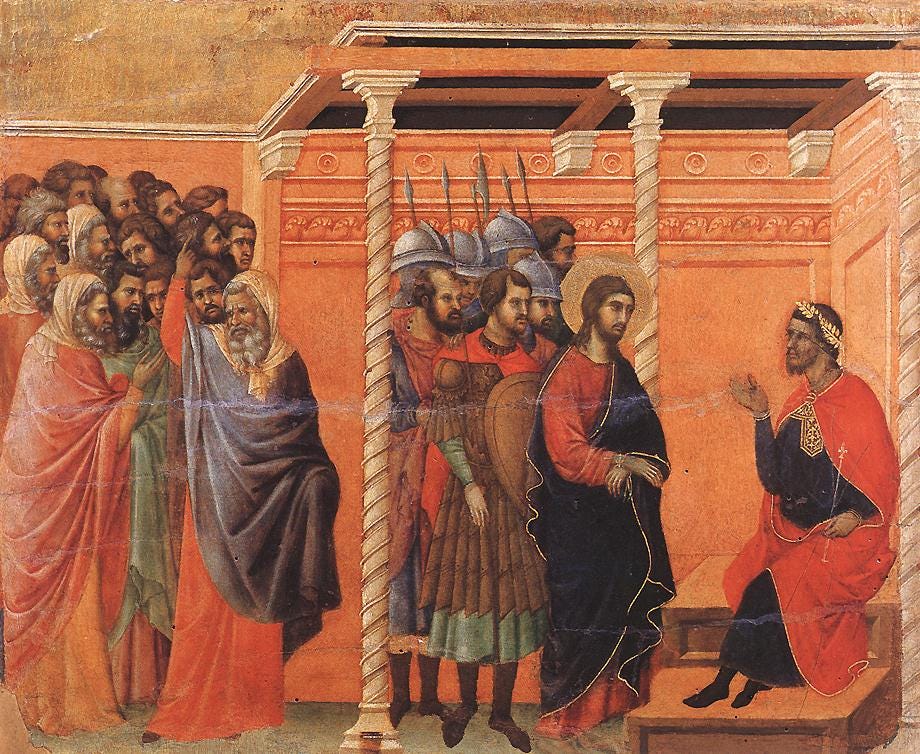
Where is the Kingdom of God? (18:28–38a)
Where is the kingdom of God? For many Christians, the answer is that the kingdom is in heaven. They see the phrase “the kingdom of God” as shorthand for God’s spiritual, heavenly realm rather than our earthly, physical world. After all, isn’t the kingdom of God often called the kingdom of heaven? And didn’t Jesus say this?
“My kingdom is not of this world. If my kingdom were of this world, my servants would have been fighting, that I might not be delivered over to the Jews. But my kingdom is not from the world” (John 18:36, ESV).
Some try to distinguish between the kingdom of God and the kingdom of heaven, but that method is flawed. Matthew is the only Evangelist who uses the phrase “the kingdom of heaven,” and he uses it interchangeably with “the kingdom of God.”1 Similarly, in parallel passages, when Matthew uses “the kingdom of heaven,” Mark and Luke consistently use “the kingdom of God,” indicating again that the two terms are interchangeable.
But then, doesn’t that suggest that the kingdom of God is in heaven if Matthew can simply call it “the kingdom of heaven” instead of “the kingdom of God”? Matthew’s Gospel features a strong Jewish character, and his use of “the kingdom of heaven” probably reflects the Jewish tendency at that time to avoid directly saying the word “God.” Therefore, the switch to “the kingdom of heaven” most likely isn’t about the kingdom’s location and is more about respecting Matthew’s Jewish audience.
What about what Jesus says to Pilate? Surely that proves that the kingdom of God is in heaven and is not “of this world.” The ESV translation here obscures the Greek and leads to mistaken theology. Let me correct that error.
“My kingdom is not from this world (ἐκ τοῦ κόσμου τούτου). If my kingdom were of this world (ἐκ τοῦ κόσμου τούτου), my servants would have been fighting, that I might not be delivered over to the Jews. But my kingdom is not from here (ἡ βασιλεία ἡ ἐμὴ οὐκ ἔστιν ἐντεῦθεν” (John 18:36, ESV revised).
Ignoring the word ἐκ and translating the phrase ἐκ τοῦ κόσμου τούτου as “of this world” rather than “from this world” is misleading at best. That’s especially true when ἐκ τοῦ κόσμου τούτου is paired with the adverb ἐντεῦθεν, which means “from here.” The word “world” doesn’t even occur in the last sentence of v. 36, but the ESV inserts it anyway.
Jesus’ point is that his kingdom, unlike the other kingdoms of this world, is not “from the world.” It comes from a different source. His kingdom is the rock cut without human hands that will strike the idolatrous statue of the kingdoms from this world and become an eternal, earthly kingdom just as Daniel prophesied.
And in the days of those kings the God of heaven will set up a kingdom that shall never be destroyed, nor shall the kingdom be left to another people. It shall break in pieces all these kingdoms and bring them to an end, and it shall stand forever, just as you saw that a stone was cut from a mountain by no human hand, and that it broke in pieces the iron, the bronze, the clay, the silver, and the gold. A great God has made known to the king what shall be after this. The dream is certain, and its interpretation sure (Dan 2:44-45a).
Jesus’ kingdom is the one given to the Son of Man in Daniel 7, where the prophet writes:
I saw in the night visions, and behold, with the clouds of heaven there came one like a son of man, and he came to the Ancient of Days and was presented before him. And to him was given dominion and glory and a kingdom, that all peoples, nations, and languages should serve him; his dominion is an everlasting dominion, which shall not pass away, and his kingdom one that shall not be destroyed (Dan 7:13–14).
The kingdom described in these two passages is not heavenly. It is a kingdom right here on earth, and it is in direct conflict with the kingdoms that are “from the world.” Jesus’ kingdom is from heaven, and so his disciples behave differently (or at least they should) from those who serve kingdoms from the world. But make no mistake, the kingdom of God is present here and now in this world, and it will one day conquer all the kingdoms that are from this world. Jesus’ kingdom is, despite what the ESV tries to force upon the English text, a kingdom very much “of the world.”
In this context, Evangelist refers to an author of one of the four Gospels.