

There is a scene in Revelation that many people overlook on the way to the dragons and the bowls of wrath. The scene spans chapters 4 and 5, and it might be one of the most important things John ever wrote (and he wrote some very significant things!). This scene is vital not just because it’s dramatic (although it is), but because it shows what is happening in the heavenly realm right now and what will continue to happen forever.
John is caught up through a door into the heavenly throne room. God is seated on the throne, surrounded by creatures and elders who never stop crying out:
“Holy, holy, holy, Lord God Almighty, who was and is and is to come” (Rev. 4:8).
But then the reason for the worship gets more specific:
“Worthy are you, our Lord and God, to receive glory and honor and power, for you created all things, and by your will they existed and were created” (Rev 4:11).
In Revelation 4, God is worshiped as the Creator — the one whose will brings all things into existence.
But as we turn to Revelation 5, John notices a scroll in God’s right hand, sealed with seven seals. A mighty angel asks, “Who is worthy to open the scroll and break its seals?” (Rev 5:2). The apparent answer is, “No one.” And so John begins to weep. The scroll is, in fact, the title deed of creation, and if no one is worthy to open it, then creation has no rightful heir. God’s plans in creation seem to have come to nothing.
One of the elders tells John to stop weeping. The Lion of the tribe of Judah has conquered. He can open the scroll (Rev 5:5).
But when John looks, he doesn’t see a lion. He sees a lamb—standing, but looking as though it had been slain (Rev 5:6).
The lion he heard about turns out, when he looks, to be a slaughtered lamb who is somehow still standing. The one worthy to inherit creation is the one who gave his life for it. And the entire heavenly assembly erupts:
“Worthy is the Lamb who was slain, to receive power and wealth and wisdom and might and honor and glory and blessing” (Rev. 5:12).
God is worshiped as Creator. The Lamb is worshiped as Redeemer. This worship is what is happening in heaven right now. Not a commemoration. Not a distant memory. The present, continuous, eternal worship of God as Creator and the Lamb as Redeemer. Two notes played together forever.
What All Christian Worship Is About
Revelation 4–5 provides the logic of Christian worship.
God is worshiped in Revelation 4 because he created everything. God is worshiped in Revelation 5 because he redeemed everything. When no one was found worthy to take up the mantle of Adam, to be the image-bearer and true inheritor of creation, God stepped into the story himself. He became a human being. He was the lamb sacrificed for the sins of the world. And now he is worthy to open the scroll.
All Christian worship is about those two things: God as Creator and Redeemer. And the one who seals that redemption inside us and makes us a new creation is the Holy Spirit, which is why, in the Nicene Creed, when we come to the Holy Spirit, we say he is “worshiped and glorified together with the Father and the Son.” At this moment, we usually bow our heads— a small physical act of reverence that mirrors our overall posture in worship. The Holy Spirit is the one in us who causes us to worship. He is the one who opens our hearts to see what John saw through the door.
Why Liturgy
The word liturgy comes from the Greek λαός (laos) and ἔργον (ergon) — “people” and “work.” It is the work of the people. Not the performance of the professional. Not a lecture with religious content. Liturgy is the corporate, participatory, embodied work of a gathered community doing what it was made to do.
Liturgy, in the ancient church, was always soaked in Scripture — not as proof texts cited from a pulpit, but as the very architecture of the worship itself. The prayers, the responses, the songs, the structure: all of it is the Bible rearranged. And it is ancient. What we do on Sunday morning was present in the worship of the early church, which itself inherited the structure of synagogue worship. When we say the Psalms together, we are worshiping the same way Jesus did.
How we worship matters because worship forms us. You become like what you worship — this is not a pious slogan, it is a psychological and spiritual fact. A person obsessed with a particular band starts to dress like them, speak like them, and value what they value. A person whose imagination is shaped by certain stories starts to see the world through them. We are always being formed by something. The question is whether we are being intentional about it.
Out of 168 hours in a week, most of us sleep for around 64. That leaves roughly 104 waking hours — and two to three of them, on a good week, get committed to gathered worship. The rest are school, work, eating, exercise, and the relentless ambient pressure of everything else that wants to tell us what it means to be a human being, what success looks like, what our bodies are for, what we owe each other, and what we should fear.
Liturgy is the church’s answer to that pressure. Not an escape from the world, but a weekly reorientation — a return to the fundamentals of who we are and whose we are, in the presence of the God who created and redeemed us.
The Two Tables
Christian worship from the beginning has been divided into two parts: the Liturgy of the Word and the Liturgy of the Sacrament (or the Table). This ordering is the historic structure, going back to the earliest centuries, and it’s reflected in Luke 24, where Jesus walks with the two disciples on the road to Emmaus.
In the early church, the Liturgy of the Word was open to the public. Anyone could come. They could hear the scriptures read, hear them preached, and join in the prayers. But when it came time for the Liturgy of the Sacrament, anyone who had not been baptized had to leave. That part was only for the faithful — for those actually incorporated into the Body of Christ. The distinction itself said something about what the church believed was happening at the table.
The question of which part carries more weight is answered, strangely, by a post-resurrection story that is the most beautiful account of worship in the New Testament.
The Road to Emmaus
Two disciples are walking away from Jerusalem on the day of the resurrection. They don’t know it’s resurrection day. They’re leaving. A stranger joins them on the road and asks what they’re talking about. They stop, astonished: Are you the only one who doesn’t know what just happened? Then they tell him everything — Jesus of Nazareth, the prophet, their hopes for redemption, the crucifixion, the empty tomb, the confused reports from the women.
The stranger then walks them through the entire Hebrew scriptures, from Moses to the prophets, showing them how all of it points to the Messiah who had to suffer and enter his glory—the greatest Bible study ever given, by the only teacher who could fully give it.
And nothing happens. The two disciples still don’t recognize Jesus. Their hearts are burning, but their eyes are closed.
When they reach the village, Jesus acts as if he’s going further. They urge him to stay. He comes in and sits at the table with them. He took the bread. He blessed it. He broke it. He gave it to them.
Take, bless, break, give. The same actions from the upper room on Maundy Thursday. And their eyes were opened, and they recognized him.
Not when he opened the scriptures. When he broke the bread.
They went back to Jerusalem immediately. And when they told the others what happened, notice how they describe it:
“How he was made known to them in the breaking of the bread” (Luke 24:35).
That is the Bible’s own gloss on what the sacrament is for. This liturgy of the sacrament is where Christ becomes known to his people.
Walking Through the Liturgy
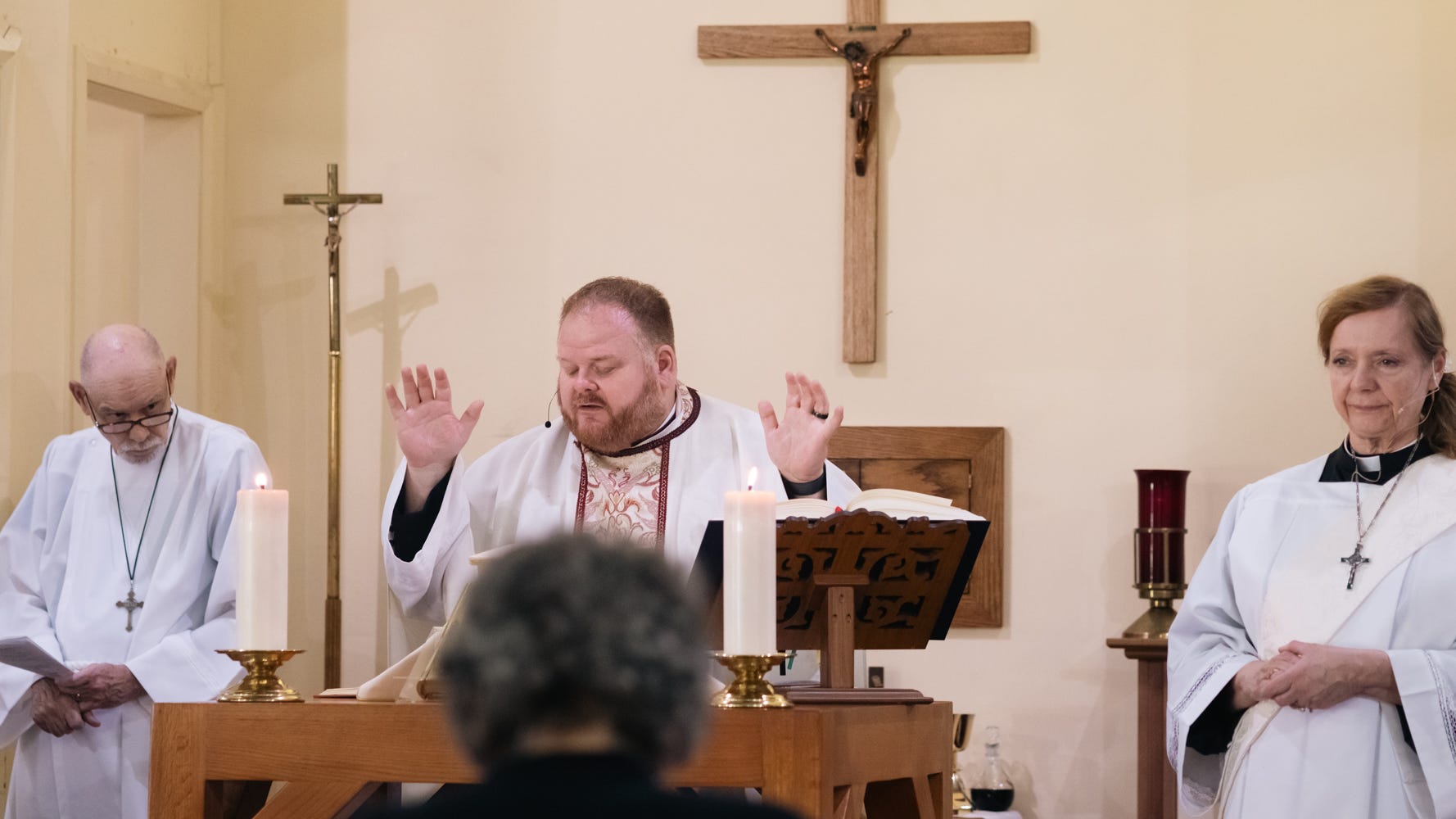
With all of that as background, let’s walk through what actually happens on Sunday mornings and why. At my church, we use Common Worship from the Church of England. If you’re in the ACNA, you’re likely using the Book of Common Prayer 2019.
The Opening and Baptismal Connection
We begin with the words: “In the name of the Father, and of the Son, and of the Holy Spirit.” Why those words? Because they are the words of baptism — the Great Commission at the end of Matthew’s Gospel (Matt. 28:19). Every service begins by returning to your baptism, to the moment you were brought into the Body of Christ. The baptismal font is at the back of the church, not by accident. You walk past it to enter, and you walk past it to leave. Your baptism is the door. Your baptism is also the thing that defines what you’re supposed to do when you walk back out into the world.
The Preparation and Confession
After the greeting, we pray the prayer of preparation: “Almighty God, to whom all hearts are open, all desires known, and from whom no secrets are hidden: cleanse the thoughts of our hearts by the inspiration of your Holy Spirit.” Every phrase is from the Bible — God who looks at the heart (1 Sam. 16:7), nothing hidden from his sight (Heb. 4:13), the clean heart of Psalm 51:10. We are not telling God anything he doesn’t know. We are asking him to do what only he can do: orient us toward him before we worship.
We then confess our sins. The structure is important: we begin with the Lord’s summary of the law—not anyone else’s, but what Jesus himself said were the two greatest commandments (Matt. 22:37–40). Then we immediately say that we have not loved God with all our heart and that we have not loved our neighbors as ourselves. The very standard we just invoked is the one we confess to have failed. Then comes the petition from Micah 6:8 — do justly, love mercy, walk humbly with your God — and the ancient cry Kyrie eleison, Lord have mercy, which is the oldest cry of the human heart toward God.
And then the celebrant pronounces forgiveness. Not as a magician performing a trick, but as a representative saying publicly what God has declared: Almighty God, who forgives all who truly repent, have mercy on you, pardon and deliver you.
We need to hear that out loud. Someone needs to say it to us.
The Gloria and the Collect
Having been forgiven, we stand and sing the Gloria — “Glory to God in the highest, and peace to his people on earth.” These are the words the angels sang when Jesus was born (Luke 2:14). Our response to forgiveness is to return immediately to praise.
The collect follows — a short, precise prayer, usually ancient, always tied to the season. It begins with a declaration about God, makes a request on that basis, and ends with a Trinitarian formula. There is one collect for every Sunday. The church has been praying some of these prayers for fifteen centuries.
The Liturgy of the Word
We hear an Old Testament reading, a Psalm (worshiping exactly as Jesus worshiped), and a New Testament reading. Then the Gospel is processed to the people — a practice inherited from synagogue worship, where the Torah scroll has been carried among the congregation for as long as we can remember. We stand for it. We respond to it. We treat it with visible reverence because the Gospels are the lens through which all of Scripture is read.
The sermon follows. Then the Creed — the whole faith confessed in the plural, not as a personal spiritual feeling but as the common conviction of the Body of Christ, the one into which each of us was baptized. No matter what the preacher just said, the Creed is truth.
Then the prayers of the people: asking the God we have heard from, worshiped, and sung about to step into the lives of specific people and a specific world. Thy will be done on earth as it is in heaven (Matt. 6:10). That is what intercession is — not informing God of problems he doesn’t know about, but asking him to do what he has said he wants to do.
The Peace
We exchange the peace of Christ. Not as a social pleasantry. The risen Christ appeared to his disciples and said: Peace be with you (John 20:19). We offer that same greeting to each other, recognizing that in Christ we stand at peace with God and are called to peace with one another. The person you should be finding in that moment isn’t your best friend. It’s the person in the building with whom you have the most unresolved tension.
The Liturgy of the Sacrament
The Eucharistic prayer begins with the ancient dialogue — “Lift up your hearts / We lift them up to the Lord” — inviting us through the same door John passed through in Revelation 4. We are joining our worship with the eternal worship of heaven. We give thanks (εὐχαριστία, eucharistia, where the word Eucharist comes from) for what God has done. We rehearse the life of Jesus in brief: born of a woman, died on a cross, raised from the dead, exalted to the right hand of the Father, from which he will come again. We sing the Sanctus — Holy, holy, holy Lord, God of power and might — the same words the angels were singing in Isaiah 6:3.
Then the words of institution: who, on the same night that he was betrayed, took bread. The prayer of epiclesis, asking the Holy Spirit to do whatever it is he does with bread and wine. We say Great is the mystery of faith — and indeed it is, because Christ died, Christ rose, and from his seat at the right hand of God, Christ will come again.
The Lord’s Prayer follows. Christ has shown up in the building. What else would we pray?
Then the breaking of bread: every time we eat this bread and drink this cup, we proclaim the Lord’s death until he comes (1 Cor. 11:26). And then the Agnus Dei — Lamb of God, you take away the sin of the world (John 1:29) — addressing him as though he is present. Because we believe he is.
Before receiving, we pray the most Anglican prayer in the entire service: the prayer of humble access. We do not presume to come to this your table, merciful Lord, trusting in our own righteousness. We have sat through the music. We have heard the readings. We have listened to the sermon. We have confessed the Creed and prayed for everyone. And then the very last thing we say before eating is: we are not worthy so much as to gather up the crumbs under your table. We out-humble the Syrophoenician woman who asked only for the scraps (Mark 7:28). We come to this table on no basis other than the mercy of God.
The Sending
After communion, a prayer of thanksgiving: Father of all, we give you thanks and praise that when we were still far off, you met us in your son and brought us home. The father sees the prodigal at a distance and starts running.
Then the blessing. Then the dismissal: Go in peace to love and serve the Lord.
And here is a thing worth knowing: the word Mass, what Catholics call the Eucharist, comes from the Latin dismissal formula Ite, missa est — “Go, it is the sending.” The whole service is named after the ending. Because the point was never to come, receive, and check a box. The point is to go. To walk back past the baptismal font that defines who you are, filled with the body and blood of Christ, and go back into the world as the people God created and redeemed you to be.
May we who share Christ’s body live his risen life. May we who drink his cup bring life to others. We, whom the Spirit lights, give light to the world.
That is the liturgy. Not a performance. Not a duty. The work of the people — and then the sending of the people — week after week, world without end.
I started attending an Anglican Church this year. This is helpful to have a better understanding of the Litergy. Thank you.