

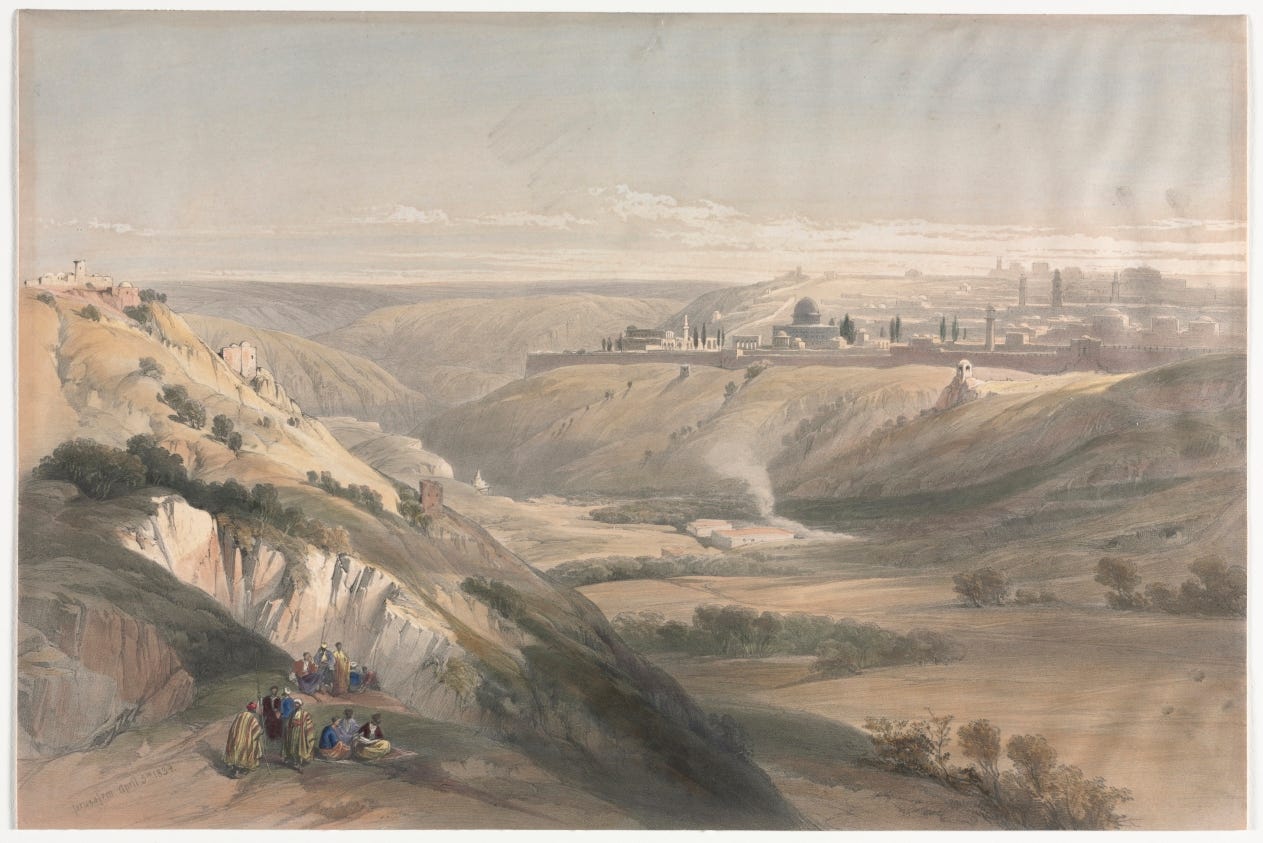
When Jerusalem is Named (Luke 21:5–6, 20–24)
March 31, 2026
Luke 21 begins with Jesus observing the crowd depositing offerings into the Temple treasury. He notices a widow drop in two small copper coins. Then he tells his disciples that she has given more than all the others because she has donated everything she had to live on (21:4). What’s surprising is that right after, Jesus’ disciples admire the Temple’s beauty, and Jesus then predicts its destruction. In effect, the widow has just given her last coin to an institution that Jesus is about to condemn.
What follows in Luke’s Gospel is the most historically transparent of the three Synoptic versions of this discourse. Where Mark 13:14 speaks cryptically of “the abomination of desolation” and instructs the reader to decode the reference, Luke strips the apocalyptic cipher entirely:
“But when you see Jerusalem surrounded by armies, then know that its desolation has come near. Then let those who are in Judea flee to the mountains, and let those who are inside the city depart” (Luke 21:20–21).
No riddle. No symbol requiring interpretation. Luke names the city and describes a siege. The desolation Jesus predicts is the destruction of Jerusalem and its Temple in AD 70, an event his first readers had either witnessed or heard described in living memory.
This clear identification of the discourse’s subject determines how the rest of the discourse is read. Jesus is not, in this passage, mapping the end of time (as we would understand it). He is speaking as a prophet in the tradition of Jeremiah and Ezekiel, announcing judgment on the city and its temple. His startling claim, the one that contributes to his death, is that Jerusalem will not be spared when God acts to establish his kingdom “on earth, as in heaven.”
Every empire will be knocked down by the stone cut from the mountain without human hands (Dan 2:34–35). That expectation would have been normative to any first-century Judean. What shocks his hearers to learn is that Jerusalem and its temple will fall along with the empires.
Jesus closes with a word his audience could verify: “This generation will not pass away until all has taken place” (21:32). The generation standing before him would live to see it. They did. “This generation” here isn’t “the church age” or some other shoe-horned definition that makes Jesus mean what he obviously does not say. If anything, “this generation” is probably an allusion intended to identify Israel in Jesus’s day with the generation that fell dead in the wilderness (cf Ps. 95:7–11).
The widow’s coins are still there at the beginning, a quiet, devastating detail. Like so many others, she gave everything to a house that would eventually crumble. Jesus offers us more than a building. He offers us a kingdom that shall never be shaken. Jerusalem and its temple shared the same fate as Jesus. They were all destroyed/killed by the Romans. But only one would rise from the dead.