

The Hours of Prayer
If you want to understand what Anglicanism is, you have to start with prayer.
When the English church was taking shape during the Reformation, there was already an established monastic tradition of praying the canonical hours — structured services of prayer spread throughout the day. These were not casual, spontaneous prayers. They involved psalms, canticles drawn from Scripture, Scripture readings, and the Lord’s Prayer: a full spiritual meal. The number of daily offices varied across monastic traditions. Still, the familiar shorthand of “seven times a day” comes from Psalm 119:164, and the standard Western pattern included seven or eight distinct hours depending on how Matins and Lauds were counted.
Thomas Cranmer, the Archbishop of Canterbury who became the primary architect of Anglican worship, understood the wisdom of that older rhythm. He also understood that most people are not monks. You cannot reasonably ask a farmer or a merchant to stop what he is doing throughout the day for the full cycle of monastic offices. So Cranmer reworked and consolidated that inheritance into the two daily offices of Morning Prayer and Evening Prayer, designed for ordinary parish life and saturated with Scripture.
The vision was simple and beautiful. Cranmer wanted the life of the church to be ordered by common prayer. The day would begin and end in the presence of God, shaped by the Word of God and shared with the people of God.
There is a reason the traditional prayers include petitions for protection from the dangers of the night. Before electricity, darkness genuinely meant vulnerability: robbers, accidents, fear. Those prayers were not poetic abstractions. They were the cries of people who knew the coming dark was real. Cranmer intended an Anglican’s day to begin and end not only with extemporaneous prayer, however good that might be, but also with something more structured, something that connected the individual to the full rhythmic life of the church.
Using Cranmer’s original lectionary and psalm cycle, a faithful practitioner of Morning and Evening Prayer reads through the entire Psalter every thirty days. Month after month, year after year, the whole sweep of human emotion and theological wrestling is encountered in a continuous cycle: lament, praise, anger, trust, awe.
What Daily Prayer Actually Is
When you pray Morning and Evening Prayer in the Anglican tradition, what you are primarily praying is Scripture. The versicles and responses are drawn largely from the Psalms. The canticles are Scriptural songs arranged for prayer: the Benedictus, which is part of Morning Prayer every day, is the song of Zechariah from Luke 1. The Magnificat, which is part of Evening Prayer every day, is the Song of Mary from the same chapter. Other canticles are drawn from the prophets, the Psalms, and the New Testament. The readings are from the Old and New Testaments and occasionally the Apocrypha. The Lord’s Prayer comes from Scripture.
This was Cranmer’s great project: not to compose spiritually edifying but nonbiblical material, but to make the language of Scripture your language. He wanted you to hear it sung, read, chanted, prayed, and recited until it became the native tongue of your soul.
The ancient principle behind this is lex orandi, lex credendi (Latin: lex orandi, lex credendi) — the law of prayer is the law of belief. The phrase itself comes from the early church, most closely associated with Prosper of Aquitaine in the fifth century, and it expresses a conviction that runs through Christian history: what you pray, over time, shapes what you believe. Cranmer understood that if he could help form the prayer life of the church, he would help form its faith. As Alan Jacobs writes, there had “perhaps never been a church” to which this principle was more applicable than the Church of England1 — a claim that reflects the particular intensity with which Anglicanism has staked its identity on lex orandi rather than on a confessional formula.
As Cranmer designed it, Morning and Evening Prayer were communal, with voices responding to one another in a pattern inherited from the ancient church. That reciprocal quality is not a stylistic preference. It is a theological statement. Christian prayer is not merely a private transaction. It is a corporate act, the voice of the Body addressed to its Head.
What the prayer book offers is a gift the church has been handing down for nearly five centuries. This is not someone’s contemporary self-improvement idea. It is the accumulated wisdom of Christians who walked this path before us and found that these words, repeated faithfully over a lifetime, form the soul in ways we may not even notice until we look back. By committing to be Anglican, you are not committing to pray the daily office. Many Anglicans do not. But you are committing to receive this gift, to know it is here, and to grow into it.
What It Means to Be Anglican
So, what does it mean to be Anglican?
The term most associated with Anglican identity is the Latin via media (via media) — the middle way. Anglicanism has often understood itself as trying to hold together things that other traditions tend to separate. The image I find most helpful comes from Thomas McKenzie’s The Anglican Way, which uses the Anglican Communion’s compass rose as a framing device. At the center of that compass rose is a shield. McKenzie argues that Anglicanism does not require you to stand at the exact center of the shield. It asks you to be somewhere on the shield.
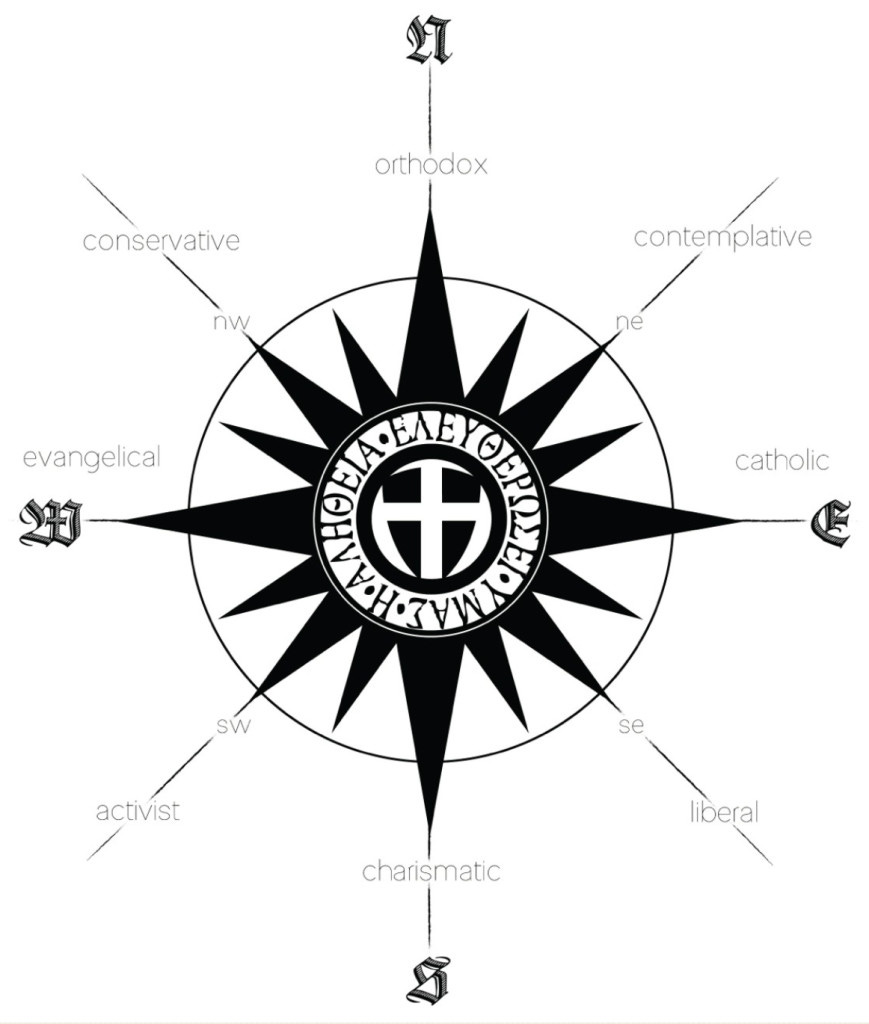
That is a meaningful distinction. McKenzie maps several axes across the shield: Evangelical and Catholic, Charismatic and Orthodox, Activist and Contemplative, Conservative and Liberal. On every one of these spectrums, Anglicanism does not insist that you stand at the center point. It asks that you hold your position in relationship to the whole, rather than treating one pole as the only legitimate Christian option.
There are Anglican dioceses that look almost indistinguishable from Rome. Others feel much closer to a contemporary evangelical church. There are Anglican communities that emphasize contemplative prayer and others that emphasize social action. All of them can still be recognizably Anglican. The via media is not merely splitting the difference. It is a principled refusal to let one pole define the whole.
McKenzie adds one more thing: all Anglicans are on a mission. The shield is not a place to stand still. It is a position from which to engage the world. This matters because via media can easily become an excuse for indecision or institutional timidity — a tradition so committed to holding things together that it never actually does anything. McKenzie’s point is that the opposite should be true. The breadth of the Anglican tent is not an end in itself. It is in the service of a common calling to bear witness to the gospel.
One telling detail: unlike Lutheranism, named after Luther, or Presbyterianism, named after a form of church polity, the word Anglican comes from the Latin Anglicanus, meaning English or of England. That does not settle every question about Anglican identity, but it does suggest something important. Anglicanism emerged not first as a sect gathered around one teacher or one doctrinal slogan, but as the church of a people in a particular place. That instinct — to be the church for a people rather than merely a niche party within the church — is woven deeply into Anglican history and identity.
The Book of Common Prayer and the Shape of a Life
If there is one thing that most distinctively defines Anglicanism as a tradition, it is the Book of Common Prayer.
Other traditions have doctrinal confessions and liturgical rites. What is unusual about the prayer book is the comprehensiveness of its ambition. Morning and Evening Prayer give shape to the day. The Eucharist gives shape to the week. The liturgical calendar, with its seasons of Advent, Christmas, Epiphany, Lent, Easter, and Pentecost, gives shape to the year. And then the prayer book contains services for the great transitions of human life: Baptism, Confirmation, Marriage, and Burial.
From the moment you enter the world to the moment you leave it, the church offers words and forms of prayer for each passage. You do not have to arrive at any of these moments in life without language. The church hands you language. The church says: We have been here before. Here are the words.
This gift is not a small thing. Much of modern life is marked by a poverty of language at its most important moments. We are often inarticulate at the graveside, awkward at the font, and vague about what marriage is. The prayer book does not claim to resolve every question, but it refuses to leave us speechless. It gives structure not just to worship, but to life itself.
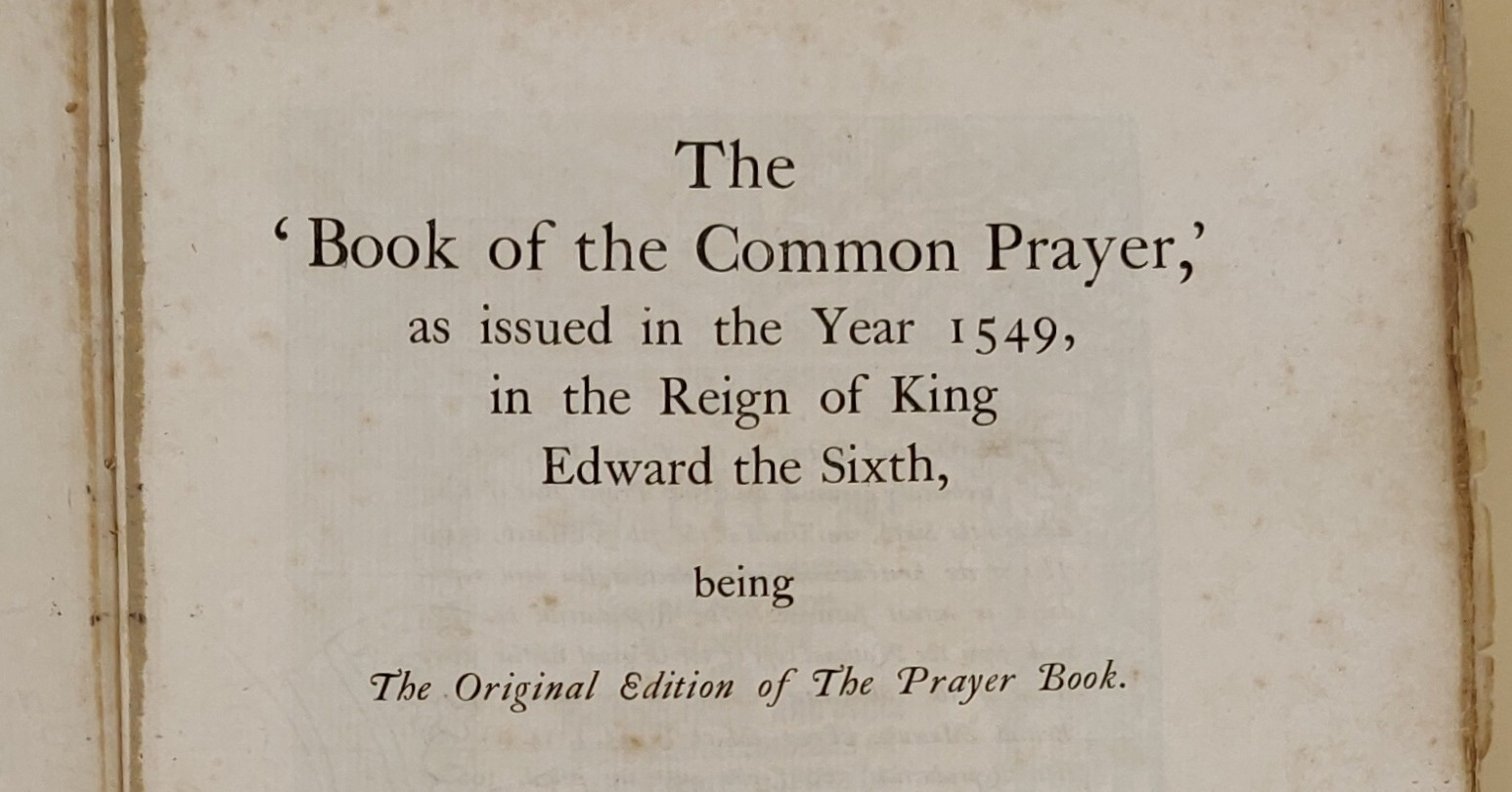
The first Book of Common Prayer was published in 1549. Since then, Anglicans have continued praying in forms recognizably descended from Cranmer’s work, though revised, updated, and translated over time. The continuity matters. It is part of what the prayer book is.
How the Anglican Church Came to Be
There is a version of the Anglican story that goes like this: an English king wanted a divorce, and when the Pope refused, he founded his own church. There is truth in that. Henry VIII’s desire to annul his marriage to Catherine of Aragon was the immediate political occasion for England’s break with Rome. But the full story is more interesting than that.
Christianity appears to have reached Britain very early. By the early fourth century, we have clear evidence of an organized British church, including three British bishops at the Council of Arles in 314. Saint Alban is remembered as Britain’s first recorded Christian martyr, though the exact date of his death is disputed. When England later broke from Rome, one of its claims was not that it was inventing Christianity anew, but that it was recovering the life of a church whose roots in Britain long predated the later medieval claims of papal jurisdiction.
Henry declared himself Supreme Head of the Church of England by the Act of Supremacy in 1534. His reasons were not primarily theological. But Thomas Cranmer, the Archbishop of Canterbury, was a genuine reformer, deeply shaped by Protestant theology on the continent. He and Henry had the same short-term goal — independence from Rome — for very different reasons. Henry wanted political and ecclesiastical control. Cranmer wanted reform. Each, in his own way, used the other.
Under Henry’s son Edward VI, Cranmer had more room to work, and the English Reformation moved forward. He produced the first Book of Common Prayer in 1549 and drafted the Forty-Two Articles in 1553, which were later revised — with substantive theological changes, not merely editorial trimming — into the Thirty-Nine Articles of Religion, formally adopted by Convocation in 1563 and ratified by Parliament in 1571. The Articles became the closest thing Anglicanism has to a formal doctrinal standard, especially for clergy. They address the authority of Scripture, original sin, election, the sacraments, and the rejection of purgatory.
When Edward died, Lady Jane Grey was placed on the throne — the traditional “nine days” figure is a popular shorthand; the actual duration was closer to thirteen days, depending on how one counts from Edward’s death, before being deposed and later executed. Then came Mary I, remembered by Protestants as “Bloody Mary,” who set about reversing the Reformation with lethal seriousness. Among those she burned were Nicholas Ridley and Hugh Latimer in Oxford on 16 October 1555. Cranmer himself, after signing a recantation under pressure, publicly withdrew it and was burned at the stake on 21 March 1556. Tradition holds — the primary source is John Foxe’s Acts and Monuments, which carries a polemical dimension but is broadly accepted by historians on this point — that he thrust his right hand into the flames first, because it had signed the recantation he now renounced.
What Latimer said to Ridley as the flames rose is worth sitting with:
Be of good comfort, Mr. Ridley, and play the man. We shall this day light such a candle by God’s grace in England as I trust never shall be put out.
Mary died, and her Protestant half-sister Elizabeth I took the throne in 1558. The Elizabethan Settlement restored royal supremacy, now using the title Supreme Governor rather than Supreme Head, and reissued a revised prayer book. The settlement sought common worship across a divided church, and did so with a degree of intentional breadth, especially in its liturgical language. That did not mean doctrinal disagreements vanished, or that the church would never speak more definitively. It meant that shared prayer and ordered worship were given pride of place in holding the church together.
It worked, imperfectly, and not without continued conflict. The Puritans, convinced that the Reformation had not gone nearly far enough, became one of the chief dissenting pressures within and eventually beyond the Church of England. But the settlement endured. And it demonstrated, perhaps more clearly than any doctrinal decree could have, how deeply Anglicanism trusts the formative power of lex orandi, lex credendi. The wager of the Elizabethan Settlement was that shared prayer sustained across generations would do more to hold the church together and form it in the faith than enforced doctrinal uniformity ever could. That instinct runs from Cranmer to the present day.
Scripture, Tradition, and Reason
This brings us to the question of how Anglicans make theological decisions.
The Reformation’s rallying cry was sola scriptura (sola scriptura) — Scripture alone. If something cannot be grounded in Holy Scripture, it cannot be imposed as necessary for salvation. Anglicanism shares that deep conviction about the primacy and sufficiency of Scripture. Article VI states that “Holy Scripture containeth all things necessary to salvation.”
At the same time, Anglicanism is often described in terms of a later image associated with Richard Hooker: Scripture, Tradition, and Reason — sometimes called the three-legged stool. The phrase itself is a twentieth-century popularization rather than Hooker’s own metaphor, and it does not appear in his Laws of Ecclesiastical Polity. But it captures something real about the Anglican method.
Scripture is the first and primary authority. The stool does not stand without it. Anglicanism is not a tradition that treats Scripture as merely one source among equals. Article VI makes that plain.
Tradition is the second. The church does not begin with us. Christians before us have read these texts, prayed these prayers, suffered for this faith, and wrestled with these questions. Their judgments do not override Scripture, but neither should they be dismissed simply because they are old.
Reason is the third. There are questions Scripture does not address directly, and there are circumstances earlier generations never faced in quite the same form. Here Anglicanism makes room for careful thought, exercised within the boundaries set by Scripture and informed by the wisdom of the church.
The order matters. Scripture comes first. Tradition is received with seriousness. Reason is exercised under the authority of the first two. That is why some Anglicans dislike the stool image and argue that it can imply a false equality among the three. That critique has force. Even so, the basic instinct remains recognizably Anglican: Scripture is primary, but we do not read it as isolated individuals cut off from the church’s memory or from the work of disciplined thought.
Anglicanism, then, is not merely an accident of English political history, though English political history is certainly part of the story. It is a tradition that has tried, with varying degrees of success and failure, to hold together catholic sacramental life and Reformation seriousness, Scripture’s primacy and tradition’s wisdom, liturgical structure and evangelical energy. It has been shaped by martyrs who believed these things were worth dying for, and by a prayer book that has been forming Christian souls for nearly five centuries.
It is worth asking, as we move through this confirmation course, not just what Anglicanism is, but why it matters. I want to be honest: it matters far less than Christianity. Being Anglican is not the point. Being a disciple of Jesus Christ is the point. But Anglicanism is a tested and time-honored model for what that discipleship can look like — a gift from the church to those of us who came later, offering a way of following Jesus that has been refined by suffering and sustained across generations.
That is what we are being confirmed into.
Alan Jacobs, The Book of Common Prayer: A Biography (Princeton University Press, 2013), 122.
In addition to morning and evening prayer, my favorite is Compline at bedtime. It winds me down and sends me off to sleep under God’s protection.