

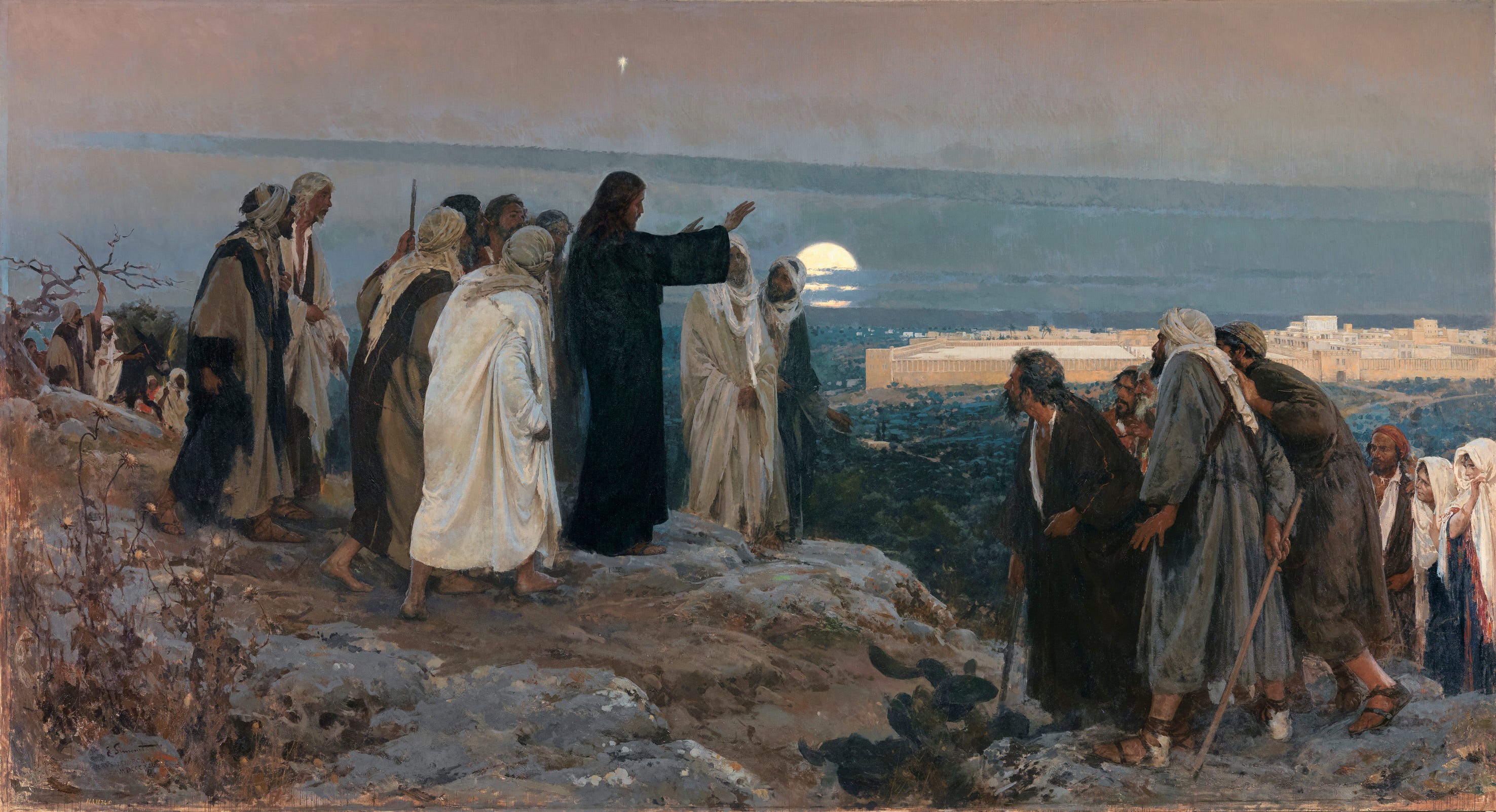
Weeping over the City (Luke 19:28–44)
The prophet Ezekiel observed the glory of God leaving Jerusalem before the exile and carefully recorded its course: It moved east, stopping at “the mountain that is on the east side of the city” (Ezek 11:23, referring to the Mount of Olives), and then departed from view.
Centuries later, Zechariah announced the day of the Lord’s return via the same route:
“On that day his feet shall stand on the Mount of Olives that lies before Jerusalem on the east” (Zech 14:4).
The God who departed to the east would come back from the east. That return would mark the long-awaited return of Yahweh to Zion.
Luke seems to assume his readers are already familiar with this theme. When he casually mentions that Jesus was “already on the way down the Mount of Olives” (Luke 19:37), he’s not just giving a geographic detail. He’s making a theological statement. The Lord is finally returning to his city. The day of visitation has arrived. The time has come for God to be king over all the earth (Zech 14:9).
So Jesus makes his way to the city. As he approaches, the crowd quotes Psalm 118:26, but something is off, like a familiar melody that sounds wrong when a single note is out of place.
Blessed is the King who comes in the name of the Lord! Peace in heaven and glory in the highest!” (Luke 19:38).
Two things stand out here. First, they add the word “king” even though the Psalm makes no mention of a king. Second, they unintentionally invert the language of an earlier scene in Luke’s Gospel.
When the angels announced Jesus’ birth, they sang of “peace on earth” (Luke 2:14). The Jerusalem crowd redirects that peace upward, to heaven, away from the world below. Both issues here point to the same conclusion. The people don’t really want “peace on earth.” What they want is a conquering king who will bring peace the way Rome does—by force and at the point of a sword—and they are trying to force Jesus into that role.
Jesus refuses to be that kind of king. He is a king, and he has come to conquer, but not the enemies they think. The people’s true enemies are not the Romans or any human made in God’s image. Their real enemies are sin, death, and the devil, and Jesus will defeat them not by embracing Rome’s way of peace, but by succumbing to it.
And so, when the city comes into view, Jesus weeps.
And when he drew near and saw the city, he wept over it, saying, “Would that you, even you, had known on this day the things that make for peace! But now they are hidden from your eyes. For the days will come upon you, when your enemies will set up a barricade around you and surround you and hem you in on every side and tear you down to the ground, you and your children within you. And they will not leave one stone upon another in you, because you did not know the time of your visitation” (Luke 19:41–44).
Found only in Luke, this lament stands at the convergence of centuries of prophetic promise, Israel’s story, and Jesus’ vocation. Israel had been waiting for its God to return, and now Yahweh is at last coming to his city and his temple to reckon with his people and make things right.
The day has come for the return of Yahweh to Zion, but the city to which he comes does not recognize him. The people see only who they want him to be, not who he truly is.
And so, the one who is the Prince of Peace declares the judgment that comes when God’s people reject his ways. Jerusalem will be torn down until there is not one stone upon another.
Luke does not preserve this lament so that Christians can condemn Jerusalem from a safe distance. The point here is not to stare and wonder how the people of Jesus’ day could have gotten it so wrong. Instead, Luke preserves this lament to make God’s people reckon with an all-important question as we prepare to celebrate Palm Sunday:
Do we know the things that make for peace?
I don’t mean personal inner peace.
I mean peace at the societal, national, and global levels.
If we truly do, then why do the heroes of many Christians today seem so fundamentally different from Jesus? And why do the values they promote seem so unlike the values of the kingdom of God?
And worst of all, why do Christians continue to endorse these unchristlike heroes and anti-kingdom values in Jesus’ name?
Jesus is the Prince of Peace. His self-sacrificial love for others, his embodiment of a love that considers others more important than himself, and his obedient taking up of his cross on the way to Good Friday represent the only true way of peace in this world.
Just outside the city that rejected the Lord’s peace, Jesus would be tortured, murdered, and give his life as a ransom for many, but in doing so, he would accomplish what no earthly king ever could.
We have no right to wonder why there is so little peace in this world when the church continues to advocate for peace the way that Rome brought peace and not the way that Jesus did. Rome brought peace at the end of a sword. Jesus brought peace by being nailed to a Roman cross for the sins of the whole world.
The God who departed Jerusalem by the east and promised to return the same way kept his word. He came back down the Mount of Olives, was rejected by the city he came to save, and won the only victory that could finally bring peace on earth.
And so, as we prepare to celebrate Palm Sunday, I am left wondering whether the Prince of Peace, sitting today on his throne at the right hand of God, looks down upon his church, called to embody his values, his life, and his self-emptying for the good of others, and says:
“Would that you, even you, had known on this day the things that make for peace!” (Luke 19:42).
May God have mercy on us all when our day of visitation comes.