

Introduction
The story of the resurrection of Lazarus begins with a delay, and the delay itself is central to the narrative.
When word reaches Jesus that his friend Lazarus is sick, his response is not what we might expect. He does not immediately pack his belongings and head for Bethany. Instead, he stays where he is. John tells us:
Now Jesus loved Martha and her sister and Lazarus. So, when he heard that Lazarus was ill, he stayed two days longer in the place where he was (John 11:5–6 ESV).
John links these two sentences with the word “so,” which is surprising and noteworthy. Because Jesus loved them, he waited. His delay is not a failure of love; it is an expression of it. Jesus has a purpose that the disciples, Mary, Martha, and Lazarus cannot yet see, and that purpose requires him to arrive late.
By the time Jesus arrives, Lazarus has been in the tomb for four days. Not one, not two, not three. But four days. Any hope of a miraculous recovery has long gone. The mourners are gathered. The sisters are overwhelmed with grief. And the smell confirms, as Martha later describes, that this is a situation no one would want to face (11:39).
Jesus walked headfirst into it anyway.
Out of the Depths
Psalm 130 opens with one of the most sincere lines in all of Scripture:
Out of the depths I cry to you, O Lord! (Ps 130:1).
The psalmist is praying from his lowest point. The Hebrew word translated “depths” refers to deep water, the kind where, when you’re in it, you cannot touch the bottom, the kind that closes in and crashes over your head. The psalmist is drowning and crying out to God from that place.
This psalm reminds us that when we come to God in prayer, he wants honesty. There is no reason to sugarcoat our words or search for the right thing to say when we pray. If you are in the depths, if the waters are crashing over your head, say so. Tell God exactly how you feel. The psalmist does, and God does not turn away.
What is remarkable about this Psalm is not that it begins in despair, but that it ends in hope — not a vague or sentimental hope, but a clear and confident one:
I wait for the Lord, my soul waits, and in his word I hope; my soul waits for the Lord more than watchmen for the morning, more than watchmen for the morning. (130:5–6).
The psalmist remains in the depths as the psalm ends. His situation has not changed, but something inside him has shifted. He has placed his hope in God’s word, in the promise that the Lord will come to help, and he is willing to wait, even in the darkness, even in the deep.
Mary and Martha were waiting like that. They sent for Jesus when Lazarus became sick, confident that he would come. They waited, and meanwhile their brother died. Jesus still had not arrived, and they buried him. By the time he arrived four days later, both sisters independently said the same thing when they saw him:
“Lord, if you had been here, my brother would not have died” (John 11:21, 32).
Those words aren’t an accusation, but they are an expression of real grief. Mary and Martha do not doubt Jesus; they believed in him fully, which is exactly why his absence pained them so greatly. When you believe that God can act and he does not, that absence is costly. It hurts.
The Valley of Dry Bones
Ezekiel understood that waiting.
In Ezekiel 37, the Spirit places the prophet in the middle of a valley filled with bones. The bones are dry, showing they have been there for a very long time. God tells the prophet exactly what they represent: “these bones are the whole house of Israel” (Ezek 37:11). The nation has been taken into Babylonian exile, and they have been there long enough for hope to turn into despair. God quotes their own words back to the prophet:
“Our bones are dried up, and our hope is lost; we are indeed cut off” (Ezek 37:11).
What follows is a vision of national resurrection. God instructs Ezekiel to prophesy to the bones, and as he does, there is a rattling, flesh appears, breath enters them, and they stand upright. The divided kingdoms of Israel and Judah will be reunited under a single king. God will put his Spirit within them and bring them home. The God who scattered them will gather them again. Their painful waiting in exile will one day be answered.
When Jesus arrives in Bethany, Israel is still waiting for that re-gathering. Rome now rules the land, and the full restoration Ezekiel envisioned has not yet occurred. A first-century Jewish family burying their brother in a tomb outside Jerusalem would have known that they were still, in some deep sense, a people waiting for God to act.
Jesus enters that waiting. When he stands at Lazarus’s tomb and calls a dead man back to life, he is doing something that carries the full weight of Ezekiel’s vision. The metaphor becomes reality. The long-awaited restoration of God’s people is not arriving through military conquest or political reform. It is arriving in the person of Jesus himself, who breathes life into the dead in the very land where the dry bones were supposed to rise.
I Am the Resurrection
When Jesus finally arrives in Bethany, he does not begin with an explanation. He offers himself. This is typical of Jesus.
When he shared a last meal with his disciples, he did not say, “Here is the theology of the cross.” Instead, he gave them a meal. In the same way, Jesus does not offer Mary and Martha a theological explanation for the delay. Instead, he offers her his presence. He says, in effect: I am here, and I am the resurrection and the life:
Jesus said to her, “I am the resurrection and the life. Whoever believes in me, though he die, yet shall he live, and everyone who lives and believes in me shall never die. Do you believe this?” (John 11:25–26).
This saying is one of the seven great “I am” sayings in John’s Gospel. Each echoes the moment in Exodus 3 when God revealed his name to Moses at the burning bush: “I am who I am” (Exod 3:14). Jesus is not offering Martha a theological concept; he is revealing to her who he truly is.
He is the God of Abraham, Isaac, and Jacob. He is the God who speaks life into dry bones in Ezekiel’s valley. He is not merely on the side of life, as if he endorses it and promotes it from a distance. He is not life’s cheerleader. He is life itself, which means that wherever he is, whenever he is present, death cannot have the final word.
But notice what John tells us before Jesus goes to the tomb. When he sees Mary weeping, and those who came with her weeping, he is deeply moved and troubled. And then:
Jesus wept (11:35).
The one who is the resurrection and the life stood at a graveside and wept. He did not dismiss the grief or rush past it to the miracle. Instead, he entered into it. Jesus is not unmoved by our death, our loss, or our crying from the depths. He is troubled by it. He weeps over it. And then, in his own time, he acts.
He orders that the stone be removed. He prays. And then, in a loud voice, he calls:
“Lazarus, come out” (11:43).
And a dead man walked out of his tomb.
Unbind Him
When Lazarus emerges from the tomb, he is still wearing his grave clothes:
The man who had died came out, his hands and feet bound with linen strips, and his face wrapped with a cloth. Jesus said to them, “Unbind him, and let him go” (11:44 ).
Death was still clinging to Lazarus. He was still clothed in it, still in some sense trapped by it. And so Jesus said: “Unbind him, let him go.
Those words are what Jesus says to death for all of us. He says, “Unbind them, and let them go.” The voice that called Lazarus out of the tomb is the same voice that speaks over everyone united to Christ by faith. Death no longer holds us. Our grave clothes no longer define us. Even in the depths and darkness of death, Christ will find us, rescue us, and set us free.1
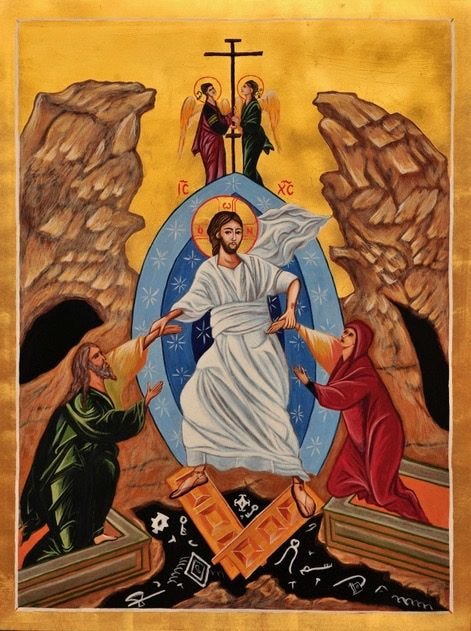
Notice what happens later in John’s Gospel. When Jesus rises from the dead, he leaves his grave clothes behind (20:6–7). He had no further use for them. He was not returning to the life he had before, subject again to weakness and death. He passed through death into something on the other side of it entirely. For each and every one of us, Jesus will say to death: “Unbind them, and let them go.”
Conclusion
Today is the fifth Sunday in Lent. Holy Week begins in one week. In a very real sense, we are still in the valley, still waiting, still crying from the depths. But we are not crying into silence. We are crying to a God who has already entered the valley, who has already stood at a graveside and wept, and who has already opened a tomb.
Jesus asks each of us the same question he asked Martha, and it is not a rhetorical one. It is personal:
“Do you believe this?” (11:26)
Do you believe not just in the idea of resurrection, or in the idea of forgiveness, but in Jesus as the resurrection itself? Do you believe that the God who spoke to the dry bones in Ezekiel’s valley, who called Lazarus out of the tomb, who rose from the dead on the third day and left his grave clothes behind, is the same God who holds your life in his hands?
If you do, then say with Martha:
“Yes, Lord; I believe that you are the Christ, the Son of God, who is coming into the world” (11:27).
The one who is the resurrection and the life will come again. When he arrives, the depths will not hold us, the grave will not have the final say, and God will wipe away every tear from every face, even his own. On that day, Jesus will say to death: “Unbind them, and let them go,” and dry bones will come back to life.
Amen.
This post is the written version of a sermon preached at St. Dunstan’s Anglican Church in Largo, FL, on Sunday, March 22, 2026. If it resonated with you, consider sharing it with someone else. On the Way is free for everyone. If you find the writing and teaching valuable and want to support it, a paid subscription is the best way to do that.
Life Group Guide
Opening Prayer
Father, we come before you honestly, just as the psalmist did, from the depths, with whatever grief, confusion, or waiting we are carrying right now. Open our eyes to see what you are doing in these texts and in our lives. Give us faith to trust that your delays are not failures of love, and that the one who called Lazarus out of the tomb is the same God who holds our lives in his hands. In the name of Jesus, Amen.
Icebreaker
What is something you have had to wait for far longer than you expected? What did that waiting do to you?
Discussion Questions
John 11 tells us that Jesus loved Martha, Mary, and Lazarus, and therefore, he waited. What does that “therefore” reveal about how Jesus understands love? How does it challenge the way we usually think about God’s delays?
The psalmist in Psalm 130 cries out from the depths without softening his words or searching for the right thing to say. What does it tell us about prayer that God invites this kind of honesty? Where do you find it hardest to pray that honestly?
Both Mary and Martha say the same thing to Jesus independently: “Lord, if you had been here, my brother would not have died.” There is no accusation in those words, but there is real grief. How do you relate to that mixture of faith and sorrow?
Ezekiel 37 is a vision of national resurrection for a people who had been in exile long enough that hope had turned to despair. When Jesus arrives in Bethany, Israel is still waiting for that restoration. How does knowing that context change the way you read the raising of Lazarus?
Jesus does not offer Martha a theological explanation for the delay. He offers her his presence and says, “I am the resurrection and the life.” What is the difference between receiving a theological answer and receiving a person? Which do you find yourself reaching for when you are in the depths?
When Lazarus comes out of the tomb, he is still bound in grave clothes, and Jesus says, “Unbind him, and let him go.” When Jesus rises, he leaves his grave clothes behind entirely. What is the difference between those two moments, and what does it tell us about the kind of life Jesus promises his people?
Jesus asks: “Do you believe this?” Do you believe not merely in the idea of resurrection or forgiveness, but in Jesus himself as the resurrection? How would you honestly answer that question right now?
Life Application
This week, identify one area of your life where you are waiting in the depths. Bring it to God honestly, not with the right words, but with the real ones. Then ask him to show you whether there is anything still binding you that he wants to unbind.
Closing Prayer
Lord Jesus, you are the resurrection and the life, and you have already entered the valley, wept at the graveside, and opened the tomb. Unbind us from whatever still clings to us and keeps us from walking in the freedom you have won. As we move toward Holy Week, fix our eyes on the one who left his grave clothes behind, and give us faith to believe that on the last day, you will say to death: unbind them, and let them go. Amen.
I was thinking here of something I read recently from Wesley Hill: “In the Eastern Christian tradition, the most important icon of the resurrection—Hē Anastasis—does not depict Jesus stepping on his gravestone in triumph or blinding the guards at the tomb with his radiance. Instead, it features a scene that Western Christians tend to call Jesus’ “descent into hell” or, more dramatically, “the harrowing of hell,” and that we often associate more with Holy Saturday than with Easter. Jesus is in the underworld, standing athwart a set of broken-down doors, their locks and chains lying at his feet like so much flotsam. He is surrounded by an almond-shaped aura of glory. With his right hand he grasps the hand of a bearded old man and with his left he seizes the hand of a woman wearing a veil. The icon shows Jesus, having thrown open the gates of Hades, snatching Adam and Eve—and, by implication, the entire human family—from death and judgment, pulling them up from their tombs as if to surge toward heaven with them. The point is vividly, powerfully clear: Easter is about Jesus, yes, but Jesus rises for all of us too. ‘For as in Adam all die, so also in Christ shall all be made alive’ (1 Corinthians 15:22 RSV)” (Easter: The Season of the Resurrection of Jesus, 46).