

We’ve been working through the Apostles’ Creed — the baptismal confession, the one said at Easter, the one candidates for confirmation are asked to learn. We’ve covered the Father and the Son. Now we’ve arrived at the third article, the one about the Holy Spirit. Except the Holy Spirit is named, and then the creed seems to move right past him into a list of other things. What’s going on there?
The Shape of the Creed
The creed has three articles. The first is about God the Father — Creator and, as we’ve talked about, covenant keeper. The second is about God the Son — the Redeemer, the one who fulfills the covenant God made with Abraham. But the third article is longer than most people realize:
I believe in the Holy Spirit, the holy catholic Church, the communion of saints, the forgiveness of sins, the resurrection of the body, and the life everlasting.
Notice: the Church, the communion of saints, the forgiveness of sins, the resurrection — all of that is under the third article. The creed isn’t saying these are separate items to believe in alongside the Holy Spirit. It’s saying they are what the Holy Spirit does. The one who makes the Church what it is, who unites us to Christ through baptism, who guarantees resurrection, who makes forgiveness a living reality in our lives — that is the Holy Spirit.
The creed has a narrative logic. The Father creates and makes a covenant. The Son fulfills that covenant and dies and rises. And then? He ascends. And when he ascends, he sends the Holy Spirit. The third article is not an afterthought. It is where the story of God and the world arrives.
A Feast You Should Know
On the day the Holy Spirit came upon the disciples in Jerusalem, Israel was celebrating a feast. This is not a coincidence.
The feast is called Pentecost — from the Greek word for fifty. Pentecost falls fifty days after Passover. And the question worth asking is: fifty days after Passover, what is Israel actually celebrating?
Think about the narrative. At Passover, the blood of the lamb is placed on the doorframe, the angel of death passes over, and Israel is set free from Egypt. They leave. And fifty days later — after crossing the Red Sea, after entering the wilderness — they arrive at a mountain. Moses goes up, and God gives him the law.
Pentecost is the feast of the giving of the Law at Mount Sinai.
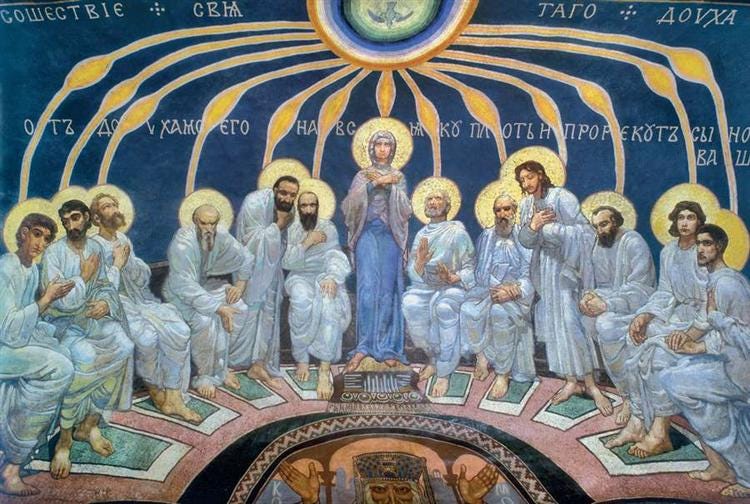
This is the context for everything that happens in Acts 2. On the very day that Israel is celebrating the giving of the law at Sinai — the law written on tablets of stone — the Holy Spirit is poured out on the people of God in Jerusalem. Fire comes down. The Spirit rushes in and fills the place. And the disciples go out speaking the mighty works of God in every language under the sun.
The significance is hard to overstate.
What the Prophets Saw Coming
Centuries before Acts 2, the prophets of Israel were told that something was wrong with the law — not with the law itself, but with where it was written.
In Jer 31:31–33, God says:
“Behold, the days are coming, declares the Lord, when I will make a new covenant with the house of Israel and the house of Judah, not like the covenant that I made with their fathers on the day when I took them by the hand to bring them out of the land of Egypt... I will put my law within them, and I will write it on their hearts.”
The law was always external. Written on stone, handed down from outside. And Israel, with hearts of stone, couldn’t keep it. God is promising something different: a new covenant, not tablets but hearts.
And in Ezek 36:25–27, God gets even more specific about how this will happen:
“I will sprinkle clean water on you, and you shall be clean... And I will give you a new heart, and a new spirit I will put within you. And I will remove the heart of stone from your flesh and give you a heart of flesh. And I will put my Spirit within you, and cause you to walk in my statutes and be careful to obey my rules.”
The mechanism of the new covenant, the thing that writes the law on the heart, is the Holy Spirit. God himself, dwelling inside his people, doing from the inside what no external law could ever accomplish.
So when the Spirit comes at Pentecost — on the very feast that celebrates the giving of the law — this is the fulfillment of everything Jeremiah and Ezekiel had been waiting for. The new covenant has arrived. The law is no longer on stone. The Spirit of God is writing it on human hearts.
The Temple Moves
There is another layer here, which requires understanding what the Holy Spirit was doing in the Old Testament.
When Israel completed the tabernacle in the wilderness, something astonishing happened: the glory of God rushed in and filled the tent. The priests had to leave because the presence was too overwhelming (Exod 40:34–35). Heaven and earth came together in that tent. It was the place where God and his people could meet.
The same thing happened when Solomon dedicated the temple. The glory of God filled it (1 Kgs 8:10–11). The temple was not merely a beautiful building or a religious institution. It was the place on earth where the living God was present — where his glory dwelt.
Then came the exile. The temple was destroyed. And before it was destroyed, the prophet Ezekiel saw something terrible: the glory of God slowly and reluctantly lifting from the temple and departing (Ezek 10–11). God left the building.
When the exiles returned and rebuilt the temple, they waited. According to rabbinic tradition, the glory never returned—and there is no account in the biblical text of the Spirit filling the Second Temple as he had filled the first.
Now go to Acts 2:1–4. The disciples are gathered. “Suddenly there came from heaven a sound like a mighty rushing wind, and it filled the entire house.” Tongues of fire descended on each of them. And they were all filled with the Holy Spirit.
The Spirit of God has rushed in and filled a building again. You expect the people to flee, as the priests did in the wilderness. But they don’t flee — because the Spirit doesn’t land on the building. He lands on them—divided tongues of fire, resting on each person.
This is a new temple. Not made of stone. The Spirit who once filled the tabernacle and the temple is now filling human bodies. Paul draws this out explicitly in 1 Cor 6:19: “Do you not know that your body is a temple of the Holy Spirit within you, whom you have from God?”
Your body is where God now dwells. The glory has returned — not to a building in Jerusalem, but to the people of God, wherever they go.
Led Through the Wilderness
There is one more image worth holding on to.
After passing through the Red Sea, Israel wandered in the wilderness for forty years. They had not yet arrived at the Promised Land. They were in between: saved from Egypt, but not yet home. And as they wandered, a pillar of cloud led them by day and a pillar of fire by night — the presence of God going before them, which the early church came to read as a type of the Holy Spirit’s guidance of God’s people.
Paul sees this as a map for the Christian life. We have been saved from sin, death, and the devil. We have passed through the waters of baptism — the Red Sea, in Christian typology. But we have not yet arrived at the Promised Land. We live in the wilderness, between salvation and the new creation.
And in this wilderness, the Holy Spirit is doing what the pillar of fire did for Israel. Rom 8:14 puts it simply: “All who are led by the Spirit of God are sons of God.”
The Spirit is our guide through the wilderness. He is, as Paul says in Eph 1:14, “the guarantee of our inheritance” — the down payment on the new creation, the foretaste of the promised land we are traveling toward. And his job, all along the way, is to form us into the image of Christ: to make us the people God created us to be, and the people God redeemed us to be.
Why This Matters
Luke opens the book of Acts with a striking phrase. He says that in his previous book — the Gospel of Luke — he wrote about “all that Jesus began to do and teach” (Acts 1:1).
Began. As if Jesus is not finished.
Luke’s point is that the ascension did not end the ministry of Jesus. It extended it. Jesus now does and teaches in the world through the Holy Spirit poured out on his people. When the Spirit comes upon you, Jesus says, “you will be my witnesses” (Acts 1:8) — not just in Jerusalem, but to the ends of the earth.
This is what the Holy Spirit is for. Not primarily dramatic experiences, not a private spiritual glow, but the continuation of the work and teaching of Jesus in the world. The Spirit dwells in you so that you can be the place where people encounter the living God — through the justice you pursue, the beauty you create, the relationships you nurture, the truth you speak.
You are the temple now. Act like it.
Questions, pushback, or thoughts? Hit reply — I read everything.