

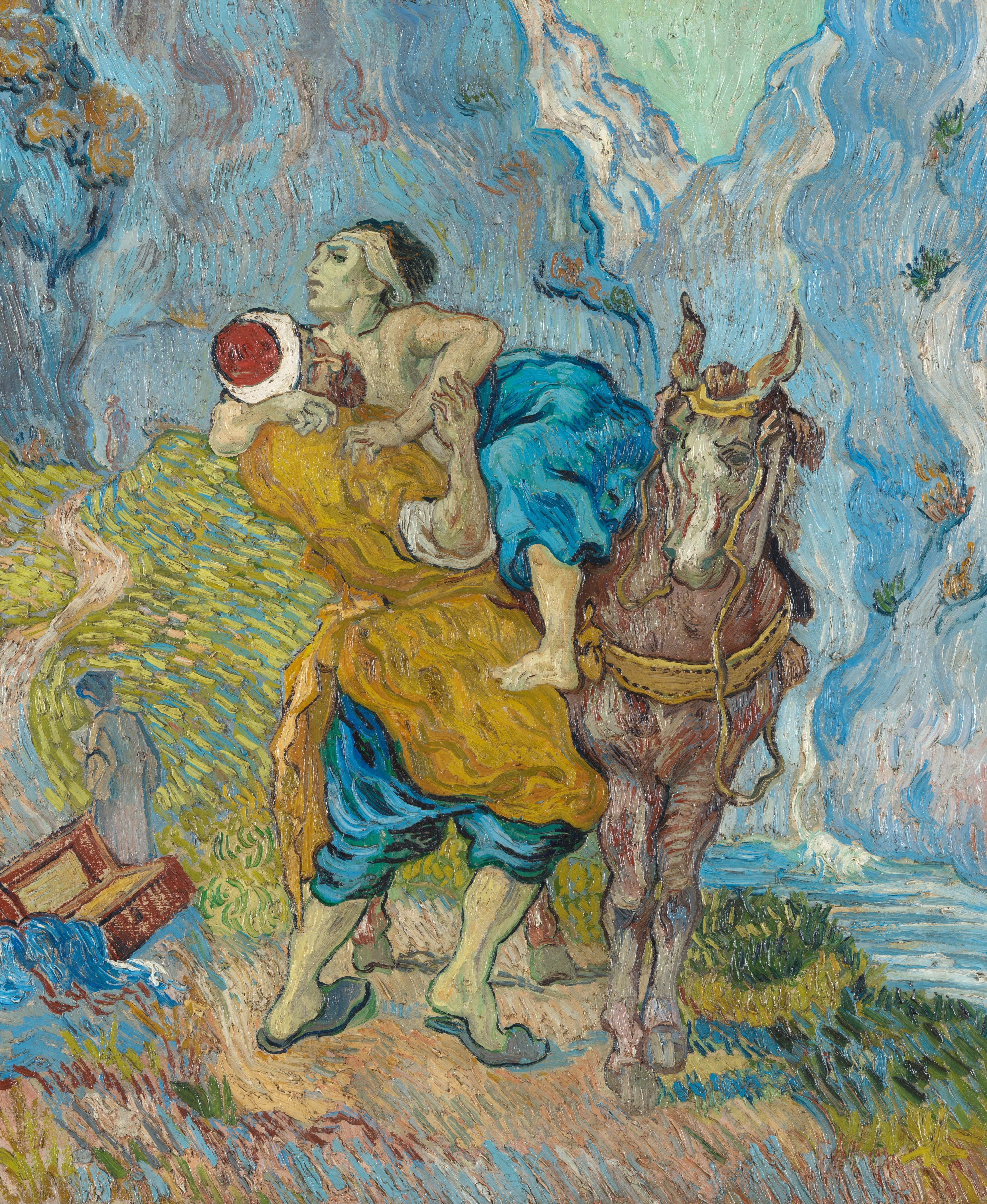
The One Who Showed Mercy
Every Christian who worships regularly has heard the Summary of the Law more times than they can count. In my church, the priest recites it near the beginning of the service, and the congregation knows it before the words are finished.
Love the Lord your God with all your heart, soul, strength, and mind.
Love your neighbor as yourself.
The lawyer in Luke 10 could do the same. When Jesus asked what the law required, the man answered without hesitation, and Jesus commended him.
“You have answered correctly; do this, and you will live” (Luke 10:28).
The lawyer’s answer was not a guess. The Shema (Deut 6:4–5) was recited morning and evening by observant Jews, and combining it with Lev 19:18 as a summary of the entire law was a recognized practice in first-century Jewish discussion. Notably, in Matthew and Mark, it is Jesus who provides the double commandment; in Luke, the lawyer states it himself (cf. Matt 22:34–40; Mark 12:28–34). The lawyer is not being corrected. He is being held accountable for what he already knows.
The issue wasn’t that the lawyer didn’t know the commandments, but that he believed knowing them was sufficient.
He pressed further, and Luke explains why:
But he, desiring to justify himself, said to Jesus, “And who is my neighbor?” (Luke 10:29).
He is not really seeking understanding; he wants to know where the line is. He knows who God is and has some idea of what it means to love God with all his heart, soul, strength, and mind, but he seeks clarification about exactly whom he must love to fulfill the second great commandment. If “neighbor” can be defined narrowly enough, the commandment becomes manageable. If “neighbor” means only those within our own circle, or only those who share our social world, or only those who have been kind in return, then love of neighbor is a duty bounded by a fence. The lawyer did not ask the question to learn; he asked it to limit.
Jesus refused to answer the direct question. Instead, he told the parable of the man who fell among robbers on the road from Jerusalem to Jericho (10:30–35). At the end, he posed a different question altogether:
“Which of these three do you think proved to be a neighbor to the man who fell into the robbers’ hands?” (10:36).
Here is the real point. The lawyer wanted to know who he was required to love, but Jesus shifted the focus: who proved to be a neighbor? The question was no longer about the limits of obligation but about the condition of the heart.
The fact that the hero of the parable is a Samaritan would have been offensive. But there is more happening beneath the surface. The details of the parable—the oil and wine, the donkey, the binding of wounds, the destination of Jericho—echo a nearly forgotten episode in 2 Chr 28, where Samaritans clothed the naked, anointed the wounded, set the frail on donkeys, and brought them to Jericho (28:15). Luke’s Samaritan is doing what a previous generation of Samaritans once did, embodying a covenant faithfulness that Israel had forsaken. The parable does more than introduce an unlikely hero; it reaches back into Israel’s own scriptures to bring conviction.
When Jesus finished the story, the lawyer gave the answer himself:
“The one who showed him mercy” (Luke 10:37).
That word “mercy” is the key. Mercy belongs to the very character of God, and he expects the same from his people. Mercy is not just a feeling; it is what motivates a person to cross the street toward someone in need rather than walk past them. The parable ends not with the boundary the lawyer was looking for, but with a definition that implicates him: a neighbor is the one who shows mercy. Jesus then says:
“You go, and do likewise” (10:37).
The Summary of the Law is heard near the beginning of the service, before the readings, before the sermon, before the table. It is placed there as a mirror held up before the congregation enters more deeply into worship. Luke 10 suggests that the mirror is effective only when we have been disturbed enough by what we see to go and do likewise.