

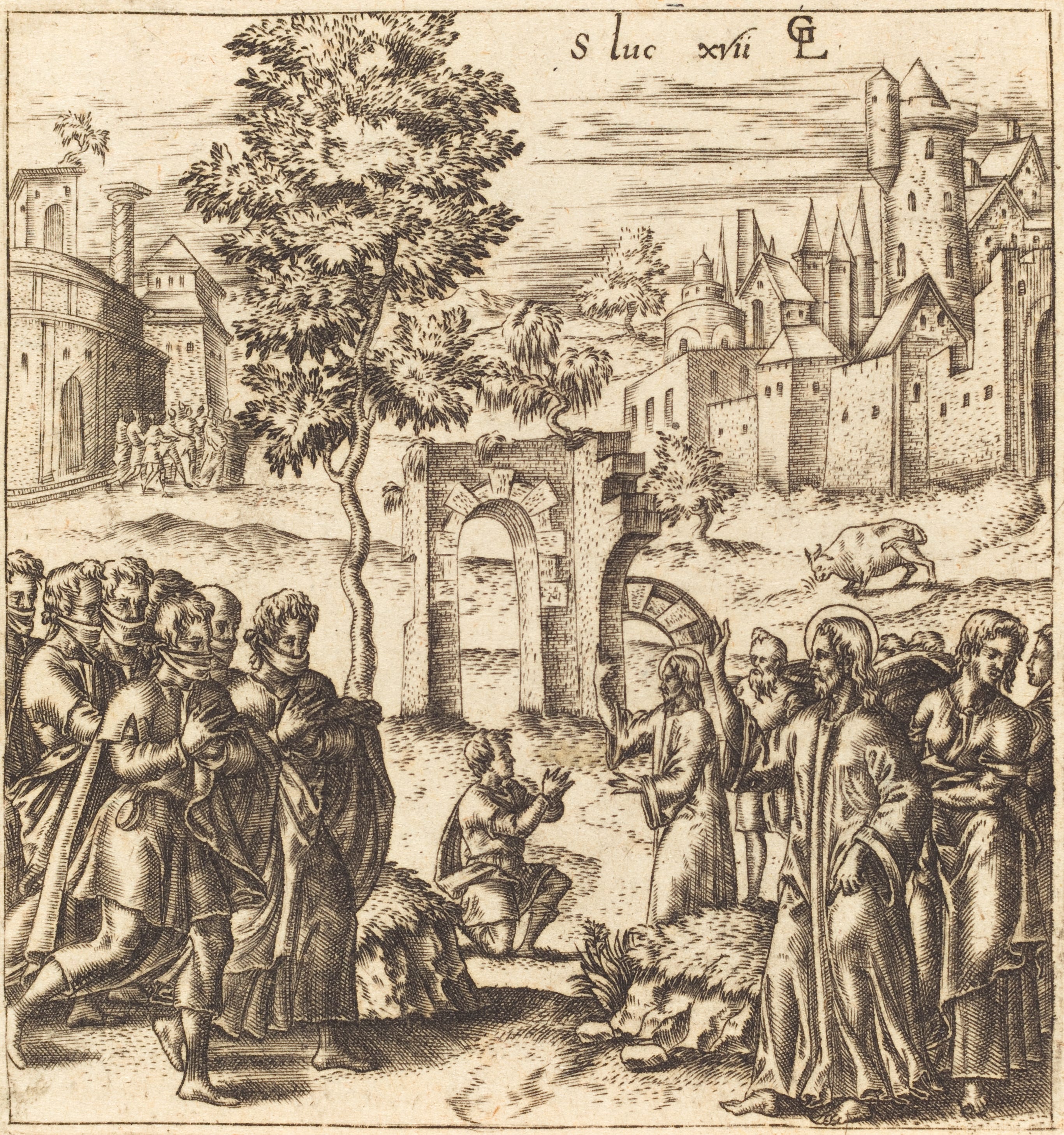
The One Who Returned (17:11–19)
When Jesus healed ten lepers on his way to Jerusalem, he was, as he does elsewhere, doing what other prophets had done before him, but on a larger scale. In 2 Kings 5, the Syrian commander Naaman came to the prophet Elisha covered in leprosy and was healed. Jesus himself referenced that story at the beginning of his ministry, noting specifically that out of all the lepers in Israel, only this foreigner was healed (Luke 4:27). Luke’s reader, prepared by that earlier story, cannot miss what is happening here. A Samaritan leper is healed while the nine Jewish ones walk on. Naaman has returned.
All ten cry out for mercy, and all ten receive it. As they go to show themselves to the priests, Luke writes that “they were cleansed” (17:14). The word is καθαρίζω, the language of ritual purification, the category the priests dealt with. Ten men enter the story as unclean. Ten leave it cleansed. And yet, the story does not end there.
One leper turns back. The Samaritan. Luke’s description of what follows is deliberately blurred:
Then one of them, when he saw that he was healed, turned back, praising God with a loud voice; and he fell on his face at Jesus’ feet, giving him thanks (17:15–16).
He praises God and falls at Jesus’ feet. Luke does not separate these two actions. The worship given to Israel’s God is shown by prostrating oneself before Jesus of Nazareth. This is Luke’s subtle Christological argument, conveyed not through words but through posture.
Then Jesus says something unexpected. The man has already been healed. Every medical fact about him has changed. Yet Jesus says, “Your faith has made you well” (17:19). The word is no longer καθαρίζω. It is σῴζω, the verb for salvation. Jesus is talking about more than just skin being restored.
Ten received cleansing. One received salvation. The difference wasn’t in what Jesus offered but in who came back.
This is why gratitude isn’t just a virtue to develop; it’s a sign of understanding. How easily we praise and give thanks shows how well we recognize what we’ve been given and how truly unwell we once were. The nine went their way, probably happy. They had been physically cleansed. Only the one who knew his deep need understood the significance of the gift. He went home saved.
He was a foreigner. Like Naaman, he was, by every social and religious standard, the last person anyone would expect to be healed. He was also the only one who returned to worship and give thanks, and therefore the only one who was saved.