

As some of you might know, I’ve been reading Lord of the Rings throughout Lent. As a theology nerd and a Tolkien nerd, this day is a big deal to me. I’ve been looking forward to writing this post for a while.
There is a date that the medieval imagination treated as the hinge of the world. It wasn’t Christmas, and it’s not Easter. The date on which the world turns is today, March 25.
We all know March 25 as the Feast of the Annunciation, the celebration of the day on which the Angel Gabriel announced to the Blessed Virgin Mary that she would conceive the Son of God. The Church has observed this feast on March 25 since at least the seventh century. The feast date was determined by working backward nine months from Christmas. The Church wanted to honor the full humanity of the incarnation, including the months Mary carried the Word of God in her womb before he ever drew a breath outside it. But there is more to this date than just the miracle of the incarnation—especially for Tolkien fans.
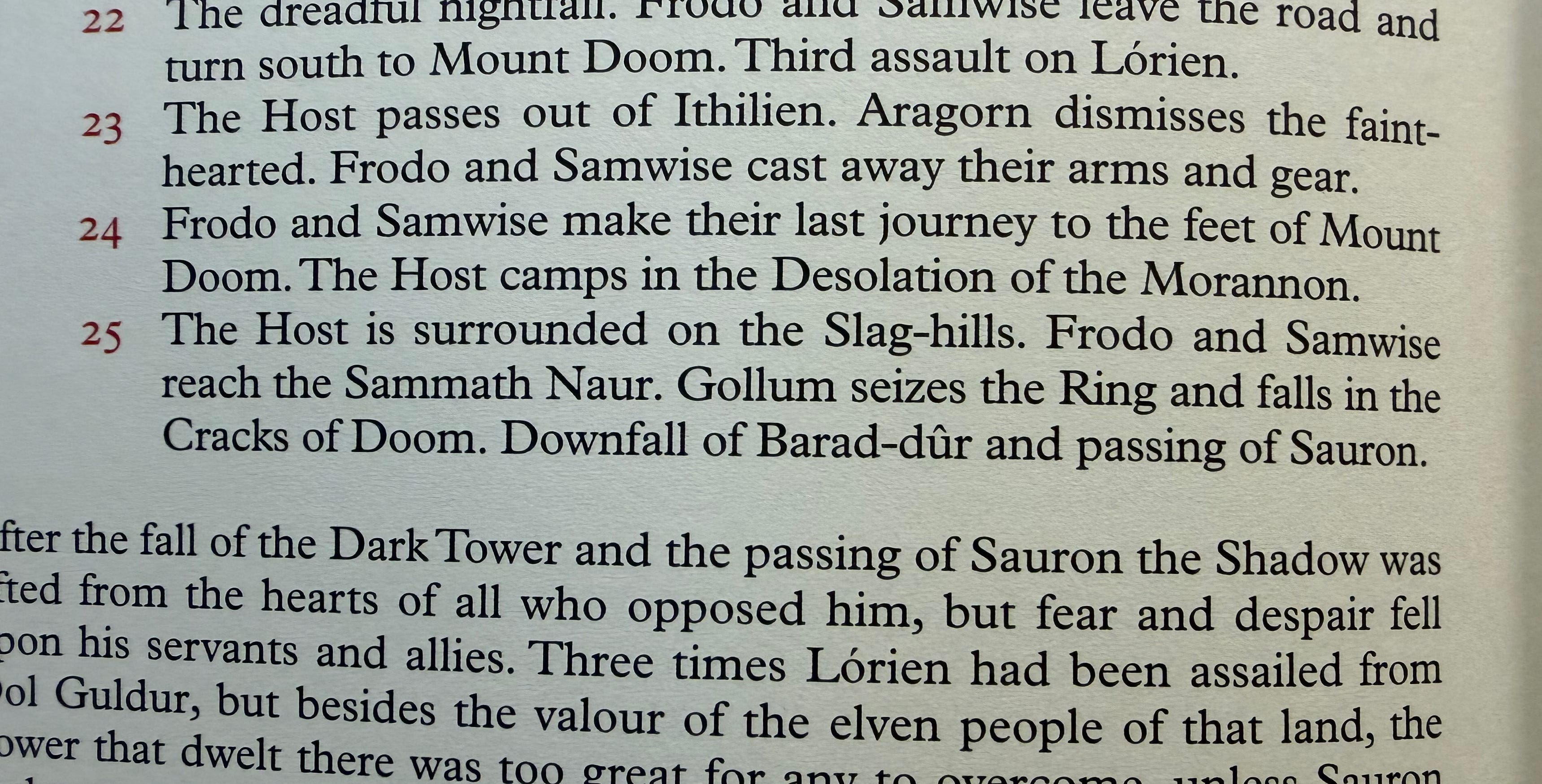
According to ancient tradition, March 25 was also the day on which (1) God created the world, (2) Adam fell, and (3) Christ was crucified. And, (if that wasn’t enough) on March 25, in a fictional world called Middle-earth, a hobbit named Frodo Baggins stood above the fires of Mount Doom, and the Dark Lord’s Ring was destroyed.
What the Feast of the Annunciation Actually Is
The Feast of the Annunciation, celebrated on March 25, commemorates the moment recorded in Luke 1:
In the sixth month the angel Gabriel was sent from God to a city of Galilee named Nazareth, to a virgin betrothed to a man whose name was Joseph, of the house of David. And the virgin’s name was Mary (Luke 1:26–27 ESV).
The angel’s message is startling in its directness. There is no long preamble, no extended vision, no elaborate symbolic apparatus. Gabriel simply announces what is about to happen:
“And behold, you will conceive in your womb and bear a son, and you shall call his name Jesus. He will be great and will be called the Son of the Most High” (1:31–32).
Mary’s response is not an ecstatic yes. It is a question: “How will this be, since I am a virgin?” (1:34). Gabriel answers, she consents, and the story of salvation turns on that consent. Without the Annunciation, there is no Nativity. Without the Nativity, there is no Passion. Without the Passion, there is no Resurrection. The Feast of the Annunciation is, in a real sense, the beginning of everything that ultimately matters. It’s no wonder that we call her “blessed. You know, besides the fact that the Bible says all generations will call her that (1:48).
March 25 and the Ancient Calendar
As I mentioned above, the medieval imagination attributed even greater significance to March 25 than to the Annunciation alone. A tradition dating back to Tertullian in the third century maintained that Jesus was crucified on March 25.1 The logic was based on what scholars call the “integral age” argument: a perfect man would live a perfectly complete number of years, dying on the same day he was conceived. If the Annunciation was March 25, then the Crucifixion must have been on March 25 as well.
This calculation aligned the Annunciation and the Passion on the same date, making March 25 both the moment when the Word became flesh and when that flesh was broken for the life of the world. Conception and Crucifixion. The beginning of the incarnation and its apparent end. The entry of God into human vulnerability and the full weight of that vulnerability on display.
Some medieval thinkers went even further, arguing from the symmetry of sacred history that March 25 was also the date of creation and the fall of Adam.2 The reasoning was typological and liturgical rather than astronomical: the same date that marked the world’s ruin by Adam must also have been the date that set in motion the world’s redemption through the second Adam, conceived by the Spirit in Mary’s womb.
Whether any of these calculations are historically accurate in a modern sense is irrelevant. What matters is the symbolic and theological framework the medieval imagination constructed around this date. March 25 was, for centuries of Christian thought, the day the world repeatedly turned, in both directions. Ruin and redemption. Death and new life. Darkness and light.
Tolkien and the Shape of Eucatastrophe
J.R.R. Tolkien was a devout Roman Catholic. He was also, as a medievalist by training and vocation, deeply influenced by this older calendar and its theological significance. When he created the timeline for The Lord of the Rings, he marked the destruction of the One Ring on March 25.3
The connection is deliberate. Tolkien carefully considered the relationship between mythology, story, and Christian truth, and he expressed this most clearly in his 1947 essay “On Fairy-Stories.”4 In that essay, he introduced a term he coined himself: eucatastrophe.
The word combines the Greek eu (” good”) with catastrophe (” sudden turn”). Tolkien defined eucatastrophe as the sudden, joyful turn in a story where everything seems lost and then, unexpectedly, it is not. He was careful to distinguish it from a simple happy ending. A happy ending can be merely a resolution, a tying up of loose threads. Eucatastrophe is something more piercing: it is joy that arrives through and after genuine suffering and apparent defeat, not instead of it. The darkness is not denied. It is transformed.
Tolkien argued that the eucatastrophe is the highest achievement a fantasy or fairy story can reach. Examples from his own stories include the moment when the eagles arrive or when the Ring is cast into the fire. These moments evoke in the reader a unique kind of joy that Tolkien described as almost physically distinct from ordinary pleasure. He called it a “sudden glimpse of the underlying reality or truth.”5
The Fairy Story That Happened
“The Gospels contain a fairy-story,” Tolkien wrote, “or a story of a larger kind which embraces all the essence of fairy-stories.”6 He meant this as the highest possible compliment. The Resurrection, he argued, is the eucatastrophe of the story of the Incarnation. The story of the world had been unfolding through darkness, betrayal, and suffering, through what seemed to be total defeat. Then came the sudden joyous turn that was not a reversal of the tragedy but a transformation of it.
Tolkien described the Resurrection as “the greatest ‘eucatastrophe’ possible in the greatest Fairy Story,” creating an emotion he called Christian joy, which nearly brings him to tears because it is so close to sorrow: “ it comes from those places where Joy and Sorrow are at one, reconciled.”7
This is the reason he chose March 25 to destroy the Ring. The date that medieval Christianity linked with key moments in salvation history—Creation, the Fall, the Annunciation/Incarnation, and the Crucifixion—was the ideal date for the eucatastrophe of his own fictional world. Not because Frodo is a Christ figure in a literal allegorical way (Tolkien despised allegory),8 but because the structure of his story was meant to echo the shape of the true story. The unexpected, undeserved, and piercing joy of redemption comes through the most unlikely of characters: a poor young woman in an occupied province, and a frightened hobbit inside a volcano.
Why This Matters in Holy Week
We are nearing the end of Lent. Holy Week is just around the corner. And today, on March 25, we celebrate the Feast of the Annunciation in the shadow of the cross.
That is precisely where the Annunciation belongs. Gabriel’s greeting did not start a tale of straightforward victory. Instead, it began the story of a sword that will pierce Mary’s soul, of a son who will be abandoned by friends, tortured by the state, and publicly killed in humiliation. The “yes” Mary spoke to the angel was a “yes” she did not fully grasp, a “yes” that would cost her more than she could have imagined as she stood there in Nazareth.
And yet, the entire arc from Annunciation to Crucifixion to Resurrection is eucatastrophic in exactly the way Tolkien described. The joy of Easter isn’t the joy of a story where nothing truly bad happened. Easter is the joy of a story where the worst possible thing happened and was transformed, not erased, into the source of life for the whole world.
When we experience that particular kind of joy, the one that catches us in the chest and nearly brings us to tears, Tolkien believed we are receiving a signal from the deep structure of reality itself. The universe is shaped like a story that leans toward joy. Not easily, not cheaply, but genuinely.
That story started, in a way, on a day like today, with an angel, a young woman, a question, and a yes. On that day, to use the words of Master Samwise Gamgee, everything sad began to come untrue.
Tertullian, Adversus Judaeos 8. Tertullian calculates the crucifixion date as March 25 based on his reading of the consular dating in the Gospels. Augustine later elaborated on the tradition (De Trinitate 4.5).
The conflation of March 25 as the date of creation, the fall, the Annunciation, and the Passion is discussed in Thomas J. Talley, The Origins of the Liturgical Year (New York: Pueblo, 1986), 91-99; and Andrew McGowan, “Celebrating Christmas,” Bible Review 18, no. 6 (2002): 22-31.
The date appears in the Tale of Years in Appendix B of The Lord of the Rings. See the image at the top of the post.
J.R.R. Tolkien, “On Fairy-Stories,” in Tree and Leaf (London: George Allen & Unwin, 1964). The essay was originally delivered as the Andrew Lang Lecture at the University of St. Andrews in 1939 and revised for publication in 1947.
Tolkien, “On Fairy-Stories,” 68 (in the standard Tree and Leaf pagination).
Tolkien, “On Fairy-Stories,” 71-72.
Tolkien, “On Fairy-Stories,” 72.
Tolkien wrote in the foreword to the second edition of The Lord of the Rings: “I cordially dislike allegory in all its manifestations, and always have done so since I grew old and wary enough to detect its presence.”
I am marking my calendar from now on. I read about this in Advent when I did my series on Mary, but dang, I forgot about it. Thanks for the reminder.
Very well said. Encouraging piece. I often forget about these feast days because they were never a part of the tradition that I grew up in. Thank you for reminding me of the significance.