

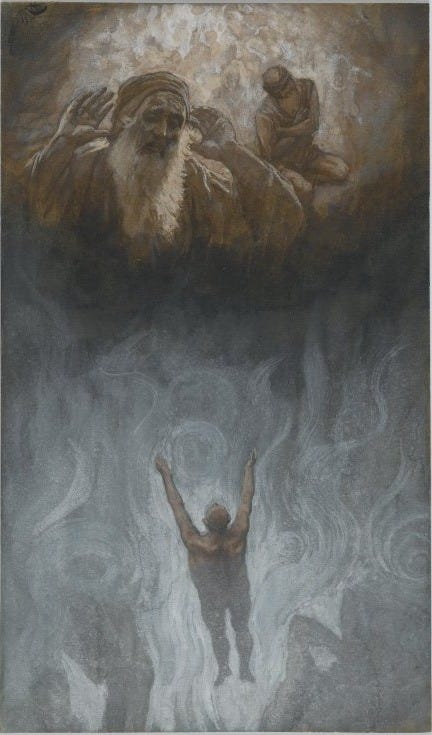
The Chasm and the Crossing (Luke 16:19–31)
March 25, 2026
The parable of the rich man and Lazarus is found only in Luke, and it is worth saying at the outset what Jesus is not doing. He is not giving a detailed map of the afterlife. Parables are not historical accounts, and trying to draw a literal geography of Hades from this story misinterprets the form entirely. Jesus is doing something more specific: he is flipping the world of his listeners upside down.
A wealthy man, dressed in purple and fine linen, feasts every day. A poor man named Lazarus lies at his gate, begging for scraps and covered in sores. The name matters: Lazarus comes from the Hebrew אֶלְעָזָר, meaning “God helps.” He is the only character in any of Jesus’ parables to be given a name, and that name is ironic. God doesn’t seem to have helped him at all. Nor does any human.
In the world his listeners inhabited, wealth symbolized righteousness. Material blessings were regarded as evidence of divine favor. Lazarus, therefore, would have been considered cursed. The rich man would have been perceived as righteous.
Then both men die, and everything is turned upside down. Angels carry Lazarus to Abraham’s side. The rich man descends to Hades, where he is in torment. The one who had everything has nothing; the one who had nothing rests with the father of the covenant people.
When the rich man appeals to Abraham, Abraham identifies what now separates them:
There is a great chasm fixed between us and you, so that those who would pass from here to you cannot, and none may cross from there to us (Luke 16:26).
The wealthy man calls Abraham father, and Abraham recognizes him as a child — the kinship is genuine. However, it changes nothing. The word “fixed” carries significance. The divide is not temporary, and no appeal to Abrahamic lineage alters it. The parable provides no solution, only a boundary that remains intact.
Abraham’s final words add to the impact. When the rich man asks for a messenger to warn his brothers, Abraham replies that they already have Moses and the Prophets. And then:
If they do not hear Moses and the Prophets, neither will they be convinced if someone should rise from the dead (Luke 16:31).
For Luke’s reader, the irony is unmistakable. Someone has risen from the dead, and those who refused Moses and the Prophets did not believe him either.
The parable is not a lesson about the geography of Hades. It is a warning about now, about the moment when the crossing is still possible, when the chasm has not yet been fixed. It’s about listening well while Moses, the Prophets, and the one greater than Moses still speak.
I look forward to when you will cover the first parable in this chapter about the shrewd manager. It appears the manager is commended for being deceitful! I don’t understand Jesus’ urging his followers to be shrewd with wealth in this life nor what that means.
As far as the rich man and Lazarus — I’ve been reading the book “I am Malala.” I’ve been saddened by their teaching that a man who would die for the cause (suicide bombing in particular) will receive 72 virgins. What about female suicide bomber?! What is her incentive? It seems a demonic teaching created by men (for whom unlimited sex is the motivation?). It saddens me to think of the many young persons who have been taken in by such an awful teaching