

I preached this sermon on a Sunday when we baptized three young boys. Baptisms are always special occasions for me, so I always try to weave the meaning of baptism into the sermon.
Introduction
The Star Wars franchise has lots of memorable, meme-able moments, but one of the most famous comes from Return of the Jedi. Admiral Ackbar, the commander of the Rebel fleet, arrives with the fleet to destroy the second Death Star, only to realize:

The Trap
This meme applies directly to our Gospel reading this morning because the Pharisees are trying to trap Jesus. They start, of course, by buttering him up. Their disciples say:
“Teacher, we know that you are true and teach the way of God truthfully, and you do not care about anyone’s opinion, for you are not swayed by appearances” (Matt 22:16, ESV).
They are really laying it on thick, and then the trap is sprung:
“Tell us, then, what you think. Is it lawful to pay taxes to Caesar, or not?” (22:17).
Now, I don’t know that anybody particularly likes paying taxes, but in the first century this question was politically and theologically loaded. Paying taxes to Caesar was an obvious and tangible sign of imperial rule. One day Rome showed up, conquered the land, and now said, “You’re going to pay us, your conquerors, a part of everything you make.”
The people didn’t like paying taxes to Caesar, so if Jesus had said, “Of course you should pay taxes to Caesar. He’s in charge. He’s the one taxing you. Submit to the government,” they almost certainly would have turned on him. After all, the people expected the Messianic Son of David to overthrow Roman rule, not tell them to submit to it.
But on the other hand, if Jesus were to say, “Don’t pay taxes to Caesar,” he would have sounded like a revolutionary and insurrectionist. When Jesus was just a boy, a revolt had broken out over this very issue, and the Romans left the revolutionaries on crosses across the countryside as a clear example of what happens when you revolt over paying taxes. The disciples of the Pharisees and the Herodians are trying to get Jesus to say something for which Pilate would have reason to kill him.
So, as they’ve framed the question, either Jesus loses the popular support of the crowd, which would have meant that the Pharisees could do with him as they pleased, or Jesus says something that the Pharisees can take back to Pilate and say, “See, this man should be put to death as a revolutionary! This is your obligation, your responsibility, Pilate.”
Jesus’ Answer
Instead of answering them right away, Jesus asks for a coin. The coin used to pay the tax to the Roman Empire was a denarius, stamped with Caesar’s face. Around the edge, the inscription reads, “Tiberius Caesar, son of the divine Augustus.”
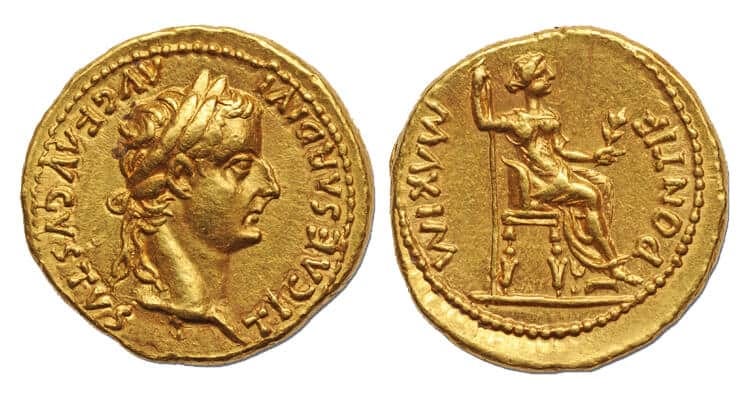
So Jesus takes the coin and asks, “Whose likeness and inscription is this?” They answer, “Caesar’s,” to which Jesus replies:
“Therefore render to Caesar the things that are Caesar’s, and to God the things that are God’s” (22:21).
Before we get into what Jesus means, it’s worth noting the reaction.
“When they heard it, they marveled. And they left him and went away” (22:22).
Jesus has clearly found his way out of this trap, so he’s neither said, “Don’t pay taxes to Caesar,” nor “Of course you should pay taxes to Caesar.” He found a third option. What is it?
Let’s go back to his answer.
“Therefore render to Caesar the things that are Caesar’s, and to God the things that are God’s” (22:21).
“The things that are Caesar’s,” in this case the coin, are Caesar’s because the coin bears Caesar’s image and because it proclaims something about Caesar to the world. If we look at the coin, it shows his face, and it says who he is. It announces who’s in charge and why: Tiberius Caesar, son of the divine Augustus. He is the son of a deity. He is the son of a former Caesar, and he is Caesar himself. He is in charge. That’s how the inscription and image on the coin functioned. They made it clear to anyone who used the coin who was in charge and why.
The Things That Are God’s
So, what are the things that are God’s? What is it in this world that bears God’s image and likeness and proclaims something to the world about who he is and why he’s in charge?
People. Humanity.
Way back at the beginning of the story, God created us in his image, and sin has marred that image in all of us, but it’s still there. It’s like a mirror that’s all fogged up after a long shower. The reflection of the person’s image is still there in the mirror, even if it’s cloudy and distorted, and hard to see except in the broadest outline.
Humanity, the whole person, belongs to God because we bear his image and likeness; so Jesus says, “Render to God the things that are God’s.” Render to God the totality of who you are. The people worried about whether they should pay taxes to Caesar. They should have worried about whether they were giving God back what he required of them, what he asked of them as people, as his image bearers.
Just a few paragraphs earlier, Jesus tells the parable of the vineyard. The master of the vineyard is at last sending his son to collect fruit from the vineyard owners, but instead of giving back to God what belongs to him, what are the vineyard owners trying to do? They’re trying to kill the owner’s son.
We can become so obsessed with social, political, and even religious questions that we forget what God requires of his people.
“He has told you, O man, what is good; and what does the LORD require of you but to do justice, and to love kindness, and to walk humbly with your God?” (Mic 6:8).
At the end of this temple disputation with the religious leaders of his day, Jesus will allude to this very passage and say:
“Woe to you, scribes and Pharisees, hypocrites! For you tithe mint and dill and cumin, and have neglected the weightier matters of the law: justice and mercy and faithfulness” (Matt 23:23).
Image of God
Jesus is telling those trying to trap him that focusing on the social and political questions of the day while failing to be the people God called you to be is the wrong approach. The irony that proves the point is that if the people had rendered to God what was his in the first place (if they had done justice, loved hesed, and walked humbly with their God), they would never have had to trade in a foreign empire’s coin.
As the people of God, we love to focus on all the peripheral things someone has convinced us matter more than anything else, and we stop asking whether we are practicing justice, loving hesed, and walking humbly with our God. We stop asking whether we are loving God with our entire being (body, mind, soul, and spirit, all of which bear his image) and whether we are loving other image bearers at least as much as we love ourselves. Instead, we have turned our attention to other matters.
And if this is true for all who bear the image of God, whose purpose in existence is to proclaim to the world who’s in charge, who he is, and why he’s in charge, how much more is it true for those who have been baptized into Christ Jesus?
When we are baptized, we’re not just doing something because Jesus told us to. We are doing something specific. We are being baptized into Christ so that his life becomes ours.
“We were buried therefore with him by baptism into death, in order that, just as Christ was raised from the dead by the glory of the Father, we too might walk in newness of life” (Rom 6:4).
Because you’ve been baptized, Paul can write:
“For you have died, and your life is hidden with Christ in God” (Col 3:3).
And since Christ is the image of God and we have been baptized into Christ, we have, as it were:
“put on the new self, which is being renewed in knowledge after the image of its creator” (Col 3:10).
Our contemporary culture is wrestling with the question of identity in many ways, and Scripture is shouting at us that your identity is first and foremost as an image bearer of God, and secondly, as an image bearer who has been baptized into Christ, in whom that image is being renewed day by day, hour by hour, minute by minute, as we continue to walk in the power of the Spirit throughout this life.
Conclusion
The image of God is in every person because humanity was created in God’s image. That image is marred and flawed, but in Christ, through baptism and the power of the Holy Spirit, we are being transformed more and more into the image of our Creator. So all people, especially those who are baptized, because we bear his image, are called to give God back the things that are God’s. That’s all of who we are: every part of us that bears the divine image, an inscription that announces to the world who God is. But instead of focusing on loving God with all that we are, and loving other image bearers at least as much as we love ourselves, we get distracted by all sorts of questions that probably have answers, but aren’t the most important things God has called us to.
So, before we get bogged down in whether we should pay taxes to Caesar (or whatever social or political hot topic of our day is), we should first ask ourselves whose image we bear and in whose image we are being renewed day by day in Christ Jesus. We do this because we belong to him. Not to a country, not to a political party, not to a social club. We belong to the God who created us, redeemed us, and is renewing us, through the power of the Spirit, in Christ Jesus our Lord, and to that God alone belongs our allegiance. Render to him the things that are his, namely all that you are, and the rest will take care of itself.
Amen.
Discussion Guide
Intro Prayer
Heavenly Father, we come before you as people who bear your image, though we confess that image is often clouded by distraction and sin. As we gather today to discuss your Word, we ask that you would quiet our hearts and open our minds. Help us to set aside the noise of the world and to hear clearly what you are calling us to. May your Holy Spirit guide our conversation, and may we leave this time more committed to rendering to you all that we are. In the name of the Father, and of the Son, and of the Holy Spirit. Amen.
Ice Breaker
What is one thing about yourself that you think most people in this group do not know?
Questions
The Pharisees tried to trap Jesus with a politically loaded question about taxes. How do you see Christians today getting similarly caught up in social or political debates at the expense of deeper spiritual priorities?
Jesus points to the image on the coin and says it belongs to Caesar. He then implies that because we bear God’s image, we belong to God. What does it mean to you personally to be made in the image of God?
Humanity was created in the image of God (Gen 1:27), and sin has marred that image in all of us, like a mirror fogged up after a long shower: the reflection is still there, but clouded and distorted. How have you experienced that distortion in your own life, and where have you seen God working to restore his image in you?
Micah 6:8 calls us to do justice, love mercy, and walk humbly with God. Which of these three do you find most challenging in your daily life, and why?
Jesus rebuked the Pharisees for tithing meticulously while neglecting the weightier matters of the law: justice, mercy, and faithfulness. What modern equivalents of this kind of misplaced religious focus have you observed or experienced?
Paul writes in Romans 6:4 that we were buried with Christ in baptism so that we might walk in newness of life. How has your own baptism (or your understanding of baptism) shaped the way you think about your identity and your daily choices?
Scripture presents our primary identity as image bearers of God (Gen 1:27), and, for those baptized into Christ, as those who have put on the new self, “which is being renewed in knowledge after the image of its creator” (Col 3:10, ESV). How does holding onto this identity help you navigate the world’s pressures and expectations?
If the coin belongs to Caesar because it bears Caesar’s image, then we belong to the God whose image we bear, the God who created us, redeemed us, and is renewing us. What area of your life do you feel you have been giving allegiance to something or someone other than God, and what might it look like to reorient that?
Life Application
This week, take a few minutes each morning to pause before the day’s busyness begins. Ask yourself one simple question: whose image do I bear? Then choose one concrete act of justice, mercy, or humble faithfulness to offer to God and the people around you. At the end of the week, reflect on how keeping your identity as God’s image bearer at the forefront changed the way you engaged with the world.
Key Takeaways
We bear God’s image and therefore belong completely to God. Just as the coin bore Caesar’s image and inscription, our entire being carries the mark of our Creator, and we are called to render to God the totality of who we are.
The real danger Jesus exposes is not the tax question itself, but the tendency to become so absorbed in social and political questions that we neglect the weightier matters of justice, mercy, and faithfulness that God truly requires of his people.
Baptism is not merely an act of obedience but a profound union with Christ. Through baptism we are buried and raised with him, and our identity is now hidden with Christ in God, with the image of God being renewed in us day by day.
Our primary identity is as image bearers of God, and for those baptized into Christ, the Holy Spirit actively restores and renews that image. This identity takes precedence over every national, political, or social label the world might assign to us.
The call of the Christian life is to give God back what is his, all of who we are, and to trust him with everything else, living out justice, mercy, and humble faithfulness as our first and greatest priority.
Ending Prayer
Lord God, we thank you for this time together in your Word. You have reminded us today that we are not our own. We bear your image, and through baptism into Christ we are being renewed in that image every day. Forgive us for the times we have traded our true identity for lesser things, for the times we have been distracted by the noise of the world and neglected justice, mercy, and faithfulness. As we leave this place, send us out by the power of your Holy Spirit to render to you all that we are. May our lives be a clear inscription that announces to the world who you are and why you alone deserve our first allegiance. We ask this in the name of the Father, and of the Son, and of the Holy Spirit. Amen.