

According to Your Faith (9:27–31)
Two blind men follow Jesus as he leaves the house where he has just raised a ruler’s daughter, crying out, “Have mercy on us, Son of David” (9:27). This is the first time in the Gospel that anyone addresses Jesus this way. Matthew has already named him “son of David” in the opening line of the genealogy (1:1), but here two men speak the title aloud as a direct plea. Calling Jesus“son of David” names him as the heir to the promises Yahweh made to David in 2 Samuel 7. They are calling him the promised king of Israel’s restoration.
Jesus does not answer them immediately. He lets them follow, still crying out, all the way into the house. Only there does he turn and ask a direct question:
“Do you believe that I am able to do this?” (9:28).
Their answer is brief: “Yes, Lord.” Jesus touches their eyes and says:
“According to your faith be it done to you” (9:29).
That opening phrase is easy to misread. It may seem to imply that healing is measured out in proportion to some inner reservoir of belief that the men had to generate on their own. But Jesus asked them one question on the way into the house. He asked whether they believed he could do what they were asking him to do, and they answered yes. The healing responds to that specific confession, not to its emotional volume. The issue at hand is not how strongly they believed but who they believed in.
Matthew then records the result in five Greek words: καὶ ἠνεῴχθησαν αὐτῶν οἱ ὀφθαλμοί (kai ēneōchthēsan autōn hoi ophthalmoi), “and their eyes were opened” (9:30).
Isaiah had promised that when God came to save his people, τότε ἀνοιχθήσονται ὀφθαλμοὶ τυφλῶν (tote anoichthēsontai ophthalmoi typhlōn), “then the eyes of the blind shall be opened” (LXX Isa 35:5). The verb is the same verb, ἀνοίγω (anoigō), and the object is the same noun, ὀφθαλμοί (ophthalmoi). Matthew describes what Jesus has just done in the vocabulary of Isaiah’s promised restoration. He then makes the connection explicit two chapters later, when Jesus answers John the Baptist’s disciples by pointing to healings of exactly this kind, using language drawn from the same passage in Isaiah (Matt 11:5).
Matthew’s point is clear: Jesus is the one who brings the divine healing promised by the prophet Isaiah (and elsewhere), and he does this as the long-awaited Son of David. Believing that Jesus can heal isn’t a guarantee of miraculous healing, but it’s certainly the starting point.
Mercy, Not Sacrifice (9:9–13)
The call to Matthew is simple and straightforward. “Follow me,” Jesus said. And Matthew rose and followed him. Jesus then went to Matthew’s house, where many sinners and tax collectors were reclining at the table with Jesus and his disciples. For the Pharisees, this was problematic.
The Pharisees don’t confront Jesus directly. They talk to his disciples, but Jesus overhears and responds to their concerns. His reply is threefold.
First, he says that it’s not the healthy who need a physician, but the sick. This reply doesn’t mean that the Pharisees were truly healthy, but rather, their perception of their spiritual health was preventing them from the healing they needed, while the tax collectors and sinners, who operated without such assumptions, were sharing a meal with the great physician.
Second, Jesus tells them:
“Go and learn what this means: ‘I desire mercy, and not sacrifice’” (9:13).
This quote is from Hosea 6:6, where Yahweh criticizes Israel for their lack of ḥesed, which can be translated in several ways; here, Matthew renders it as “mercy.” There’s nothing wrong with that translation, but ḥesed is more complex than the word “mercy.”
Ḥesed primarily refers to “steadfast love” or “covenantal faithfulness.” Yahweh showed ḥesed to Israel, and in return, Israel was expected to show ḥesed to Yahweh. They would accomplish this partly through the sacrificial system, but more importantly, according to the prophets, it would also be achieved by the people extending ḥesed into the broader community. Those who had received ḥesed were meant to become ḥesed-people. Sacrifice and ritual alone were not enough.
Lastly, Jesus concludes by telling the Pharisees that he came not to call the righteous but sinners, which should be understood the same way as the first part of his response. It’s not that the Pharisees were righteous, but rather that their perception of themselves as righteous kept them from seeing the ḥesed happening right before their eyes.
This passage should serve as a sobering reminder to us. We can become so absorbed in our religious systems and checklists, trying to determine who’s in and who’s out, and labeling and identifying everyone’s sin except our own, that we might be missing the ḥesed that God is working in the world right before our eyes. At the very least, with anyone we interact with—especially those we might now consider the contemporary “tax collectors and sinners”—our desire for them should be mercy. Not vengeance. Not retributive justice. Not punishment. But ḥesed.
If we have received ḥesed, then we must be ḥesed people.
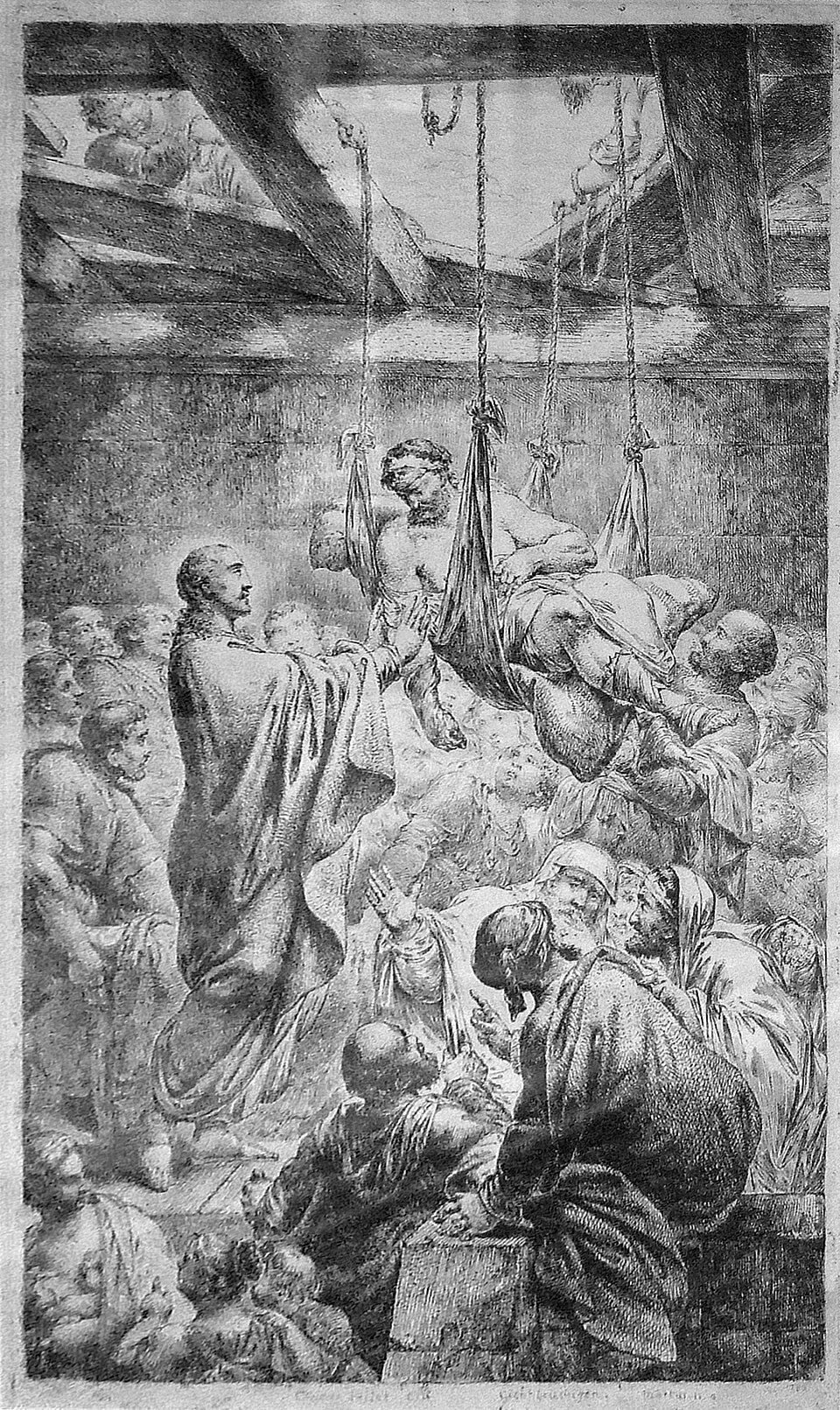
Authority on Earth (9:1–8)
The friends brought the paralyzed man to Jesus expecting healing. What they received was something much more essential.
“Take heart, my son; your sins are forgiven” (Matt 9:2, ESV).
If you were that paralytic, you might have thought: “Thanks for the forgiveness update, but that’s not exactly what I came for!” Jesus, as always, went beyond expectations and addressed the deeper issue first.
The scribes immediately recognized what Jesus was claiming. Their silent accusation was powerful: blasphemy. They knew that only God forgives sins. When someone declares sins forgiven, he is acting as if he were the one God of Israel who alone “forgives iniquity and transgression and sin” (Exod 34:7). This wasn’t a small theological debate. From their point of view, Jesus was claiming to do what only the LORD—the one God acknowledged in Israel’s daily prayers—could do, and the penalty for blasphemy was death.
Jesus didn’t back down. Instead, he posed a riddle:
“Which is easier, to say, ‘Your sins are forgiven,’ or to say, ‘Rise and walk’?” (Matt 9:5).
Then came the stunning declaration: “But that you may know that the Son of Man has authority on earth to forgive sins”—and he healed the paralytic (9:6). Anyone can claim to forgive sins invisibly. But commanding a paralyzed man to walk? That’s immediately verifiable. The physical healing authenticated the spiritual one.
Notice also what Jesus called himself: “the Son of Man.” This self-designation echoes Daniel’s vision of “one like a son of man” who comes on the clouds of heaven and receives an everlasting kingdom from the Ancient of Days (Dan 7:13-14). In Jewish understanding, coming on clouds is something only God does. Jesus was issuing a cryptic challenge: Can you discern who I really am? As the heavenly Son of Man, he possessed authority on earth to do what only God can do—forgive sins.
The crowds glorified God “who had given such authority to men” (Matt 9:8). They sensed something unprecedented but didn’t fully grasp it yet. Do we? When we come to Jesus with our immediate needs, are we willing to let him address our deepest problem first—the breach between us and God?
I’ve heard it taught that Jesus recovering sight to the blind was a fulfillment of something only the Messiah would be able to do. What are your thoughts on that issue?