

Immediately (4:18–22)
Jesus is walking beside the Sea of Galilee when he sees two brothers, Simon and Andrew, casting a net into the water. Jesus says to them, “Follow me, and I will make you fishers of men” (4:19).
Before looking at what it means to follow Jesus, it is worth pausing on the phrase “fishers of people” itself because it comes from the Old Testament. In Jeremiah, God promised to gather his scattered people back from exile, and in the middle of that promise, he says:
“Behold, I am sending for many fishers, declares the Lord, and they shall catch them” (Jer 16:16).
Christ choosing fishermen and telling them that they will become fishers of people is itself a signal that the return from exile is happening in the ministry of Jesus and his disciples. The dawn Matthew announced two verses earlier (4:16) is coming. The exile is coming to an end.
But the main point of the passage is not the allusion. It is what happens next.
“Immediately they left their nets and followed him” (4:20).
Immediately.
Then the same thing happens again. James and John are in the boat with their father Zebedee, mending nets, and Jesus calls them:
“Immediately they left the boat and their father and followed him” (4:22).
Following Jesus is not a casual commitment. Simon, Andrew, James, and John did not get a season to finish what they had started or a chance to explain themselves to the people they were leaving, at least so far as we know. The call came, and they left the world they knew, their vocation and their family, and followed Jesus.
A great deal of what passes for commitment to Jesus in the church today costs us very little, maybe no more than an hour and a half on a Sunday morning. But the call in this passage makes a claim on our lives — on our time, our money, our bodies, our gifting, our families, on the totality of what we have. We are the ones Jesus still means to make into fishers of people, and he is still sending us into the dark places of the world carrying the light that has dawned in him. That is not a small commission, and it does not come cheap. Simon and Andrew left their nets in the water. James and John left their father standing in the boat. Jesus said to follow him, and they did.
Immediately.
The Faithful Son (4:1–11)
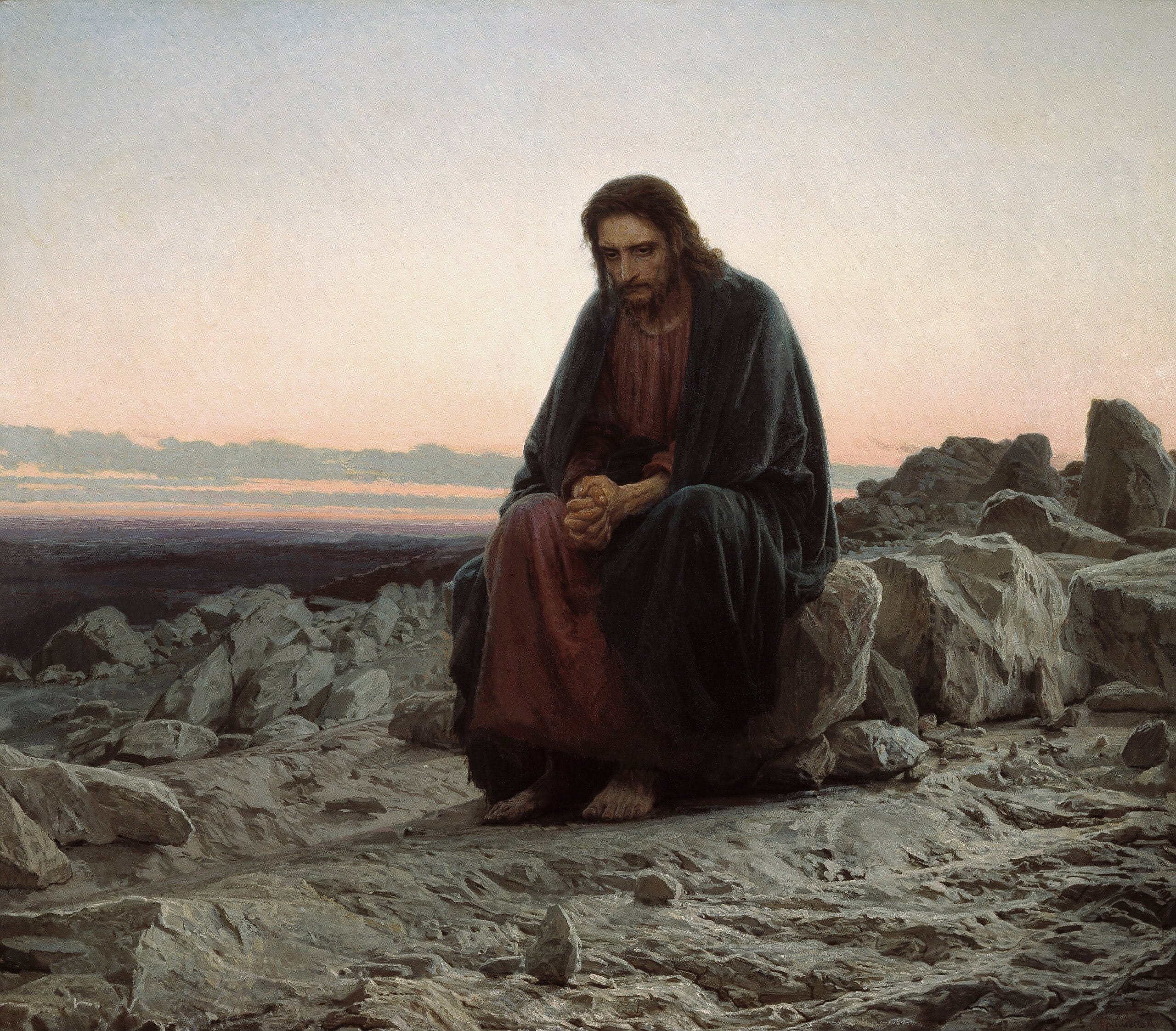
Israel’s wilderness journey is a story of repeated failure. God redeems his people from Egypt, brings them through the water, and leads them into the desert, where they repeatedly prove that they are incapable of trusting him. The wilderness narratives are a sustained account of rebellion: against his provision, against his presence, against his covenant at Sinai itself.
Matthew has been building toward this moment since chapter two, when the Holy Family heads to Egypt in fulfillment of Hos 11:1 (“Out of Egypt I called my son”). Once again, that passage is not a prophecy. Matthew’s point is that Jesus is reenacting Israel’s story, i.e., he’s filling it full.
The forty days and forty nights make this typology explicit. Israel spent forty years in the wilderness. Jesus spends forty days. To make matters even clearer, when Satan comes to him, Jesus does not reach for the Psalms, the Proverbs, or the Prophets. He quotes Deuteronomy. Every citation Jesus uses to respond to Satan comes from Deut 6–8, Moses’s great retrospective on the wilderness years. Jesus is not merely resisting temptation. He is reliving Israel’s test and succeeding where Israel failed.
The first temptation corresponds to Israel’s hunger in the wilderness. Satan tells him to turn stones into bread. Jesus answers with Deut 8:3, the passage that explains why God let Israel go hungry in the first place: “that he might make you know that man does not live by bread alone, but man lives by every word that comes from the mouth of the LORD.” The hunger was a test of trust in God’s provision. Israel failed that test repeatedly.
The second temptation corresponds to Israel’s testing of God at Massah, where the people demanded proof that God was actually present with them (Exod 17:7). The place name itself means “testing.” Satan quotes Psalm 91 and invites Jesus to throw himself from the pinnacle of the temple to see whether the angels will catch him. Jesus answers with Deut 6:16: “You shall not put the LORD your God to the test, as you tested him at Massah.” Israel demanded a sign of God’s presence. Jesus refuses to demand one.
The third temptation corresponds to Israel’s idolatry at Sinai. Satan shows Jesus all the kingdoms of the world and offers them in exchange for an act of worship. Jesus answers with Deuteronomy 6:13: “You shall worship the LORD your God and him only shall you serve.” While God was giving his Law on Sinai, Israel was constructing a golden calf at the foot of the mountain(Exod 32). The idol was Israel’s answer to the pressure of an absent God. Jesus worships the Father alone.
One further layer runs beneath all three exchanges. Satan’s taunt, “If you are the Son of God,” is not a Christological provocation in a vacuum. Exodus 4:22 names Israel as God’s firstborn son. Son of God is Israel’s title. Satan is “asking” whether this son will prove faithful, or whether he will follow the pattern of the nation before him.
He does not follow Israel’s pattern. He is faithful where Israel was faithless.
God’s solution to the problem of sin was always Israel-shaped. Now, a single faithful Israelite succeeds in the wilderness where the whole nation failed, answering every temptation with the words of Moses to the wilderness people.
The Son Israel Never Was (4:1–11)
Israel’s story and Jesus’ story run parallel in Matthew. The infant Jesus goes to Egypt and then returns (2:15), just as Israel did. He crosses the water at the Jordan (3:13–17), just as Israel crossed the Red Sea (and eventually the Jordan too). Now, the Spirit drives him into the wilderness for forty days, just as Israel spent forty years there.
Matthew wants the reader to feel the weight of that pattern.
When Satan approaches Jesus, the first temptation occurs after forty days of fasting. Jesus is hungry. The challenge is straightforward: if you are the Son of God, feed yourself. Jesus responds with Deut 8:3:
Man shall not live by bread alone, but by every word that comes from the mouth of God (Matt 4:4).
Moses spoke those words to Israel as a reflection on the manna. God allowed the people to hunger, then fed them in the wilderness, but with rules: take only enough for today, trusting that tomorrow’s supply will arrive. When the people tried to hoard, the manna spoiled. The hunger was a test. Israel failed it disastrously. At Kibroth-hattaavah, “the Grave of Cravings,” their refusal to trust God’s provision led to their death (Num 11:34). They could not wait on God's promise when their stomachs were empty.
Jesus, hungry in the wilderness as Israel was, does what Israel could not. He trusts his Father's provision rather than taking matters into his own hands.
The second temptation moves to the pinnacle of the Temple. Satan quotes Psalm 91:11–12, the promise of angelic protection, and invites Jesus to stage a spectacle. The argument is: if God has promised to protect you, prove it. Jesus answers from Deuteronomy 6:16: “You shall not put the Lord your God to the test.” The verse points back to Massah, where Israel demanded proof that God was still present in their midst (Exod 17:1–7). The people had the water from the rock, the manna from heaven, the pillar of cloud and fire, and still they pressed God for a sign. The temptation at the pinnacle is the same one Israel failed at Massah: leveraging God’s own promises to manufacture certainty rather than trusting the word already given.
The third temptation takes Jesus to a high mountain, where Satan offers all the kingdoms of the world. Daniel 7:14 already promises exactly that to the Son of Man: dominion over all peoples, nations, and languages. Satan’s offer is real in the sense that the destination is real. The shortcut is the problem. The path from the wilderness to the throne runs through Gethsemane and Golgotha, not through an act of worship rendered to the one who does not own what he is offering. Jesus answers from Deuteronomy 6:13. Israel in the wilderness traded their God for a golden calf, seizing a god they could control rather than trusting the one who had promised to bring them to the land. Jesus refuses the same exchange.
Every citation is drawn from the same block of Moses’ retrospective on Israel’s wilderness generation. Matthew is making a claim about who Jesus is. God’s solution to the problem of sin was always Israel-shaped. Israel was called to be the people through whom God would bless the world. But Israel in the wilderness was just Adam in the garden again, refusing to trust the word of God, grasping at provision and security on their own terms. The question the Old Testament leaves unanswered at its close is whether a faithful Israel will ever emerge.
Matthew 4 is the answer. Jesus is the faithful Son, the Israel God always intended, succeeding in the wilderness where the nation failed and where Adam failed before them. The kingdoms of the world will belong to him. The path there runs through the cross, not through the shortcut Satan offers.
The People who Walked in Darkness (4:12-17)
I preached on Matthew 4 this past Sunday, so I’ll try not to repeat myself. I will add a link to that sermon here when it’s posted on Substack (likely tomorrow).
We probably all know Isaiah 9:6.
For to us a child is born, to us a son is given; and the government shall be upon his shoulder, and his name shall be called Wonderful Counselor, Mighty God, Everlasting Father, Prince of Peace (Isa 9:6, ESV).
This passage is among the most well-known verses in the Bible because of its association with Christmas. But what about Isaiah 9:1-2, which Matthew quotes here in chapter four?
It’s important to note that the Gospel of Mark, which Matthew uses as a source for his Gospel, has a parallel passage (Mark 1:14-15) for this section of Matthew’s Gospel, but he does not include the quotation from Isaiah. This is methodologically significant. When Matthew takes material from Mark and adds to it, we should pay close attention. These additions aren’t random - they highlight what Matthew wants to emphasize for his audience.1
The fact that Matthew interrupts Mark’s narrative flow to include this lengthy quote from Isaiah shows he wants his readers to view Jesus’s Galilean ministry through a prophetic perspective.
Here’s the passage from Isaiah.
But there will be no gloom for her who was in anguish. In the former time he brought into contempt the land of Zebulun and the land of Naphtali, but in the latter time he has made glorious the way of the sea, the land beyond the Jordan, Galilee of the nations. The people who walked in darkness have seen a great light; those who dwelt in a land of deep darkness, on them has light shone (Isa 9:1–2).
The contempt brought on the land refers to the Assyrian conquest of the northern kingdom in the 8th century BC. Zebulun and Naphtali were among the first territories to fall when the Assyrians invaded (2 Kings 15:29), and the region became known as “Galilee” - literally “the circuit” or “district” - a provincial designation that spoke of Israel’s subjugation to foreign powers. But God promises through the prophet that a day will come when God will make that same land glorious and replace its darkness with a great light. That light has come in the person of Jesus, who is now ministering in Galilee.
By quoting this passage from Isaiah, Matthew signals, as all the Evangelists do in many ways, that Israel’s exile was coming to an end in the ministry of Jesus. The region that was first to fall to foreign conquest and first to be exiled is now the first to see the great light. He is the light that shines in the darkness (it almost sounds exactly like John), and his very presence makes the place glorious.
The light that ended Israel’s exile still shines today. We, too, can find ourselves in dark places—seasons of spiritual dryness, times when God feels absent, and periods when we feel cut off from the life God promises. Matthew’s point is that Jesus’s very presence is what transforms darkness into light. We don’t need to wait for circumstances to change or for our spiritual state to improve. The light has already come. Christ’s presence in our lives means the exile is over, the darkness is broken, and the way to God is open. The question isn’t whether the light is shining—because it is. The real question is whether we’re walking in it.
This methodology is known as redaction criticism.
I forget which theologian (Bonhoeffer?) stated that there is no cheap grace. Jesus died a humiliating, degrading, cruel, public execution. Yet so many evangelical spaces tell people to “bow your head and close your eyes” to accept Christ “into their heart.” I have always had odd feelings about how that seems to say we should be embarrassed or sheltered to make a confession of faith. I’m thankful my conversion was public and that I was taught to take following Jesus seriously and soberly. Immediately is right! When He calls, we should follow.