

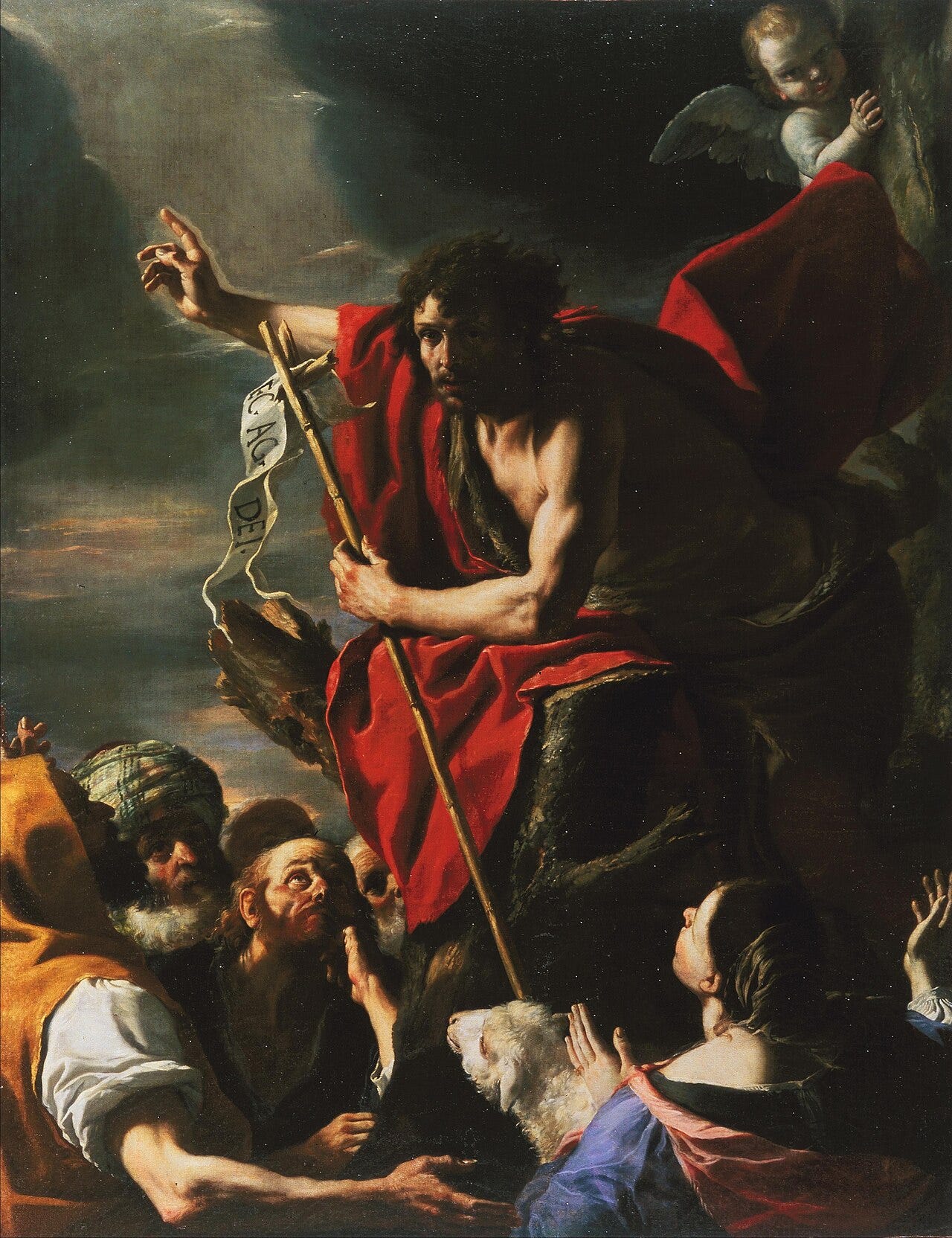
The Day That Is Coming (3:11–12)
John the Baptist tells the Pharisees and Sadducees that the axe is already laid to the root of the trees (3:10). Now he tells them whose hand is on the axe.
“I baptize you with water for repentance, but he who is coming after me is mightier than I, whose sandals I am not worthy to carry. He will baptize you with the Holy Spirit and fire (3:11).
Carrying a master’s sandals was a slave’s task, and John says he isn’t qualified even for that. But the title he uses has a history. Malachi promised a messenger who would prepare the way, followed by the arrival of the Lord himself: “the Lord whom you seek will suddenly come to his temple; and the messenger of the covenant in whom you delight, behold, he is coming” (Mal 3:1). Matthew leaves no doubt that he reads John through Malachi. Jesus later applies Mal 3:1 to John and then says outright, “he is Elijah who is to come” (11:10, 14). When John speaks of the one coming after him, he speaks as Malachi’s messenger about Malachi’s Lord.
And the next thing Malachi talks about is fire.
But who can endure the day of his coming, and who can stand when he appears? For he is like a refiner’s fire and like fullers’ soap. He will sit as a refiner and purifier of silver, and he will purify the sons of Levi and refine them like gold and silver, and they will bring offerings in righteousness to the LORD (Mal 3:2–3).
Malachi’s fire refines. It burns impurity out of silver, starting with the priests who serve at the altar. But the book closes with a consuming fire.
For behold, the day is coming, burning like an oven, when all the arrogant and all evildoers will be stubble. The day that is coming shall set them ablaze, says the LORD of hosts, so that it will leave them neither root nor branch (Mal 4:1).
John’s preaching draws on the same coming day and the same fire, and his axe at the root (3:10) answers Malachi’s “neither root nor branch.” John then turns to the threshing floor.
His winnowing fork is in his hand, and he will clear his threshing floor and gather his wheat into the barn, but the chaff he will burn with unquenchable fire” (3:12).
Malachi’s two fires have become one baptism. The coming one doesn’t bring the Spirit for some people and fire for others. He baptizes “with the Holy Spirit and fire,” and what the baptism does depends on what it falls upon. Wheat is gathered into the barn, and chaff burns. Silver comes out of the furnace pure; stubble doesn’t come out at all.
Malachi’s refining began with the sons of Levi, and John aims these words at the Pharisees and Sadducees who have come out to watch him baptize (3:7). The fire starts closest to the altar. The mistake is assuming we can have the Spirit’s presence without the Spirit’s fire. John knows of no such baptism. Jesus is the Lord Malachi promised, and the fire he brings purifies a people who will bring righteous offerings to God.
The Voice in the Wilderness (3:1–6)
Jesus’ ministry begins not with Jesus but with John the Baptist. This should not surprise us. The connection between John and Jesus is one of the most important threads running through all four Gospels, and all four link John to the same Old Testament text:
“The voice of one crying in the wilderness: ‘Prepare the way of the Lord, make his paths straight’” (Matt 3:3, quoting Isa 40:3).
We often call John the forerunner of the Messiah, which he is, but he is much more than that. John prepares the way of the Lord. In Isa 40:3, the word translated as “Lord” is the divine name. This is Yahweh himself returning, and John prepares his way. But John actually prepares the way for Jesus. Therefore, Jesus is Lord/Yahweh. This connection, developed right from Isaiah 40:3, marks the beginning of the church’s confession of who Jesus is.
What John does to prepare the way of the Lord is call people to repentance, because the long-awaited kingdom of heaven is at hand:
“Repent, for the kingdom of heaven is at hand” (3:2).
This kingdom is not a spiritual realm existing only in our hearts or beyond the clouds. The kingdom of heaven is an intensely political term, one that concerns how the present world is ordered and ruled. Matthew calls it “the kingdom of heaven” rather than naming God directly because he is following the reverent Jewish practice of substituting “heaven” for the divine name. We are probably better off hearing the term as “the kingdom from heaven,” which arrives to confront the kingdoms of this world, rather than “the kingdom of heaven,” tucked safely away up above the clouds.
Because the kingdom is political in this sense, the repentance John calls for is political and social as well as personal. The question hanging over Judah in John’s day was not only whether individuals were sorry for their sins but whether the nation had been faithful to its calling as God’s people, or had instead aligned itself with the empires of the world. That is the question John’s voice puts to us again from the wilderness. How much have we aligned ourselves with the kingdoms and empires of this world rather than with the kingdom of God, dressing our compromises in the language of pragmatism or patriotism or simply getting along?
King, Sacrifice, Servant (3:13–17)
When Jesus came up out of the water at the Jordan, the heavens opened, and a voice from heaven spoke. This heavenly voice combines three Old Testament texts into a single declaration of who Jesus truly is.
The first is Psalm 2:7. This psalm is a coronation psalm, almost certainly composed for a Davidic king’s enthronement, perhaps even Solomon. When a new son of David took the throne, the Lord declared him his royal son:
“You are my Son; today I have begotten you.” (Ps 2:7)
The voice at the Jordan echoes that declaration. A new son of David has arrived, and the Father publicly acknowledges him. Davidic sonship in this context is not primarily a claim of divinity. This language signifies a royal installation, declaring a special relationship between God and his king.
But notice that Psalm 2 says nothing about a “beloved” son. That word comes from elsewhere. The LXX of Genesis 22:2 renders the divine command to Abraham as “Take your beloved son Isaac, whom you love.” The Hebrew יָחִיד (“only/unique”) becomes ἀγαπητός in Greek, the same word used in Matthew 3:17. The baptismal voice fuses the royal language of Psalm 2 with the sacrificial weight of the binding of Isaac. The one declared to be the king at the Jordan is simultaneously the son whose death the Father will not prevent. Abraham told Isaac that the Lord would provide for himself a sacrifice, and then an angel stayed Abraham’s hand. Jesus is the sacrifice the Lord has finally provided.
The second half of the declaration draws on Isaiah 42:1:
Behold my servant, whom I uphold, my chosen, in whom my soul delights; I have put my Spirit upon him; he will bring forth justice to the nations.
The synonymous phrasing with “well pleased” makes the allusion certain, and the Spirit descending on Jesus corresponds to the Spirit placed upon the servant in that same verse. The Servant Songs do not end well. They end at Isaiah 53, where the servant is pierced for transgressions, crushed for iniquities, and bears the grief of the people.
When Jesus is baptized, the voice from heaven quotes and alludes to the OT to declare him as king, sacrifice, and servant. All three identities are combined in a single sentence, and Matthew will spend the rest of his Gospel exploring each one. The king will give his life as a ransom for many. The beloved Son will not be spared. The servant will bear the iniquities of the people to the very end, and when he is risen from the dead, he will rule as David’s son at God’s right hand as king over heaven and earth.
Do Not Presume (3:7–10)
“And do not presume to say to yourselves, ‘We have Abraham as our father,’ for I tell you, God is able from these stones to raise up children for Abraham” (Matt 3:9).
Presumption quietly destroys genuine faith.
The religious leaders standing at the Jordan weren’t bad people. They were the best people. They were the most devout, the most knowledgeable, and the most committed to God’s law. And that was precisely the problem. Their very devotion had become an obstacle to repentance.
They had Abraham as their father. They had the Temple. They had the Torah. They had centuries of tradition, daily prayers, and meticulous observance. Surely all of this mattered to God? Surely God wouldn’t judge them the same way he would judge those tax collectors and sinners?
Presumption whispers different lies to each of us. It says, “I’m already good enough.” It says, “God knows my heart.” It tells us, “I’ve been faithful for years,” or “My family has always been religious,” or “I do more than most people.” It’s not that these things are necessarily untrue. The problem is that they become shields against the Spirit’s convicting work.
But there’s another type of presumption that’s just as dangerous. We assume we know exactly what God’s Word says and precisely what God’s will is. We’ve read the Bible. We’ve studied theology. We know the answers. As a result, we stop listening. We stop asking questions. We stop being surprised by Scripture or challenged by the Spirit.
The Pharisees and Sadducees knew their Scriptures inside out. They could quote the Law and the Prophets easily. Their interpretations were well established, and their theological views were firm. But when John the Baptist appeared in the wilderness calling for repentance, they couldn’t hear him. Their confidence in what they believed God’s Word said kept them from hearing what God was really communicating through his prophet.
The danger for the religious is confusing proximity with transformation. We know the right words, sing the right songs, and perform the proper rituals. But has our knowledge about God truly led to a real relationship with God? Have our religious practices yielded the fruits of genuine repentance: humility, mercy, justice, and love?
Presumption is especially dangerous because it feels like faith. After all, isn’t confidence in God a good thing? Yes, but there’s a difference between trusting in God’s grace and relying on our religious record. There’s a difference between trusting God’s Word and assuming we’ve mastered it. One leads to gratitude and ongoing growth. The other leads to complacency and spiritual pride.
So ask yourself: What am I presuming about my relationship with God? What religious credentials do I depend on instead of truly repenting? Where have I stopped listening because I think I already know what God is saying? What would it look like today to bear fruit worthy of repentance rather than relying on yesterday’s fruit?
The kingdom is at hand. The ax is at the root. But God’s kindness is also close, prepared to turn stones into children of Abraham and to change religious people into true disciples.