

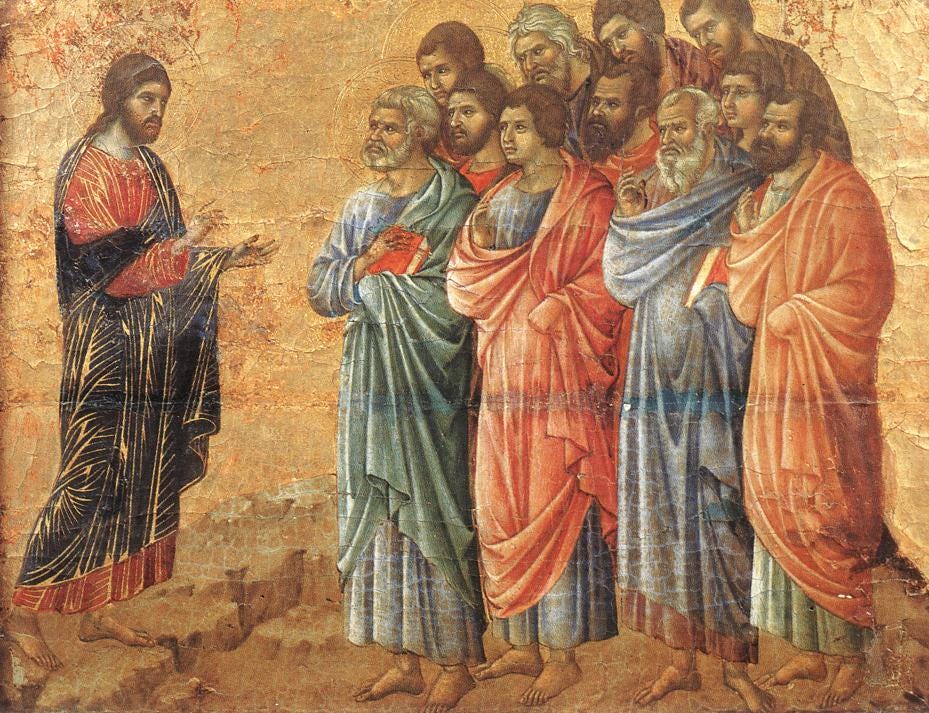
All Authority Has Been Given to Me (Feb. 21, 2026)
Matthew does not end quietly. The final scene of his Gospel takes place on a mountain in Galilee, where the risen Jesus stands before his disciples and makes a declaration that would have stopped any Jewish reader in their tracks:
“All authority in heaven and on earth has been given to me” (Matt 28:18).
Those words echo a vision from the book of Daniel, where the prophet sees “one like a son of man” approaching the Ancient of Days on the clouds of heaven:
And to him was given dominion and glory and a kingdom, that all peoples, nations, and languages should serve him; his dominion is an everlasting dominion, which shall not pass away. (Dan 7:14)
Matthew has been building toward this moment. Throughout the Gospel, Jesus refers to himself as the Son of Man — the figure Daniel saw receiving cosmic authority from God himself. Now, standing on the other side of the cross and empty tomb, Jesus declares that the vision has been fulfilled. The dominion has been given. The enthronement has occurred. What Daniel saw in a night vision, the disciples are witnessing in a Galilean morning.
This truth is crucial for understanding what comes next. The claim of authority isn’t just an introduction — it’s the basis. Since all authority has been bestowed upon him, Jesus proceeds:
Go therefore and make disciples of all nations, baptizing them in the name of the Father and of the Son and of the Holy Spirit, teaching them to observe all that I have commanded you (Matt 28:19–20a).
The “therefore” carries significant theological weight. Jesus doesn’t present the Great Commission as a hurried plea or a moral duty hanging in the air. Instead, he presents it as the result of a completed reality—mission springs from enthronement.
It also influences how we understand authority itself. Notice what Jesus does not say. He does not say all authority has been given to the Scriptures his followers will write or to the Church they will build.
Whatever authority the Bible or the Church has is real, but it is secondary — derived from Jesus, accountable to Jesus, and subject to correction by Jesus.
The Great Commission, then, is not an errand we embark on based on our own initiative. It is participation in the ongoing reign of the one to whom all authority has already been granted. We do not go because the need is urgent, although it is. We go because the King has spoken.