

Where’s the Body? (28:11–15)
While the women are still on their way to tell the disciples what they have seen, Matthew turns his attention back to the tomb they have just left. Some of the guards go into the city, not to Pilate, who assigned them, but to the chief priests, who had asked Pilate for their service in the first place (27:62–65).
The chief priests assemble with the elders and, in Matthew’s own phrase, have “taken counsel” (28:12). He has used this phrase twice before. The chief priests and elders “took counsel against Jesus to put him to death” (27:1), then handed him to Pilate. After Judas hanged himself, they “took counsel” again and bought a potter’s field with his returned silver (27:7). Now, a few verses after the resurrection, the same leaders take counsel a third time, and they use again the same tool they used on Judas two chapters earlier (26:15). Money bought Jesus’s death. Now it is spent trying to bury the fact that he did not stay dead.
The story itself has an obvious hole. Saying “His disciples came by night and stole him away while we were asleep” (28:13) requires sleeping men to testify to what happened while they were unconscious. The priests seem to know this will not hold up on its own, so they offer to bribe Pilate if needed:
“If this comes to the governor’s ears, we will satisfy him and keep you out of trouble” (28:14).
Roman soldiers who failed at their post rarely got a second chance. For example, Herod had the sentries who lost Peter put to death for exactly this kind of failure (Acts 12:19).
Matthew adds one more line, and it is an odd one for a Gospel writer to volunteer: “this story has been spread among the Jews to this day” (28:15). Matthew is aware of this objection to the resurrection, and presumably he knows some of his readers are too. The simplest thing for anyone who wanted to disprove the resurrection to do would have been to produce Jesus’ body. But they couldn’t. And when they couldn’t, they made up a story to explain why: his disciples took him even though there were armed guards at his tomb. But armed guards and a bag of money don’t change the simple truth. They couldn’t produce a body because that body had risen from the dead.
Emmanuel through the Spirit (28:20)
Matthew’s Gospel ends with a promise that creates an obvious problem. Jesus stands before his disciples on a Galilean mountain, commissions them to make disciples of all nations, and closes with this:
“And behold, I am with you always, to the end of the age.” (28:20)
Then the narrative ends.
Matthew has no account of the Ascension nor a description of the Spirit’s descent. If you knew the story of Jesus only from the Gospel of Matthew, you would have the impression that the resurrected Christ remained with his disciples on earth forever. That is, after all, what Jesus says at the end of the book.
But of course, that’s not what happened. Jesus said, “I am with you always,” and then he left.
Jesus ascended to the right hand of God, and he left his disciples behind.
That fact would be a theological problem if it weren’t for Pentecost. Pentecost is the answer to the question, “How is Christ with us always if he’s in heaven and we’re still here on earth?”
When Jesus ascended to the right hand of God, he poured out the Holy Spirit on his disciples (Acts 2:1-4). And while we rightly say that the Holy Spirit is a Person of the Trinity distinct from God the Son, we also confess (using the filioque clause) that the Spirit “proceeds from the Father and the Son.” The Holy Spirit is the Spirit of the Father, yes, but he is also the Spirit of the Son. He proceeds from both of them, and this is consistent with the witness of the New Testament.
Paul identifies the Spirit as “the Spirit of his Son” by whom we cry, “Abba, Father” (Gal 4:6). He also refers to “the Spirit of Jesus Christ” (Phil 1:19), while Luke calls him “the Spirit of Jesus” (Acts 16:7). The Spirit is the Spirit of Christ just as much as he is the Spirit of the Father.
When Jesus says, “I will be with you always” and then leaves, he doesn’t abandon us forever. Ten days after the Ascension, Jesus poured out his own Spirit on his people. This is how Christ chose to be with us always, not by remaining bodily and keeping the Spirit to himself, but by ascending to heaven and pouring out his Holy Spirit into the life of every believer.
Jesus was Emmanuel bodily. He is now Emmanuel through his Holy Spirit.
All Authority Has Been Given to Me (28:16–20)
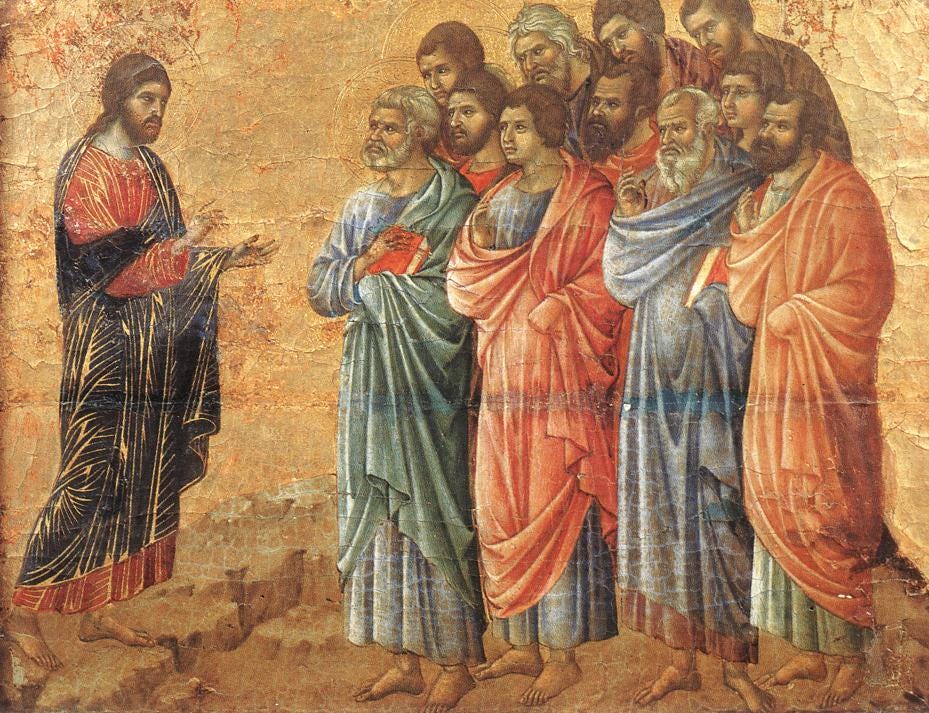
Matthew does not end quietly. The final scene of his Gospel takes place on a mountain in Galilee, where the risen Jesus stands before his disciples and makes a declaration that would have stopped any Jewish reader in their tracks:
“All authority in heaven and on earth has been given to me” (Matt 28:18).
Those words echo a vision from the book of Daniel, where the prophet sees “one like a son of man” approaching the Ancient of Days on the clouds of heaven:
And to him was given dominion and glory and a kingdom, that all peoples, nations, and languages should serve him; his dominion is an everlasting dominion, which shall not pass away. (Dan 7:14)
Matthew has been building toward this moment. Throughout the Gospel, Jesus refers to himself as the Son of Man — the figure Daniel saw receiving cosmic authority from God himself. Now, standing on the other side of the cross and empty tomb, Jesus declares that the vision has been fulfilled. The dominion has been given. The enthronement has occurred. What Daniel saw in a night vision, the disciples are witnessing in a Galilean morning.
This truth is crucial for understanding what comes next. The claim of authority isn’t just an introduction — it’s the basis. Since all authority has been bestowed upon him, Jesus proceeds:
Go therefore and make disciples of all nations, baptizing them in the name of the Father and of the Son and of the Holy Spirit, teaching them to observe all that I have commanded you (Matt 28:19–20a).
The “therefore” carries significant theological weight. Jesus doesn’t present the Great Commission as a hurried plea or a moral duty hanging in the air. Instead, he presents it as the result of a completed reality—mission springs from enthronement.
It also influences how we understand authority itself. Notice what Jesus does not say. He does not say all authority has been given to the Scriptures his followers will write or to the Church they will build.
Whatever authority the Bible or the Church has is real, but it is secondary — derived from Jesus, accountable to Jesus, and subject to correction by Jesus.
The Great Commission, then, is not an errand we undertake on our own initiative. It is participation in the ongoing reign of the one to whom all authority has already been granted. We do not go because the need is urgent, although it is. We go because the King has spoken.
In the book and movie, *The Case for Christ,* former Chicago Tribune investigative journalist concluded Christianity was true because of the resurrection! Prior to his research, he had been an avowed atheist. I think as modern-day believers, we neglect the power of the resurrection as “proof” of who Jesus claimed to be!