

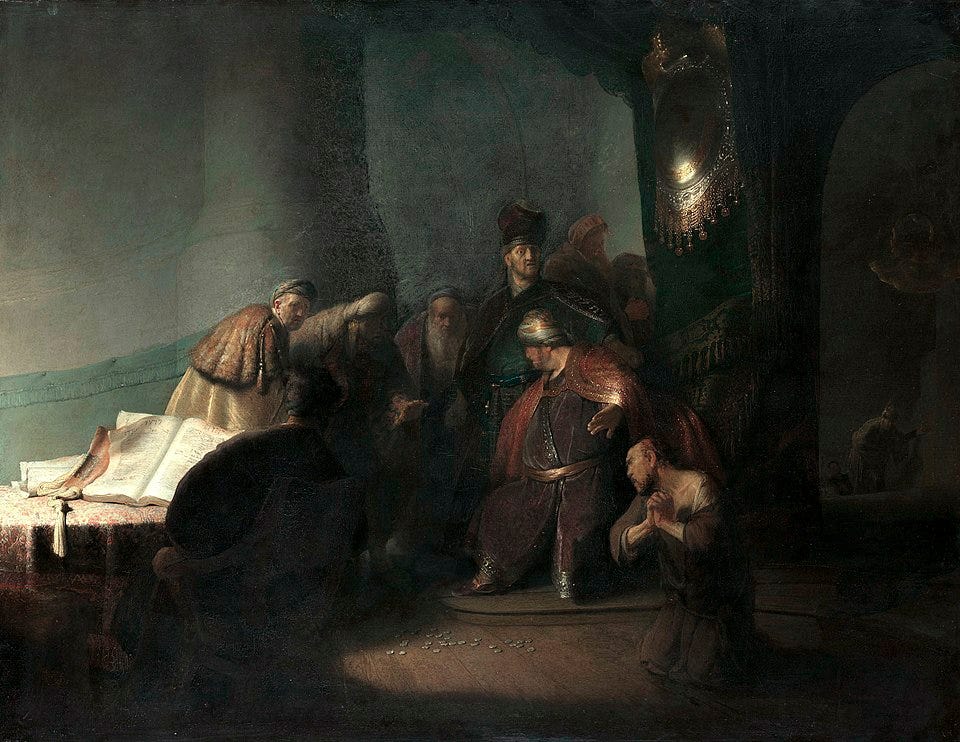
As the Lord Directed Me (27:7–10)
Judas is dead by his own hand, and the chief priests are left with thirty pieces of silver they cannot use.
“It is not lawful to put them into the treasury, since it is blood money” (27:6).
The men guarding the temple’s holy fund are scrupulous about it even now, even in the face of their own guilt. Blood money is not something you deposit; it is something you get rid of.
So they buy a field from a potter and turn it into a burial ground for foreigners (27:7). The field receives a name that outlives the transaction: “the Field of Blood,” a name Matthew says has stuck “to this day” (27:8).
Matthew says the whole transaction fulfills a word attributed to the prophet Jeremiah:
Then was fulfilled what had been spoken by the prophet Jeremiah, saying, “And they took the thirty pieces of silver, the price of him on whom a price had been set by some of the sons of Israel, and they gave them for the potter’s field, as the Lord directed me.”
However, the quotation is not found in Jeremiah. It belongs to Zechariah, where a rejected shepherd’s wages, thirty pieces of silver, are thrown into the Lord’s house, to the potter (Zech 11:12–13).
Matthew appears to have the quotation right and the prophet wrong, until you look at what actually happens in his own story: a potter, a field bought with silver, and a burial ground. Zechariah's oracle has the potter and the silver, but no field and no burial ground. Those two missing pieces come from Jeremiah: a field bought with silver weighed out in payment (Jer 32:6–9), and a valley outside Jerusalem pressed into service as a burial ground because there is no room left to bury the dead (Jer 19:6, 11). Jeremiah also gives the potter a scene of his own, at his wheel, reworking what he is making (Jer 18:2–4), which is not needed to fill a gap in Zechariah but strengthens the same association.
Matthew's field, bought with blood money and turned into a grave for outsiders, is Jeremiah's valley. Zechariah supplies the sentence Matthew quotes; Jeremiah supplies the story that sentence is quoted into. Matthew names the prophet who explains what the field became, not the one whose words he borrows.
The quotation Matthew gives them ends with the potter’s own claim that the silver was given for the field at the Lord’s direction. The priests thought they were disposing of a problem no one would trace back to them. Scripture says they were following directions they didn’t know they had received. Everything that happened during Holy Week happened because it was the Lord’s plan.
When the Graves Were Opened (27:51–53)
Ezekiel saw a valley full of bones. Dry, scattered, lifeless: Israel in exile, the covenant people cut off from their land and from their God. The vision was not primarily about individual survival after death; it was about the end of exile. “These bones are the whole house of Israel,” God tells the prophet. “They say, ‘Our bones are dried up, and our hope is lost; we are indeed cut off’” (37:11). And then Yahweh speaks:
“Behold, I will open your graves and raise you from your graves, O my people. And I will bring you into the land of Israel” (37:12).
The Septuagint is precise: “I will open your graves” (ἀνοίγω... τὰ μνήματα) and bring you up from them. Opening the graves and returning the people to the land are one and the same act. Resurrection, in Ezekiel’s vision, is the end of exile.
Matthew 27 brings that promise into sudden focus. When Jesus breathed his last, the earth shook, the rocks split, and the tombs were opened: τὰ μνημεῖα ἀνεῴχθησαν (27:52). The language and imagery are Ezekiel’s, now unfolding in Jerusalem at the foot of the cross.
Matthew is precise about the timing. The tombs opened at the moment of Jesus’s death, but “many bodies of the saints who had fallen asleep were raised, and coming out of the tombs after his resurrection they went into the holy city and appeared to many” (27:52–53). The cross opens the graves; the resurrection is the moment they emerge. Death is broken at Golgotha, but the new creation begins to move through the empty tomb three days later.
The “saints” (οἱ ἅγιοι, “the holy ones”) who appear in Jerusalem are the firstfruits of Ezekiel’s promise: faithful Israel raised, returned, walking in the city. Their appearance to “many” (ἐνεφανίσθησαν πολλοῖς) carries the vocabulary Matthew uses elsewhere for resurrection appearances. They are witnesses to what has begun.
We tend to treat resurrection as a distant promise, a consolation reserved for the future. Matthew 27 will not allow that. The bones have already been breathed into. The exile has ended. The tomb that opened at Golgotha is the fissure through which the new creation has already begun to pour. To live in Christ is to live already on the other side of that opening.
Remorse is Not Repentance (27:3–10)
Judas realized something had gone terribly wrong. When he saw that Jesus had been condemned, Matthew tells us he “changed his mind” and returned the thirty pieces of silver to the chief priests and elders, saying:
“I have sinned by betraying innocent blood” (Matt 27:4).
It’s a confession, of sorts. It’s grief, of sorts. But Matthew’s word choice reveals something important about what it is not.
The word Matthew uses for Judas’s response is μεταμέλομαι (metamelomai) — a word that means to regret, to feel remorse, to wish things had gone differently. It is not the word μετανοέω (metanoeō), which appears throughout the New Testament for genuine repentance — a turning of the whole self away from sin and toward God. Judas feels the weight of what he has done. He even speaks the truth about Jesus’s innocence. But his grief turns inward rather than outward, toward despair rather than toward the one he has betrayed.
The contrast with Peter is revealing. Peter also fails Jesus terribly in the previous chapter, denying him three times with curses and oaths (26:69–75). Matthew does not use metanoeō for Peter here either. But Peter’s story does not end in a field bought with blood money. Something in Peter reaches outward, toward grace, toward restoration — the path that metanoeō describes.
Lent is a season meant to encourage this kind of self-examination. It doesn’t ask whether we feel guilty about our sins — most of us do, at least at times. It questions whether our sorrow over sin leads us toward God or turns inward on itself. Remorse alone can become a kind of prison, a fixation on our failure that, paradoxically, keeps us focused on ourselves rather than on the one who forgives.
The difference between Judas and Peter is not the severity of their sin but the direction of their sorrow
This is excellent! Thank you for this illuminating emphasis on the difference between remorse and repentance - it speaks directly to a situation and people for whom I am praying.
In regard to Judas killing himself: do we have any idea what prompted such a drastic decision? According to Matthew’s gospel, his death occurs long before Jesus is sentenced to death by crucifixion. I’ve always puzzled over Judas’ decision to commit suicide