

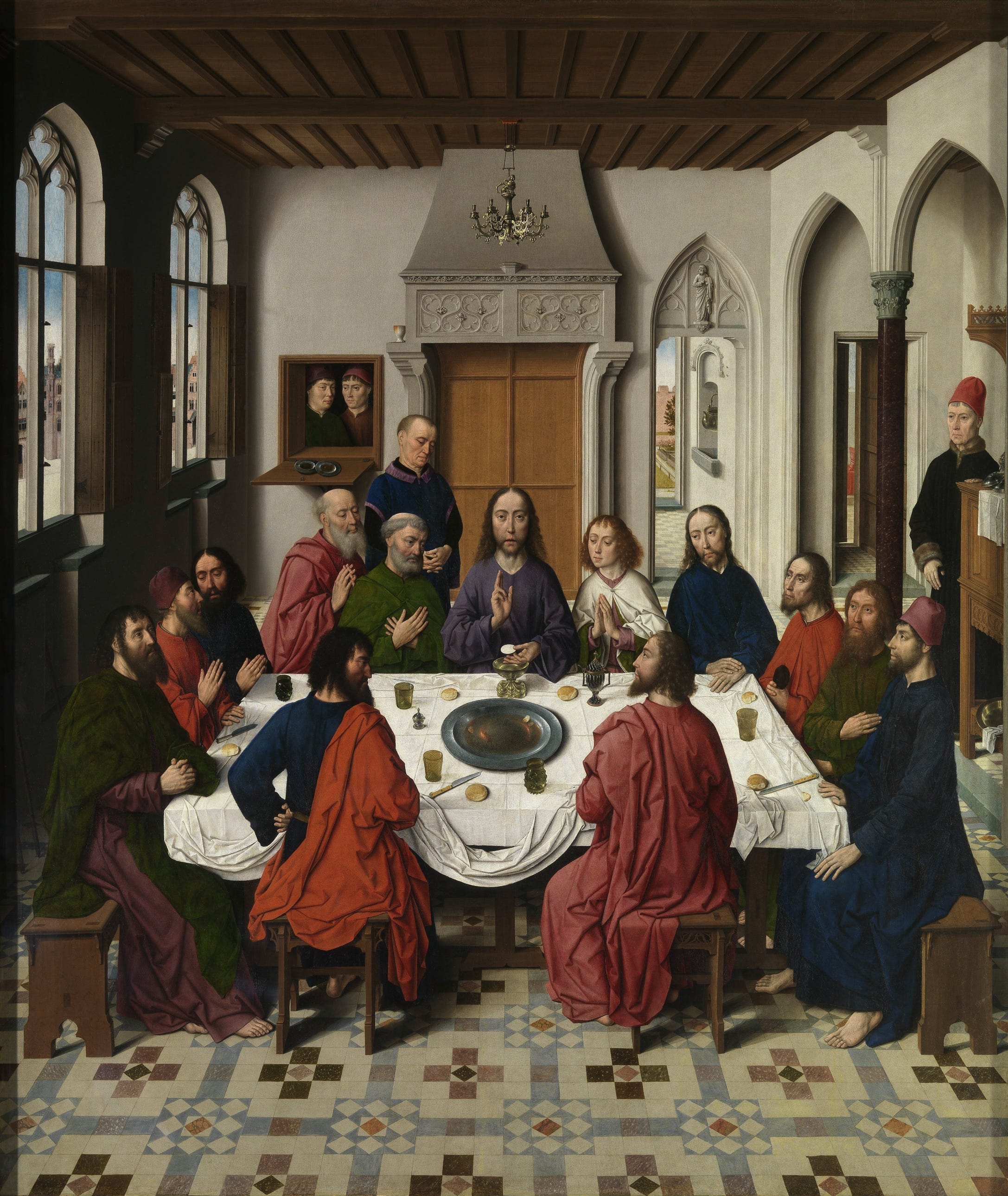
I Will Strike the Shepherd (26:31–35)
Walking toward the Mount of Olives, Jesus tells the Twelve what this night will bring.
You will all fall away because of me this night. For it is written, “I will strike the shepherd, and the sheep of the flock will be scattered” (Matt 26:31).
The quotation is from Zechariah 13:7, and Matthew’s version of it contains a significant change.
In both the Hebrew and the Greek Old Testament, the command to strike is addressed to someone else. The Lord calls out, “Awake, O sword, against my shepherd... strike the shepherd” (Zech 13:7). Here it is an order given to the sword itself, or presumably to the person bearing the sword. Jesus does not cite it this way. He quotes the passage in the first person, future tense: “I will strike.” The command once addressed to the sword becomes a declaration in the mouth of God himself. The shepherd is not struck by happenstance, by the crowd that will arrive with clubs, or even by Judas’s arrangement with the chief priests. The God who commands the sword is the one who will strike the Shepherd.
This language is that of punishment. Jesus is taking Israel’s (and the world’s) punishment on himself, and then the sheep “will be scattered.” Jesus uses the same construction for what will happen to the Twelve: “you will all fall away.” The disciples will not simply fail on their own; they will be caught up in the same action that strikes the shepherd.
Peter cannot hear this as anything but an insult to his loyalty.
“Though they all fall away because of you, I will never fall away” (Matt 26:33).
Jesus answers with a very specific prediction.
“Truly, I tell you, this very night, before the rooster crows, you will deny me three times” (26:34).
Peter insists again, and so do the rest (26:35). None of them yet understand that the coming scattering is about a lack of resolve. God will strike, and the sheep will scatter.
Jesus does not leave the Twelve with no hope. Zechariah’s oracle knew that one day the scattered flock would be regathered and once more called “my people” (Zech 13:9). So Jesus says:
But after I am raised up, I will go before you to Galilee. (v. 32)
The shepherd struck down will not stay that way forever. The same God who struck him for the sake of the whole world will raise him up, and he will gather the flock back together.
The Sword and the Servant (26:47–56)
Isaiah 53 depicts a figure who has every reason to resist but chooses not to.
“He was oppressed, and he was afflicted, yet he opened not his mouth; like a lamb that is led to the slaughter... so he opened not his mouth” (Isa 53:7).
The servant’s silence reflects not helplessness but vocation. Yahweh himself designs the servant’s journey.
“It was the will of the LORD to crush him” (53:10).
Matthew has already linked Jesus to this servant before the passion begins. At 8:17, citing Isaiah 53:4 in a direct fulfillment formula, Matthew provides his readers with the interpretive key: the servant’s surrender, when it happens, will be chosen rather than forced.
When the crowd arrives in Gethsemane with swords and clubs, the other Evangelists mention the sword, the severed ear, and a brief response from Jesus. Matthew includes all of this and goes further. Only Matthew preserves the three-part argument Jesus gives for why he does not resist, and it provides the most theologically clear statement of the passion’s logic among the four Gospels.
First:
“All who take the sword will perish by the sword” (v. 52).
Violence perpetuates itself; it solves nothing. Second:
“Do you think that I cannot appeal to my Father, and he will at once send me more than twelve legions of angels?” (v. 53).
A Roman legion numbered about 6,000 soldiers, and a single angel defeated 185,000 Assyrian troops in one night (2 Kgs 19:35). What Jesus describes is an overwhelming force, which is available but intentionally not used. Third:
“But how then should the Scriptures be fulfilled, that it must be so?” (v. 54).
The Greek δεῖ (dei, “it must”) indicates divine necessity. The servant’s journey demands his surrender.
Peter draws his sword in a fundamental misunderstanding of the servant’s vocation. When the disciples run away and Matthew records that “all this has taken place that the Scriptures of the prophets might be fulfilled” (v. 56), he is not just noting an incidental detail. He is completing the interpretive loop that started at 8:17.
The church has not stopped reaching for Peter’s sword. We reach for it whenever we imagine the kingdom advances by force, whether political, social, or physical. Jesus had the power to prevent his arrest and chose not to use it. The sword is never the way of the cross.
Promise Kept (26:26-29)
Matthew has been working toward this moment since the first chapter. When the angel announced the birth of Jesus, he declared:
“You shall call his name Jesus, for he will save his people from their sins” (Matt. 1:21).
Twenty-six chapters later, Jesus himself gathers with his disciples in an upper room, takes the cup, and says something found in no other account of the Last Supper — not in Mark, not in Luke, and not in Paul’s independent tradition in 1 Cor. 11:23–25.
“For this is my blood of the covenant, which is poured out for many for the forgiveness of sins” (Matt. 26:28).
Mark and Luke include the words of institution, but neither Evangelist adds “for the forgiveness of sins.” Neither does Paul. Matthew alone includes those four words — and they are not accidental. They close a loop that has been open since the angel’s announcement before Jesus’ birth. The name and the mission have finally converged at the table.
The name and the mission have finally converged at the table.
The phrase also carries the weight of Israel’s deepest hope. When Jeremiah described the coming new covenant, he did not end with law written on hearts or the knowledge of God spreading among the people — though he promised both. He ended with this: “For I will forgive their iniquity, and I will remember their sin no more” (Jer. 31:34). Forgiveness was the covenant’s goal. Matthew presents Jesus as the one who arrives there, and the language Jesus uses is intentionally sacrificial. Blood poured out for many echoes the Levitical offerings and the suffering servant of Isaiah 53. Forgiveness comes not despite sacrifice but through it, and here Jesus himself is both the priest and the offering (Heb. 7:27).
This scene is one of those moments where Matthew’s careful structure becomes clear to an attentive reader. The Gospel isn’t just a collection of Jesus’s teachings and miracles loosely arranged around a passion narrative. Matthew is making a case. He presents Jesus as the one who will save his people from their sins, and he makes sure the reader doesn’t forget it. At the table, on the night before the crucifixion, Jesus explains what his death achieves. The forgiveness of sins isn’t a side note to the passion — it is its main purpose.
As you approach the Lord’s Table, reflect on what it means to receive the cup that Jesus himself explained. He did not leave the meaning unclear. The blood of the covenant is poured out for the forgiveness of your sins. The promise made before his birth is kept in the upper room.