

This Generation Will Not Pass Away (Feb. 16, 2026)
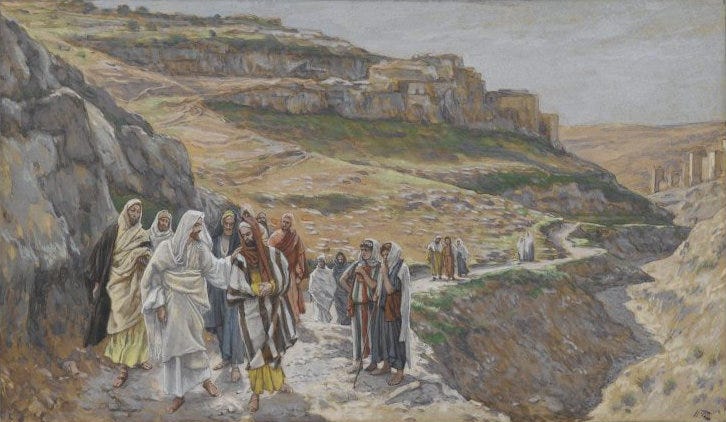
Matthew describes the disciples asking Jesus a question that reveals much more about their expectations than they realize.
“Tell us, when will these things be, and what will be the sign of your coming and of the end of the age?” (Matt 24:3).
For centuries, readers have believed the disciples were asking about two separate events: the temple’s destruction and Jesus’s distant second coming. However, this misreads their question badly, as the parallel passages in Mark and Luke show.
The Greek word translated as “coming” is parousia, which means “presence” or “arrival.” Paul uses it throughout his letters in exactly this common sense. He mentions the parousia of Stephanas, Fortunatus, and Achaicus (1 Cor 16:17). He rejoices at the parousia of Titus (2 Cor 7:6–7). He compares his bodily parousia with his letters (2 Cor 10:10). The word did not have mystical overtones. It was the standard term for someone’s arrival, especially for the visit of a royal or official personage.
The disciples weren’t asking about Jesus floating down on a cloud at the end of time. They wanted to know when he would become king in Jerusalem. They had followed him to the holy city, expecting his coronation. Now he had just predicted that not one stone of the temple would be left upon another (Matt 24:2). Their question was simple: When will you actually take power?
More importantly, they believed all these events would occur simultaneously. In Second Temple Judaism, the destruction of the temple was linked to the end of the age (note: not the end of the world). The temple was viewed as the center of the cosmos, the place where heaven and earth met. How could it fall and the age continue as it had? The disciples thought that temple destruction, Jesus’s royal installation, and the end of the current evil age were all part of the same catastrophic event.
Jesus’s answer confirms the temple’s fall within their generation:
“Truly, I say to you, this generation will not pass away until all these things take place” (Matt 24:34).
The apocalyptic imagery that follows—“the sun will be darkened, and the moon will not give its light, and the stars will fall from heaven” (Matt 24:29)—is not about the collapse of the space-time universe. This imagery is standard Old Testament language for massive political upheaval and the fall of great powers. When Isaiah and Ezekiel spoke of cosmic signs, they meant Babylon’s fall and Egypt’s defeat (Isa 13:10; Ezek 32:7–8). Jesus is using the same prophetic vocabulary. Jerusalem’s destruction will be an earth-shattering event in Israel’s story, the vindication of Jesus as the true prophet and Israel’s representative.
The disciples wanted to know when Jesus would come to power. His answer is both immediate and delayed in ways they could not imagine. The temple would fall within a generation, vindicating his prophetic ministry. But his true enthronement, his real parousia, would mean something far stranger than a military coup in Jerusalem. The question reveals how much they still had to learn about the kingdom they thought they understood.