

Let the Reader Understand (24:15–22)
Jesus has just told his disciples that the temple will fall and that not one stone will be left upon another (24:2). They then ask him for a sign (24:3). In the middle of his answer, he gives them one:
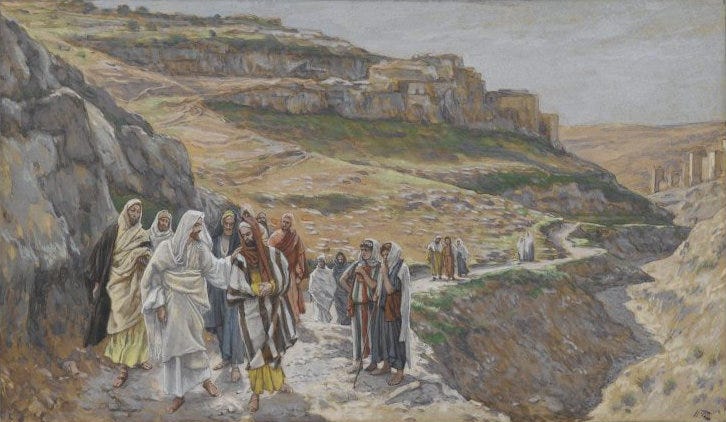
So when you see the abomination of desolation spoken of by the prophet Daniel, standing in the holy place (let the reader understand), then let those who are in Judea flee to the mountains (24:15–16).
Mark records this same warning without naming Daniel. He writes only “the abomination of desolation” and leaves the source unstated (Mark 13:14). Matthew adds the attribution himself, and the Greek is the same formula he uses elsewhere for a marked Old Testament citation: τὸ ῥηθὲν διὰ ... τοῦ προφήτου (to rhēthen dia ... tou prophētou), “that which was spoken through ... the prophet” (Matt 2:17; 3:3).
Daniel’s original context is important. The phrase τὸ βδέλυγμα τῆς ἐρημώσεως (to bdelygma tēs erēmōseōs), “the abomination of desolation” (Dan 9:27; 11:31; 12:11), described the desecration of the Jerusalem temple in 167 BC, when Antiochus Epiphanes set up a pagan altar over the altar of burnt offering and stopped the daily sacrifice. Any literate Jew in Jesus’s audience would have recognized the reference at once: temple defilement leading to national catastrophe, survived only by those who read the sign correctly and acted on it. Jesus tells his disciples that the pattern is about to repeat, and that it is again Jerusalem’s own house that stands under judgment (cf. 23:38).
There is a question of whether “let the reader understand” is an editorial aside or part of what Jesus said. If the latter, the “reader” is the reader of the book of Daniel. If the former, the “reader” could still be the reader of the book of Daniel or could refer to the reader of the Gospel. Some have theorized that those tasked with transporting and reading the Gospel aloud to the community were, at this point, to add commentary or information not included in the written text.
I tend to agree with the opinion that this is an editorial aside (although sometimes I vacillate). If so, then these words are a warning to those still living in Judea of what was to come, and, for what it’s worth, suggest an earlier date for the writing of Matthew’s Gospel than is typically assumed. The conventional dating of Matthew’s Gospel makes such a warning to Matthew’s readers basically irrelevant since the historical event has already passed by at least a decade.
What follows is concrete and unglamorous, but makes abundantly clear that this discourse is not about the end of the world but about a national catastrophe. The audience is warned to flee without going back for a coat (24:17–18) and to pray that the flight does not fall in winter or on a Sabbath, when travel would be hardest (24:20).
Verse 21 then borrows Daniel’s own language for what comes next: “great tribulation, such as has not been from the beginning of the world until now, no, and never will be,” echoing Daniel 12:1’s “time of trouble, such as never has been since there was a nation.” Jesus takes the vocabulary of Israel’s worst national catastrophe and applies it not to the end of the world but to the end of the temple standing in front of him.
Much bad eschatology has developed from reading this chapter and its parallels apart from their historical context and without due attention to the Old Testament language from which Jesus is borrowing. Fleeing to the mountains won’t help anyone escape the end of the space-time universe. But it would help someone escape the destruction of a city, and that’s exactly what Jesus is predicting throughout this chapter.
The Coming of the Son of Man (24:30)
The source of Jesus’s language in Matthew 24:30 is the night vision in Daniel 7. Four beasts emerge from the sea; four empires have oppressed God's people. Then the scene shifts:
“I saw in the night visions, and behold, with the clouds of heaven there came one like a son of man, and he came to the Ancient of Days and was presented before him” (Dan 7:13).
The direction of the movement matters. In Daniel, the one like a son of man does not descend to earth; he ascends to the divine throne room. The movement is upward, and the outcome is enthronement: dominion, glory, and an everlasting kingdom are given to him before the Ancient of Days (7:14). When the angel interprets the vision (7:26–27), the transfer of power is complete: the fourth beast is destroyed, and the kingdom passes to the people of the Most High.
Matthew 24:30 places Jesus squarely inside this vision:
“Then will appear in heaven the sign of the Son of Man, and then all the tribes of the earth will mourn, and they will see the Son of Man coming on the clouds of heaven with power and great glory” (Matt 24:30).
The Danielic background makes it clear that the coming of the Son of Man does not depict Jesus descending through the sky. The sign appears in heaven because it symbolizes a heavenly event: the condemned prophet's vindication before God’s own tribunal. The phrase “coming on the clouds” is Daniel’s way of describing the transfer of dominion from the empire to the Son of Man, and Jesus uses it in the same way.
But who is the “they” who will see? Matthew’s passion narrative provides the audience. At his trial, Jesus directly tells the high priest:
“From now on you will see the Son of Man seated at the right hand of Power and coming on the clouds of heaven” (Matt 26:64).
Jesus here conflates Daniel 7:13 with Psalm 110:1 (”Sit at my right hand, until I make your enemies your footstool”). The Psalm sits at the center of the argument, and its logic governs the entire passage: the coming of the Son of Man is the act by which God puts Jesus’s enemies under his feet. The “they” who will see the Son of Man coming in 24:30 are not the disciples; they are those who condemned Jesus, like the high priest.
The mourning that follows in 24:30 echoes Zechariah 12:10–12, where the tribes of the land mourn when they look on the one they have pierced. That is not the mourning of those awaiting rescue. It is the recognition of the guilty.
Matthew 24:30 is not, despite the numerous claims to the contrary, but about the second coming. It is about a heavenly verdict rendered in space and time within the generation standing before him.
This Generation Will Not Pass Away (ch. 24)
Matthew describes the disciples asking Jesus a question that reveals much more about their expectations than they realize.
“Tell us, when will these things be, and what will be the sign of your coming and of the end of the age?” (Matt 24:3).
For centuries, readers have believed the disciples were asking about two separate events: the temple’s destruction and Jesus’s distant second coming. However, this misreads their question badly, as the parallel passages in Mark and Luke show.
The Greek word translated as “coming” is parousia, which means “presence” or “arrival.” Paul uses it throughout his letters in exactly this common sense. He mentions the parousia of Stephanas, Fortunatus, and Achaicus (1 Cor 16:17). He rejoices at the parousia of Titus (2 Cor 7:6–7). He compares his bodily parousia with his letters (2 Cor 10:10). The word did not have mystical overtones. It was the standard term for someone’s arrival, especially for the visit of a royal or official personage.
The disciples weren’t asking about Jesus floating down on a cloud at the end of time. They wanted to know when he would become king in Jerusalem. They had followed him to the holy city, expecting his coronation. Now he had just predicted that not one stone of the temple would be left upon another (Matt 24:2). Their question was simple: When will you actually take power?
More importantly, they believed all these events would occur simultaneously. In Second Temple Judaism, the destruction of the temple was linked to the end of the age (note: not the end of the world). The temple was viewed as the center of the cosmos, the place where heaven and earth met. How could it fall and the age continue as it had? The disciples thought that temple destruction, Jesus’s royal installation, and the end of the current evil age were all part of the same catastrophic event.
Jesus’s answer confirms the temple’s fall within their generation:
“Truly, I say to you, this generation will not pass away until all these things take place” (Matt 24:34).
The apocalyptic imagery that follows—“the sun will be darkened, and the moon will not give its light, and the stars will fall from heaven” (Matt 24:29)—is not about the collapse of the space-time universe. This imagery is standard Old Testament language for massive political upheaval and the fall of great powers. When Isaiah and Ezekiel spoke of cosmic signs, they meant Babylon’s fall and Egypt’s defeat (Isa 13:10; Ezek 32:7–8). Jesus is using the same prophetic vocabulary. Jerusalem’s destruction will be an earth-shattering event in Israel’s story, the vindication of Jesus as the true prophet and Israel’s representative.
The disciples wanted to know when Jesus would come to power. His answer is both immediate and delayed in ways they could not imagine. The temple would fall within a generation, vindicating his prophetic ministry. But his true enthronement, his real parousia, would mean something far stranger than a military coup in Jerusalem. The question reveals how much they still had to learn about the kingdom they thought they understood.
I have spent the bulk of my Christian life in evangelical spaces where the books and subsequent movies (Left Behind) series have interpreted so much of what Jesus said, and the book of Revelation, as “end-time” prophecy in the coming of Jesus, the rapture of believers, a thousand-year reign of Christ resulting in??? Honestly I’m not sure I know what has been taught happens after that.
Where would one go to learn how these doctrines developed (my understanding is these are relatively new ideas in the history of Christianity and were not taught in most of church history)?