

The Fig Tree & This Mountain (21:18–22)
Mark spreads the fig tree scene over two mornings, with the temple action sandwiched between the cursing and the discovery of the withered tree the next day (Mark 11:12–14, 20–21). Matthew collapses the whole incident into a single moment: the tree withers “at once” while Jesus is still standing there (21:19–20), and the whole scene follows immediately after the cleaning of the temple (21:12–17).
It’s important to understand the geography. Jesus is walking from Bethany, and the path carries him back across the Mount of Olives and down into the city with the temple mount rising across the valley the whole way.
When Jesus tells the disciples that faith could say to “this mountain, ‘Be taken up and thrown into the sea’” (21:21), the demonstrative is critical. “This mountain” points at something specific and in view, not a generic illustration about any regular mountain. The nearest mountain (and the one Jesus has just finished pronouncing judgment on) is the temple mount itself.
Israel’s poetry had already described that mountain in cosmic terms. The earth is founded “upon the seas” and established “upon the rivers” (Ps 24:2), and Zion, “beautiful in elevation,” is the fixed point of that founding, “the city of the great King” (Ps 48:2). Solomon’s temple had made this literal in bronze: the great basin standing in its court was called simply “the sea” (1 Kgs 7:23), a working model of the chaos that had been subdued at creation and which the temple now held in check. For that mountain to be uprooted and hurled back into the sea it was raised from is to undo the very act that gave Zion its footing. Jesus is describing dry ground pulled out of the chaotic water now being hurled back into them by the disciples’ faith.
The fig tree and the mountain are one verdict rendered twice, once as enacted parable and once as an expression of faith. Faith here is not a technique for producing whatever the disciples happen to want but trust that the judgment Jesus has already begun is not too large a thing for God to finish. The promise that follows, “whatever you ask in prayer, believing, you will receive” (21:22), describes prayer that has caught up with what God is actually doing rather than asking him to do something else.
In the Temple (21:12–17)
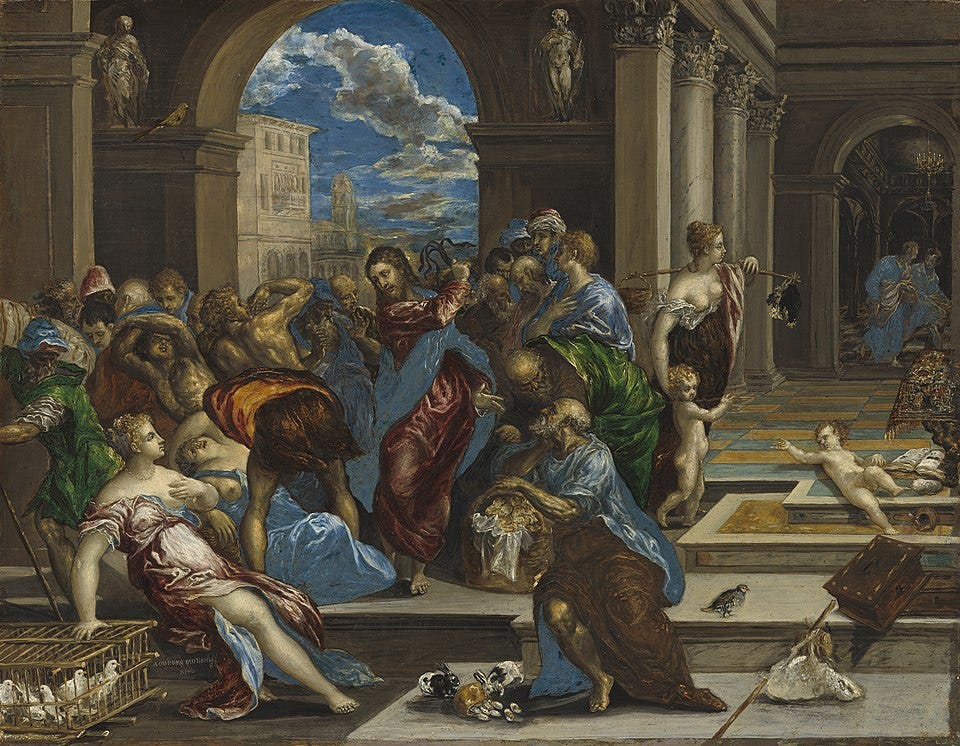
When Jesus enters the temple, it’s a divine act. Israel’s God has arrived at his temple, and he is executing his judgment. The buyers and sellers are driven out, the money changers’ tables are overturned, and the dove sellers’ seats are knocked over.
His verdict on what the temple has become draws from two prophets. Isaiah said that the temple should be “a house of prayer” (Isa 56:7); Jeremiah warned that it had become “a den of robbers” (Jer 7:11), meaning a hiding place for those exploiting the vulnerable before retreating into religious routine. Together, the two quotations form a single criticism: the temple exists to encounter God, but it has become a place of escape into empty religious ceremony instead.
What follows after this moment is unique to Matthew. Mark and Luke move directly from the cleansing to the confrontation with the religious leaders. Matthew inserts something neither of them records:
“And the blind and the lame came to him in the temple, and he healed them” (21:14).
Earlier in the Gospel, when John the Baptist sent from prison asking whether Jesus was the one to come, Jesus answered by pointing to what was happening: the blind are receiving their sight, the lame are walking (11:5). These were echoes of Isaiah’s new-exodus hope (Isa 35:5–6). Now those healings move into the temple itself, and they happen not because the temple is functioning properly (he has made sure it isn’t) but because the true temple was there in person.
The children see what’s happening, and they begin crying, “Hosanna to the Son of David. But the chief priests and scribes are indignant:
“Do you hear what these are saying?” (21:16).
Jesus does not quiet the children. He asks whether the leaders have ever read Psalm 8.
The Hebrew of Psalm 8:2 says that from the mouths of infants and nursing babies God has established ʿōz (strength) “because of your foes, to still the enemy and the avenger.” The LXX renders ʿōz not as strength but as αἶνον (ainon), “praise.” Matthew quotes the Greek:
“Out of the mouth of infants and nursing babies you have prepared praise” (21:16).
The praise that silences God’s enemies doesn’t come from those with credentials. It comes from the mouths of the vulnerable. In Psalm 8, the “foes” who are silenced by this praise are those opposing what God is doing. Jesus directs this psalm at leaders who are, at that moment, doing just that. They have just witnessed the blind and lame healed in the temple. They have seen that the New Exodus is finally happening. But their main concern is whether Jesus deserves the praise he is getting. The psalm answers that question and reveals their position.
We reproduce this failure more easily than we might think. The temptation isn’t always to deny what God is doing; sometimes it’s to be outraged that the credit is going to someone we didn’t authorize or someone outside our camp. These leaders wanted to control the temple and the people’s holiness, but something they couldn’t control or did not sanction was happening right in front of them. By week’s end, they would try to take permanent control by silencing Jesus for good. For now, God’s praise was being spoken by the vulnerable, and no outrage from the powerful could silence it.
Palm Sunday and Psalm 118 (21:1–11)
When Jesus enters Jerusalem, the crowds lay their cloaks on the road and cut branches from the trees. What they shout is (in part) directly from Psalm 118:
“Hosanna to the Son of David! Blessed is he who comes in the name of the Lord! Hosanna in the highest!” (Matt. 21:9, quoting Ps 118:26).
The crowds are not improvising. Psalm 118 was the final psalm of the Egyptian Hallel (Pss 113–118), the sequence of psalms sung at the Passover seder.1 As Jesus entered Jerusalem in the days before Passover, every Jewish pilgrim who had ever celebrated the feast would have recognized these words. The question the crowds are answering, perhaps without fully realizing it, is who is the one for whom these songs have always been waiting.
But notice what they add. They call Jesus “Son of David.” To hail David’s Son in the first century was not an act of gentle piety. It carries the weight of the Davidic warrior tradition, the hope for a king who would defeat their enemies and restore Israel’s sovereignty. The crowd wants a conqueror riding into Jerusalem. What they get instead is the fulfillment of Zech. 9:9: a king who is “humble” (πραΰς), riding a donkey, a figure the prophet explicitly links with peace rather than war. The crowds are singing the right psalm about the wrong kind of king, at least from their point of view.
“Hosanna” captures this exactly. When the crowd shouts “Hosanna” (ὡσαννά), they are quoting Ps. 118:25 directly, transliterating the Hebrew הוֹשִׁיעָה נָּא, meaning “Save us, we pray.” The crowds intended it as a plea for military rescue, the kind Israel had longed for under Roman rule. Jesus accepts the cry but will spend the rest of the week reinterpreting what salvation truly means.
The crowds shout, “Hosanna to the Son of David!”, meaning one thing. Jesus enters Jerusalem with a completely different purpose. This contrast will carry through all of Holy Week.
The Way of Righteousness (21:28–32)
Matthew 21:28–32
Just before Jesus shares the parable of the two sons, the chief priests and elders confront him in the temple with a pointed question.
“By what authority are you doing these things, and who gave you this authority?” (Matt. 21:23).
Jesus avoids giving a direct answer, but he doesn’t leave them without a response. The parable of the two sons is his reply and is unique to the Gospel of Matthew.
The parable is simple. A father asks his two sons to work in the vineyard. One agrees but doesn’t go. The other says no, but later changes his mind and goes. When Jesus asks which son did the father’s will, the religious leaders correctly answer: the second son. But then comes Jesus’s explanation, and this is where most people miss the point.
Jesus says:
“Truly, I say to you, the tax collectors and the prostitutes go into the kingdom of God before you. For John came to you in the way of righteousness, and you did not believe him, but the tax collectors and the prostitutes believed him. And even when you saw it, you did not afterward change your minds and believe him” (Matt. 21:31–32).
The key phrase here is “the way of righteousness” (ἐν ὁδῷ δικαιοσύνης). This phrase is not just a nice way of talking about living a moral life. As N. T. Wright has shown, dikaiosynē in biblical thought often refers to God’s covenant faithfulness—his righteousness in the sense of God acting to set things right and fulfill his promises to Israel. John the Baptist came “in the way of righteousness,” meaning he announced that God was now acting to restore his people and fulfill his covenant promises.
When the tax collectors and prostitutes heard John’s preaching, they recognized that God was at work fulfilling his promises. They saw that God’s saving justice was breaking into the world, and they responded with repentance. When the religious leaders heard John, they missed it entirely. These were the very people who were supposed to be custodians of Israel’s hope for God’s covenant faithfulness. Yet, they could not recognize it when God was actually delivering on it.
This parable is Jesus’s response to the authority question. The same covenant faithfulness of God that validated John the Baptist’s ministry also validates Jesus’s ministry. Those who saw God’s saving work in John naturally saw it in Jesus too. The religious leaders, who agreed with God’s covenant promises through their religious practices but rejected John’s call to repentance, showed they could not see God’s righteousness when it was right before their eyes.
Matthew shares this parable to help his readers grasp an essential point. The key question isn’t whether we verbally agree to God’s covenant promises but whether we recognize when God is actively fulfilling them. When God’s saving justice enters the world, do we notice it? Or, like the first son and the religious leaders, do we say yes with our words while remaining blind to what God is truly doing?
For the curious, these six Psalms are called the Egyptian Hallel Psalms because Ps 114 describes the exodus from Egypt.
I have so so much I’m thinking about in relation to Jesus’ entry into Jerusalem and how it seems a similar nationalism/militarism has taken root among some believers. They resemble the zealots of Jesus’ day — hoping for a Savior who will “give it” to all they perceive as enemies or persecutors. I’ve actually heard a woman say she was being “persecuted” for her beliefs because her job expected her to follow DEI guidelines! That’s not persecution; it’s living in “Rome,” if that makes sense. I feel the push for Christian nationalism is similar to what we see here in Jesus’ day — the hope for a nation ruled by God. While that is admirable, at some level, that isn’t God’s call in our lives. WE are to be salt and light — penetrating the darkness with His love that draws people in. I’m saddened that so many people of whom I used to worship with, have taken on this mantel of nationalism.
Of wanting a Savior who fights cultural battles, rather than submitting to a crucified Lord who calls us to follow in his steps.
The section on the fig tree and “this” mountain is so helpful in uncovering and finally making sense of certain actions and words of Jesus with which I have long wrestled. Thank you for sharing this.
Oh Father, tune our hearts to you so that our intercession may be “prayer that has caught up with what [You] are actually doing rather than asking [you] to do something else.”