

Down the Mountain (17:14–20)
“Lord, have mercy on my son, for he has seizures and he suffers terribly. For often he falls into the fire, and often into the water” (17:15).
The man kneeling before Jesus does not offer a theory about his son’s condition. He only cares that his son is suffering.
Jesus’s answer is sharper than one might expect:
“O faithless and twisted generation, how long am I to be with you? How long am I to bear with you?” (17:17).
The rebuke does not fall on the father, who has done nothing but ask for mercy. It falls on the present “generation” of the people of God, those to whom John was sent to prepare the way and to whom the Lord has now come in the person of Jesus.
In the Song of Moses, Israel is called “a crooked and twisted generation,” γενεὰ σκολιὰ καὶ διεστραμμένη (genea skolia kai diestrammenē; Deut 32:5 LXX), a people who had seen the exodus and Sinai and still would not trust the God who delivered them. Jesus keeps Moses’s γενεὰ and διεστραμμένη and trades σκολιά, “crooked,” for ἄπιστος (apistos), “faithless.” It is Israel’s unbelief that Jesus names here.
Matthew has already told us where Jesus is standing when he says this. “As they were coming down the mountain” is how the chapter resumes after the transfiguration (17:9), and Jesus is still descending when he meets this crowd (17:14). Moses came down from Sinai with the tablets and found Israel worshiping a calf (Exod 32:15–20). Jesus comes down from a mountain where he has just been revealed in glory, with Moses and Elijah standing beside him, and finds a boy still convulsing and disciples who could not help him.
The transfiguration was certainly an incredible event, but it would be a mistake to think that that’s what Jesus means by “the kingdom of God.” The kingdom Jesus announces is found first and foremost not on the peak of the mountain but much farther down the mountain, where people are still suffering, and a father is still crying out for mercy.
Jesus rebukes the demon, and the boy is healed at once (17:18). When the disciples ask privately why they could not do it, Jesus does not hand them a technique. He hands them a diagnosis: “Because of your little faith,” ὀλιγοπιστία (oligopistia), the noun form of a word Matthew has already used for Peter's sinking in the water and for the disciples' panic in a storm (8:26; 14:31).
We are drawn to the mountain. We want the retreat, the unusually moving service, and the powerful time of private prayer to be the whole of the Christian life. Like Peter, we want to stay in those moments (17:4). But the Gospel does not let anyone stay. Jesus doesn’t stay on the mountain. He makes his way down the slope to a suffering child because that is where the kingdom is doing its work, and he asks us to keep moving down with him. Our unbelief, like Israel’s in the wilderness and the disciples’ at the foot of this mountain, is not for lack of having seen something real; it is a reluctance to leave the mountain for the place where spiritual, physical, social, and economic release is still desperately needed.
Listen to Him (17:1–8)
Matthew 17 begins with the words“And after six days” (17:1). In Exodus 24, the cloud of God covered Sinai for six days before the divine voice called to Moses on the seventh (Exod 24:16). The mention of the number of days here at the beginning of the chapter is an intentional allusion to Sinai.
In this new Sinai event, Jesus takes Peter, James, and John up a high mountain, and there he is transfigured before them. His face shines like the sun, and his clothes become white as light. Moses and Elijah appear with Jesus.
Peter’s impulse is to build three booths, one for each of them. The word Matthew uses for ‘booths’ is σκηνάς, which is the same word the Greek Old Testament uses for the tabernacle, the tent of God’s dwelling. Peter wants to enshrine the moment. He does not yet understand what the moment means.
A bright cloud, the visible presence of God, overshadows them, and from within the cloud comes a voice:
“This is my beloved Son, with whom I am well pleased; listen to him” (17:5).
The first part of the declaration echoes the baptism (Matt 3:17). The last three words reach even further back. In Deuteronomy 18, as Moses prepared Israel to enter the land without him, he promised that God would raise up another prophet like himself, and he gave Israel a single instruction about that prophet: “it is to him you shall listen” (Deut 18:15). Moses added that this prophet would speak everything God commands, and whoever refused to hear him would be held accountable (18:18–19). Israel’s task, after Moses, was to recognize this figure when he came.
The voice from the cloud is performing that identification. The disciples fall on their faces, terrified. When they look up, they see no one but Jesus only. Moses and Elijah, the Law and the Prophets, have served their purpose and withdrawn. The one they pointed to stands alone on the mountain. The time of listening to the Law and the Prophets as the ultimate authority has come to an end. Now that authority rests on Jesus.
That’s why Walking with Jesus exists: to help us listen to Jesus.
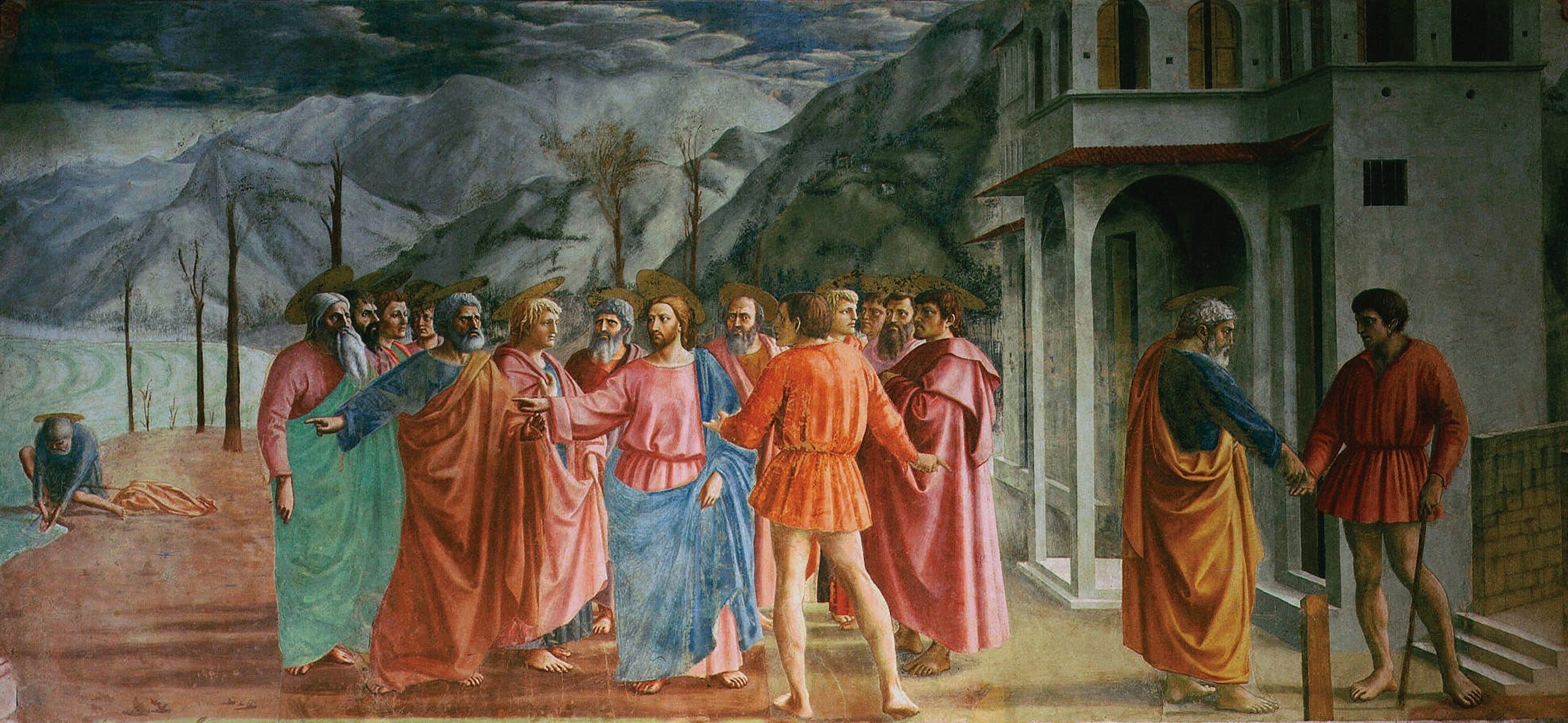
The Son and the Temple Tax (17:24–27)
The unusual story in Matthew 17:24-27, found only in Matthew’s Gospel, reveals something important about Jesus’s identity. The tax mentioned is not a Roman civil tax but the yearly half-shekel temple tax that all Jewish males paid to support the upkeep and operations of the Jerusalem temple. This religious duty traces back to Exodus 30:11-16, where God commanded a census tax to support the tabernacle. By the first century, collectors gathered this tax across the Jewish world to pay for temple repairs, sacrificial supplies, and the daily functions of Israel’s main place of worship.
Jesus’s reasoning is powerful. Kings don’t tax their own sons; they tax others. If the temple is God’s house, and Jesus is God’s Son, then he doesn’t need to pay to support his Father’s house. Jesus makes a striking claim to divine sonship, spoken quietly during a personal conversation with Peter. He is claiming his special connection to the God of the temple and his authority over the very institution that shapes Jewish religious life.
Yet Jesus chooses to pay the tax anyway. He exercises his freedom by limiting it, refusing to cause offense even when he has every right to cling to his privilege. Jesus demonstrates pastoral wisdom worth reflecting on. There are times when insisting on our rights does more harm than good, and when accommodation serves the gospel better than assertion. Jesus models a kind of freedom that is expressed not in defiance but in voluntary submission for the sake of others.
The payment method is also important. Jesus doesn’t just reach into a purse. Instead, he tells Peter to go fishing and promises a miraculous coin in the first fish’s mouth. The amount is precisely right—one stater, worth four drachmas—enough for both of them. This miracle demonstrates Jesus’s authority over creation while exemplifying an act of humble obedience. God provides for obedience, even when that obedience is voluntary in nature.
The short story reveals something fundamental about Jesus. He is the Son with authority over the temple itself, yet he submits to its rules. He is free, but he chooses humility and service instead of confrontation. The King pays taxes in his own kingdom, and he does so through a miracle that hints at his true identity to those who have ears to hear.
You answered one of my burning questions — why the mention of “after six days.” I think being Gentiles, we often miss the references to Israel’s history but Jews of Jesus’ day certainly wouldn’t have!
So my second burning question is: without photos or paintings, how did the disciples recognize Moses and Elijah?