

Their Heart is Far from Me (15:1–20)
Pharisees and scribes from Jerusalem confront Jesus because his disciples eat without washing their hands, a tradition required by the elders (15:1–2). Jesus turns the accusation back on them. Forget violating the tradition of the elders. They’re violating the commandment of God by allowing a son to declare his assets given to God, which would allow him to enjoy his wealth while releasing him from supporting his parents. His verdict is blunt:
So for the sake of your tradition you have made void the word of God (15:6).
He then calls them hypocrites and quotes Isaiah:
This people honors me with their lips, but their heart is far from me; in vain do they worship me, teaching as doctrines the commandments of men (15:7–9, citing Isa 29:13).
The Greek of verse eight, “with the lips they honor me, follows the Septuagint rather than the Hebrew. The Hebrew calls Israel’s worship a commandment of men, learned by rote, a note on its origin. The Greek translation of verse nine renders a verdict on their worship: μάτην δὲ σέβονταί με (matēn de sebontai me), “in vain do they worship me.”
Isaiah is condemning hollow religion, and Jesus applies that judgment to the men before him.
Jesus then turns to the crowd and tells them that it is not what goes into the mouth that defiles a person, but what comes out of it (15:11). Jesus tells a parable to explain, and when Peter asks about the meaning of the parable, Jesus is explicit.
Whatever goes into the mouth passes into the stomach and is expelled, but what comes out of the mouth proceeds from the heart, and this defiles a person. For out of the heart come evil thoughts, murder, adultery, sexual immorality, theft, false witness, slander (15:17–19).
Notice that Jesus isn’t as concerned with the form of something (how we worship, what we eat, etc.) but with what’s going on in the heart. The “best” worship can be a vain exercise. Focusing on what goes into the body more than on what comes out of it is an external focus rather than an internal one. But Jesus isn’t primarily concerned with how well you worship or how carefully you maintain the right perspective on external matters. His first concern is what’s going on inside your heart, and dealing with our heart is (unfortunately) a far more difficult task than dealing with anything external.
The God of Israel (15:29–31)
Isaiah 35 is one of the most focused eschatological passages in the Hebrew Bible. The oracle begins with a vision of the desert blooming (35:1–2), declares Yahweh’s coming to save (35:4), and lists the signs that will mark that arrival.
“Then the eyes of the blind shall be opened, and the ears of the deaf unstopped; then shall the lame man leap like a deer, and the tongue of the mute sing for joy” (Isa 35:5–6).
The chapter ends with a highway through the wilderness on which the redeemed of Yahweh return to Zion (35:8–10). Isaiah 35 is paired with chapter 34, which is an oracle against the nations: judgment first, then the renewal of creation. The healings in 35:5–6 serve as eschatological signs, indicating that the new exodus has begun. These are physical healings because the new exodus is an embodied event, not just a spiritual abstraction.
Matthew 15:29–31 does not have a direct parallel. Mark 7:31–37 describes a single healing of a deaf-mute. Instead, Matthew offers a summary of healings involving the blind, lame, crippled, and mute, which closely echo Isaiah 35:5–6. Matthew isn’t describing a specific miracle; he’s summarizing themes from Isaiah’s language, applying the new-exodus imagery to what Jesus is doing.
Jesus goes up on the mountain and sits, adopting the posture of the authoritative teacher from chapter 5, as the crowds gather, laying the sick at his feet. The list includes: lame, blind, crippled, mute, and many others. Every category appears in Isaiah 35. Matthew is demonstrating the Isaiah program in progress.
The most exegetically significant phrase is the crowd’s response: “they glorified the God of Israel” (15:31). A Jewish crowd would typically say “God” or “the LORD.” The phrase “the God of Israel” refers to those for whom Israel’s God is just one deity among others (meaning Gentiles; cf. 1 Sam 5:7–11; 6:3; Ezra 1:3). The geographical context supports this: after the encounter with the Canaanite woman, Jesus is operating in Gentile territory. The witnesses in this Isaiah 35 scene are not Israel; they are the nations, responding with exactly the worship that Isaiah’s vision anticipates.
The contrast in this chapter is striking. Earlier, Pharisees from Jerusalem have come to challenge tradition, and Jesus’ own disciples needed a private explanation of what he meant (15:1–20). The crowds in 15:29–31 ask nothing, debate nothing, and demand nothing. They bring the broken to Jesus’ feet and praise the God of Israel when they see what he does.
A Place at the Table (15:21–28)
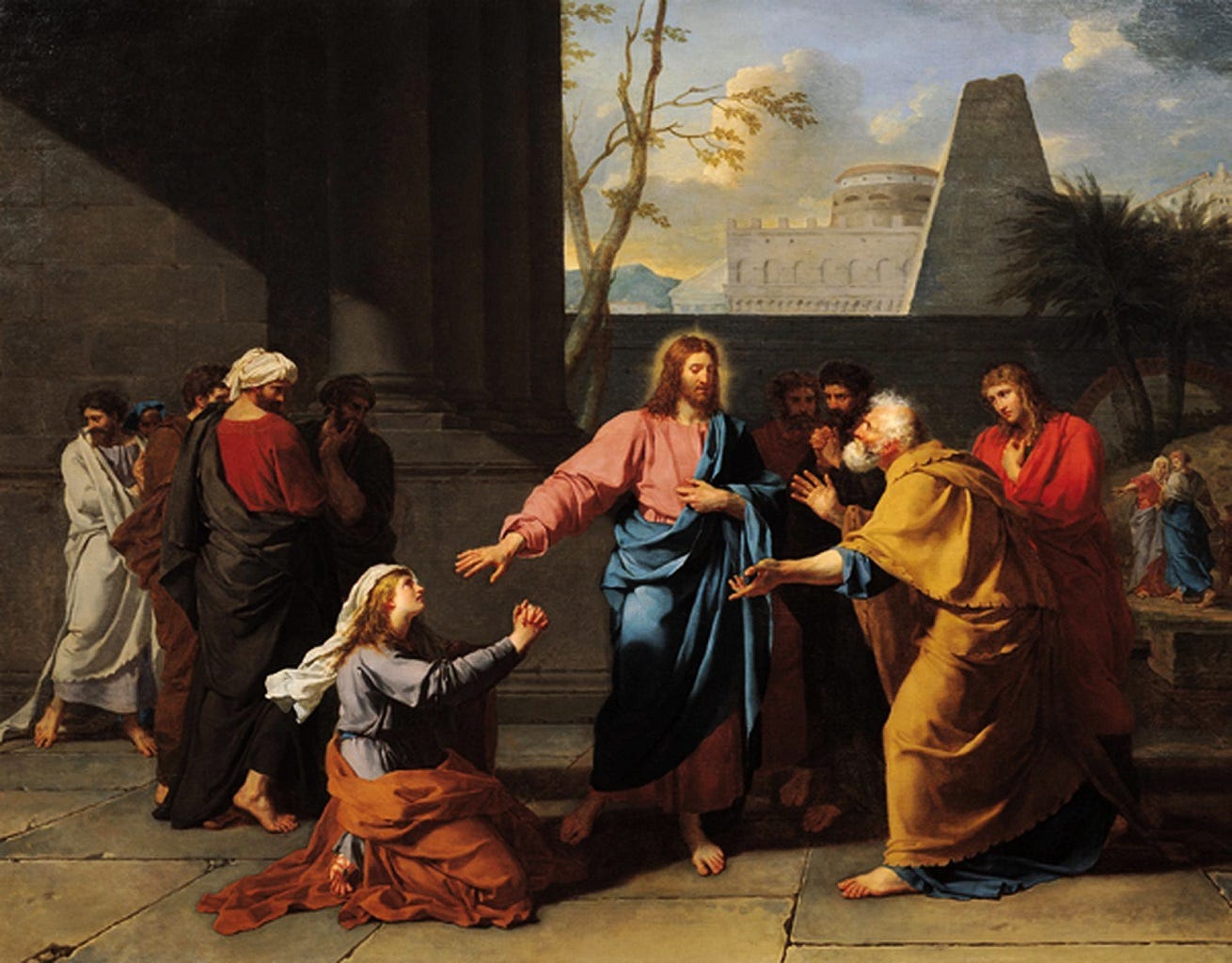
There are moments in Scripture that make us uneasy, and Jesus’s encounter with the Canaanite woman is one of those. When this desperate mother cries out for help, Jesus initially ignores her. When he finally speaks, his words feel harsh to modern ears.
And he answered, “It is not right to take the children’s bread and throw it to the dogs” (Matt. 15:26).
Dogs? Did Jesus just use a racial slur? Many readers have thought so. After all, Jewish people in the first century sometimes called Gentiles “dogs” using the Greek word κύων, which meant wild, unclean animals roaming the streets. But that is not the word Jesus uses here.
Jesus uses κυνάριον, which means a small dog, a household pet, or a lap dog (like Finn). This distinction is essential. Jesus is not throwing an insult. He is creating a picture of a family gathered around a meal. The children are at the table, and the family’s cherished pet dog is there too. This word is not an image of exclusion. It is an image of inclusion.
Why does Jesus speak this way to the woman? He seems to be doing what he sometimes did with others: testing them to reveal what is in their hearts. When the rich young ruler came to Jesus, Jesus told him to sell everything he had. This was not a universal command but a specific test meant to expose the man’s love of possessions. Jesus wanted the man to see his own heart clearly.
Something similar happens here. Jesus seems to be testing the woman’s faith. Did she come just because she heard he was a healer? Or does she truly understand who he is and approach him with the kind of faith he values? Her response reveals everything.
She said, “Yes, Lord, yet even the dogs eat the crumbs that fall from their masters’ table.” (Matt. 15:27)
She does not demand. She does not assume she deserves anything. She doesn’t defend her own righteousness; she simply asks if there might be mercy for her daughter. This reflects the humble, trusting faith Jesus was seeking.
Then Jesus answered her, “O woman, great is your faith! Be it done for you as you desire.” And her daughter was healed instantly. (Matt. 15:28)
The woman arrived as an outsider, but through her humble faith, she left as someone welcomed at the table. How we approach Jesus matters. He is not our cosmic genie or wishing well. He is the Son of God, and we come to him not demanding what we think we deserve, but trusting entirely in his mercy.