

The Small, Hidden Kingdom (13:31–35)
Jesus compares the kingdom of heaven to a mustard seed sown in a field, proverbially the smallest seed a farmer would bother planting. What grows from it is still modest. It is “larger than all the garden plants,” but it is still a garden shrub, not a forest tree., But then Jesus adds one more detail. He says that it “becomes a tree, so that the birds of the air come and make nests in its branches” (13:32).
Ezekiel had already used that image for Yahweh’s restored kingdom. It would be like a cedar planted on the mountain height of Israel under which “birds of every sort will nest” (Ezek 17:23), and Daniel’s vision of Nebuchadnezzar’s empire pictures a tree in whose branches “the birds of the heavens lived” (Dan 4:12). In both texts, the tree is a kingdom and the birds are the nations gathered under it. Jesus is claiming the same thing for his kingdom.
The leaven parable is parallel to this one. A woman hides leaven in three measures of flour. “till it was all leavened” (13:33). Three measures is somewhere near fifty pounds, enough bread for about a hundred people, and yet it is transformed by something too small to see once it disappears into the dough. The mustard seed is a small thing that eventually becomes visible. The leaven is a small thing that never becomes visible on its own, and yet its effect is seen through the finished work.
Matthew then pauses the story to explain why Jesus is teaching this way:
“This was to fulfill what was spoken by the prophet: ‘I will open my mouth in parables; I will utter what has been hidden since the foundation of the world’” (13:35).
The line is Psalm 78:2, and it is attributed to Asaph. This psalm retells Israel’s history to a generation that hadn’t lived it, and it opens with a promise to hide none of that history from the children still to come (Ps 78:4). Jesus’s parables are doing something closer to that than to concealment. Jesus’ words were revealing something not obvious to those just watching. The kingdom is working, as small and unseen as it may be, and when its work is complete, it will have changed the whole world.
We can’t always judge by what we see because the kingdom doesn’t work this way. It’s the smallest seed that will one day grow into a great tree. It’s the invisible leaven that changes the dough thoroughly, even if we can’t see it.
The Harvest of the Son of Man (13:24–30, 36–43)
The parable of the weeds and its interpretation are unique to Matthew. Jesus tells it to the crowd: a man sows good seed in his field; an enemy comes at night and sows weeds among the wheat; the servants want to pull the weeds immediately, but the master restrains them. Wait until the harvest. The reapers will handle the separation then, not now.
The crowd hears it and moves on. The disciples don’t. When they press Jesus for an explanation later that day, the interpretation he gives is explicitly Danielic.
The sower of the good seed is the Son of Man (13:37). In Daniel 7, the one like a son of man is brought before the Ancient of Days and receives “dominion and glory and a kingdom” over all peoples and nations (Dan 7:14). Matthew’s Jesus consistently employs “Son of Man” with this figure in view: one who holds authority, one who will come in judgment. The connection becomes explicit when Jesus says the Son of Man will send his angels to gather from his kingdom all causes of sin (13:41). The language is intentional. Daniel’s Son of Man receives a kingdom; Matthew’s Son of Man acts from within that kingdom.
The climax of the interpretation is verse 43:
“Then the righteous will shine like the sun in the kingdom of their Father” (13:43).
The phrase echoes Daniel 12:3: “those who are wise shall shine like the brightness of the sky above; and those who turn many to righteousness, like the stars forever and ever.” Matthew’s Jesus draws on Daniel’s resurrection imagery — the vindication of the wise — to describe what is coming at the close of this age. The “end of the age” (συντέλεια τοῦ αἰῶνος) in Matthew is not a reference to the end of universal history. It refers to the close of the present Jewish age, the coming crisis that Jesus’ ministry is already precipitating. The harvest he describes is not distant. It is imminent.
The Sower has been sowing, but weeds have grown in the field. Jesus is teaching in a moment when violent revolution was a live option — a quick, forcible separation of the righteous from the wicked. But a violent purge would have destroyed wheat along with weeds. The coming crisis would make the separation clear enough: the judgment will fall on the present age (the destruction of Jerusalem), while the righteous will be vindicated in language drawn straight from Daniel’s resurrection vision. Jesus doesn’t need the servants to act. He just has to wait.
A Kingdom of Incomparable Value (13:44–45)
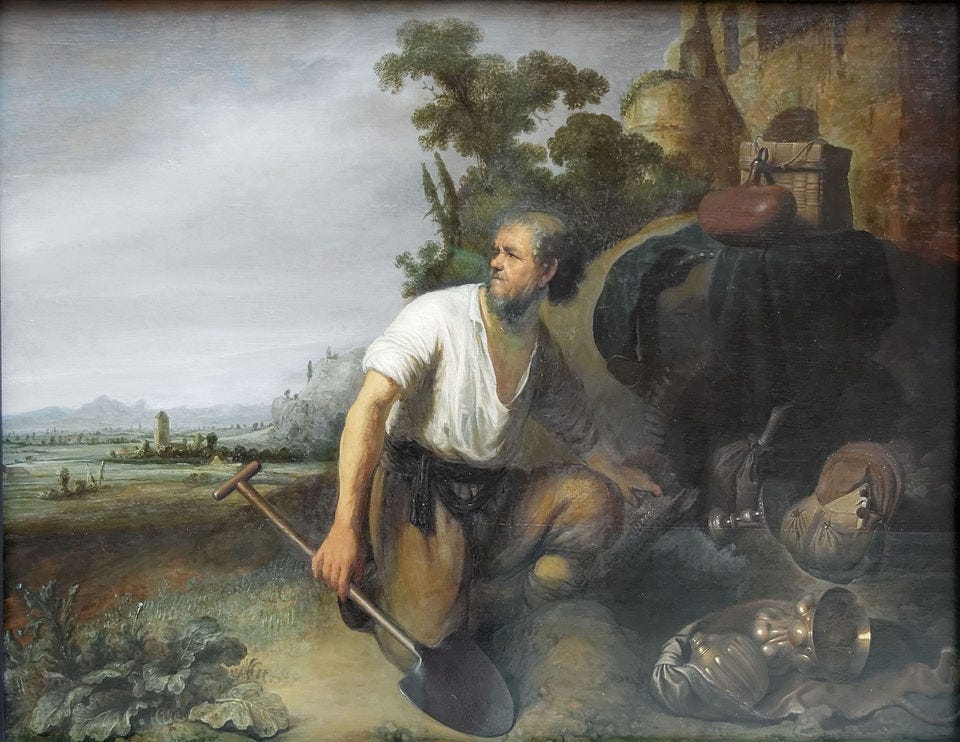
The parables of the hidden treasure and the pearl of great price might be the shortest parables Jesus ever told. Three verses, two images, one point. The kingdom of heaven is like a treasure hidden in a field that someone accidentally finds and happily sells everything to obtain. The kingdom of heaven is also like a merchant seeking fine pearls who, upon finding one of great value, sells everything to buy it. Both parables conclude the same way: total liquidation, full commitment, and gaining something that makes everything else seem worthless in comparison.
What strikes me first is the different paths to discovery. One person accidentally finds treasure while working or passing through a field. The other deliberately seeks fine pearls as part of their profession. Some of us stumble into the kingdom unexpectedly, surprised by grace we never knew to look for. Others search for years, examining different philosophies and religions, until we finally encounter the one thing our seeking hearts were made for. The kingdom welcomes both the surprised and the seekers, the accidental and the intentional.
But notice what they share. Both recognize incomparable value when they see it. Both respond with joy rather than reluctance. The man who finds the hidden treasure does not grimly calculate what he must sacrifice. He acts “in great delight” (Matt. 13:44, ESV). Both are willing to sell everything they have, not out of duty but desire, not from obligation but from the overwhelming realization that they have found something worth infinitely more than everything else combined.
These parables challenge the idea that religions are like pearls to collect or different experiences to gather on our spiritual journey. There is only one great pearl. There is only one treasure trove. Everything else is insignificant beside it. The gospel of the kingdom that Jesus proclaims and embodies is not just one option among many religious paths. It is the singular treasure that puts all other allegiances, identities, and sources of meaning into perspective.
This creates urgency. The kingdom isn’t a pleasant idea to consider when it’s convenient. It requires a decision. What might it cost us to acknowledge that Jesus and his kingdom are the one thing worth having? What would it look like to sell everything else—not necessarily our possessions, but our other loves, our alternative securities, our carefully gathered religious experiences—to gain the one treasure that will never disappoint us?