

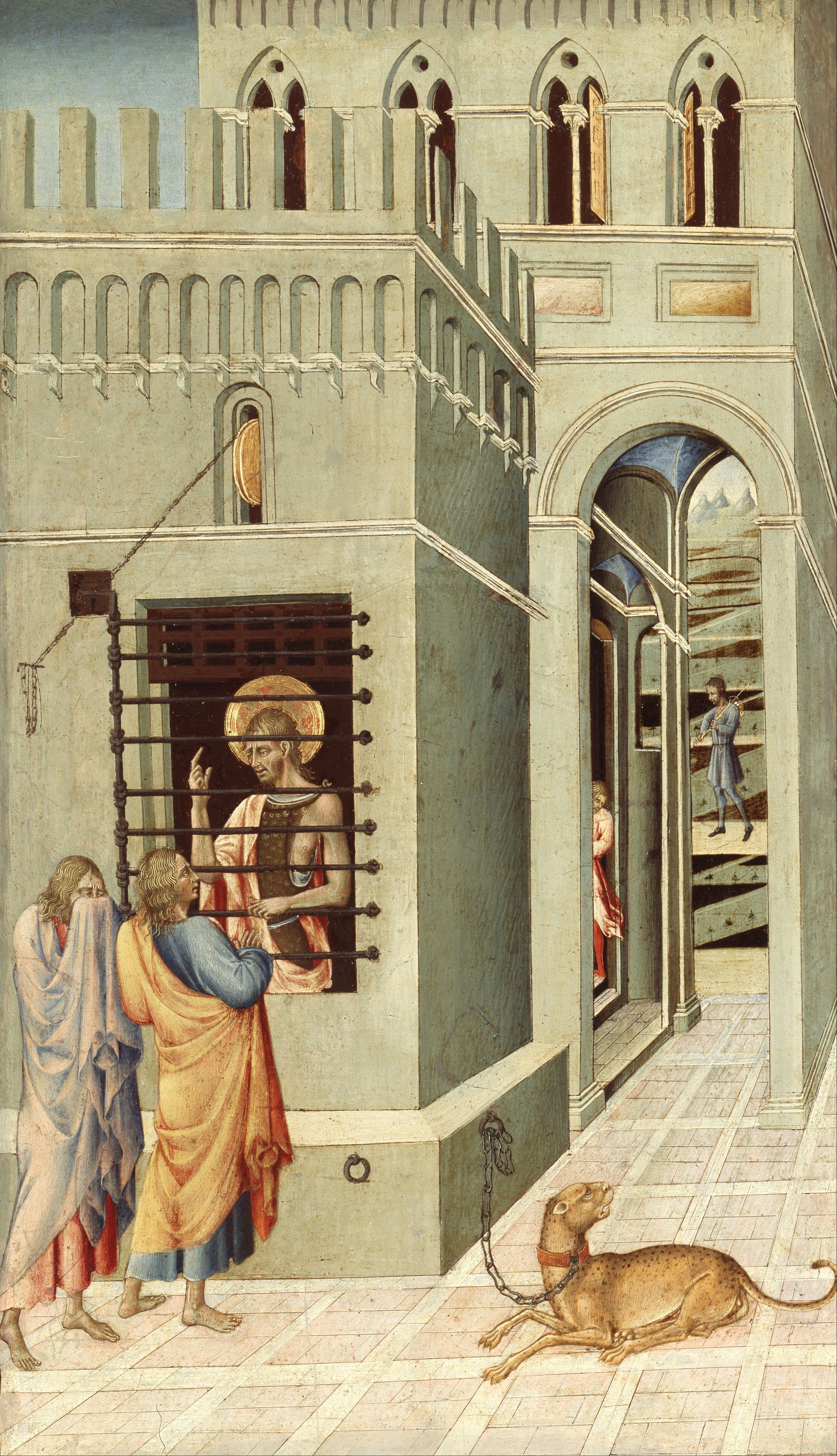
The Promised Elijah (11:7–15)
As John’s disciples turn back to report to him, Jesus speaks to the crowd about the man they had gone out to see.
What did you go out into the wilderness to see? A reed shaken by the wind? What then did you go out to see? A man dressed in soft clothing? Behold, those who wear soft clothing are in kings’ houses. What then did you go out to see? A prophet? Yes, I tell you, and more than a prophet (11:7–9).
John was no reed that bent with popular opinion, nor was he a royal courtier softened by comfort. He was a prophet. Actually, he was more than a prophet. But what does Jesus mean by this? Jesus grounds this saying in Scripture:
This is he of whom it is written, Behold, I send my messenger before your face, who will prepare your way before you (11:10).
The quotation is split into two halves, each from a different (but already related) text. The opening words, “I send my messenger [[same word for ‘angel’]] before your face,” come from Exodus 23:20. Matthew uses ἀποστέλλω (apostellō), “I send,” in the simple form used in Exodus itself. When Malachi later borrows this same opening for his own prophecy, he intensifies the verb to ἐξαποστέλλω (exapostellō), so the plainer form here points back to Exodus, not Malachi, for this half of the sentence.
The second half, “who will prepare your way before you,” belongs to Malachi alone. Exodus never speaks of preparing a way; it speaks only of an angel who guards the people on their way. And here Jesus makes his one change. In Malachi, the way is prepared “before me,” before the LORD who is coming to his own temple (Mal 3:1). In Matthew, it is prepared “before you.” Jesus puts himself where Malachi placed the LORD
The verses that follow measure John by two standards at once. No one born of woman is “greater than John the Baptist,” and yet the least citizen of the kingdom now dawning is greater than he (11:11). That dawning has already provoked violence; John’s own cell is evidence of it (11:12). The era defined by the Law and the Prophets ends with John the Baptist (11:13).
Then Jesus goes back to Malachi. The messenger of Malachi 3:1 is named later in the same book: Elijah, who will be sent before the great and awesome day of the LORD comes (Mal 4:5–6). Jesus is doubling down on what he said moments ago about John.
And if you are willing to accept it, he is Elijah who is to come (11:14).
John, in prison and uncertain, but that doesn’t change the fact that he is the promised Elijah. His imprisonment says quite a bit about how well the task of preparing the way actually went.
Jesus knows he’s speaking in code drawn from the prophets, and so he uses the same sensory organ language the prophets used:
He who has ears to hear, let him hear (11:15).
My Yoke Is Easy (11:25–30)
The personification of Wisdom is a defining feature of Second Temple wisdom literature. In Proverbs 8, Wisdom is a figure present at creation, calling out to those who lack understanding. In Sirach 24, she speaks in her own voice:
“Come to me, you who desire me, and eat your fill of my fruits” (Sir 24:19).
The chapter then equates Wisdom with the book of the covenant, the law of Moses (Sir 24:23). Studying and following the Torah was seen as acquiring Wisdom. The practical expression of that understanding was the yoke. Sirach revisits this image in chapter 51, again speaking in Wisdom’s voice.
“Put your neck under the yoke, and let your soul receive instruction. I labored a little and found for myself much rest” (Sir 51:26–27).
The Greek word for “rest” is ἀνάπαυσις. The pattern remains consistent: Wisdom calls, offers the yoke, and promises rest to those who respond.
Jesus directly references that tradition.
“Come to me, all who labor and are heavy laden, and I will give you rest. Take my yoke upon you, and learn from me, for I am gentle and lowly in heart, and you will find rest for your souls. For my yoke is easy, and my burden is light” (Matt 11:28–30).
The similarities between these two texts strongly suggest that the parallels are intentional. The invitation (”come to me”), the yoke, and the rest (ἀνάπαυσις, v. 29) are part of Wisdom’s vocabulary. When Jesus declares that all things have been handed over to him by the Father, and that no one knows the Father except the Son (v. 27), he is speaking in the language of Wisdom herself, hidden from the proud and revealed to the humble (cf. Sir 1:6–8). Jesus stands at the center of the tradition, claiming to be its fulfillment.
Jesus does not invent the image of a yoke; the question he is answering is whose yoke you bear. The crowds already carry one: the Torah, the very yoke Sirach’s Wisdom promised would bring rest. In the hands of its teachers, that promise has gone unfulfilled. Jesus offers himself as its replacement, the Wisdom Torah pointed toward, now embodied, delivering the rest that the Torah promised but could not itself provide.
Those who have followed Jesus for many years will know this to be true. Yes, Jesus calls us to take up our cross and follow him, but when we do, often to our great surprise, we discover that his yoke is easy and his burden light. In him, we find true ἀνάπαυσις.
What You Hear and See (11:2–6)
John the Baptist is in prison. He has already declared Jesus as the one who is to come — he is the voice crying in the wilderness, the forerunner of the Lord. Yet, from his cell, he sends word to Jesus:
“Are you the one who is to come, or shall we look for another?” (Matt. 11:3, ESV).
It’s a surprising question. But it makes sense when you consider what John is facing. He paid a heavy price for his declaration. He’s in prison, and the man he believed was coming hasn’t set him free. The rumors about Jesus don’t match what John expected the Messiah to be doing. John’s doubt isn’t unreasonable — it stems from a real encounter with a world that doesn’t yet look the way he thought it would.
We understand that feeling. We’ve all asked some version of John’s question — maybe not aloud, but quietly during those times when we pray, work, wait, and heaven feels silent, when the world is broken, and God doesn’t seem to be fixing it on our timeline.
Jesus could have responded to John with a theological argument — a system that explains why things are the way they are. He could have made sweeping claims about what God is doing behind the scenes of history. He did neither. Instead, he said:
“Go and tell John what you hear and see: the blind receive their sight and the lame walk, lepers are cleansed and the deaf hear, and the dead are raised up, and the poor have good news preached to them” (11:4–5).
Jesus is referencing two Isaianic texts here. The healings reflect Isa 35:5–6, which is an end-of-exile passage that describes God returning to his people and restoring what is broken.
“Then the eyes of the blind shall be opened, and the ears of the deaf unstopped; then shall the lame man leap like a deer, and the tongue of the mute sing for joy” (Isa. 35:5–6).
The final item on Jesus’s list (“The poor have good news preached to them”) draws on a Second Isaiah passage.
“The Spirit of the Lord GOD is upon me, because the LORD has anointed me to bring good news to the poor” (Isa. 61:1).
The word Matthew uses here — the word we translate as “preaching good news” — is the very word from which we get “gospel.” Jesus isn’t pointing John to a theory. He is pointing him to the kingdom, which is already at work and already breaking in, even if it hasn’t fully arrived.
When people asked the theologian and missionary Lesslie Newbigin whether he was an optimist or a pessimist about the world, he would reply, “I am neither an optimist nor a pessimist. Jesus Christ is risen from the dead.” That is the posture Jesus invites John into, and he invites us into it as well. This posture is not a theological system, nor is it guesswork. It is rather an invitation to encounter what God has done and is doing in the world, and thus to know that the kingdom of God is coming, even when it doesn’t seem like it.
I envision the yoke used for oxen it is a 2 oxen yoke. Usually one oxen is the experienced leader, older, stronger and wiser. The other is me still learning and inexperienced. The wiser one guides me and protects me. His burden is light!