

Found Without Being Sought (5:1–20 again)
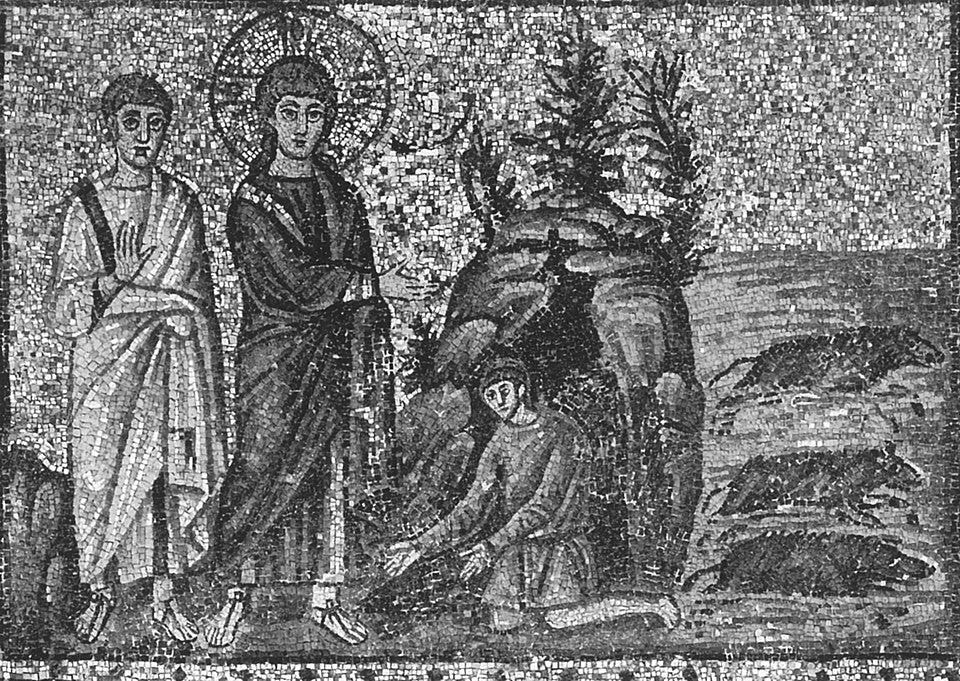
Jesus crosses the sea for the first time into Gentile territory, and he meets a man on the shore who has come from the tombs. Mark says the man lived there: no one could bind him anymore, not even with a chain, and night and day he cried out among the graves, cutting himself with stones (5:2–5).
The language here is reminiscent of Isaiah 65, which catalogs how Israel had traded the LORD for other gods, including those “who sit in tombs, and spend the night in secret places; who eat pig’s flesh, and broth of tainted meat is in their vessels” (Isa 65:4). Sitting in tombs meant seeking the dead for oracles, spending the night among graves to receive by dream what the dead were thought to know. Eating pig’s flesh meant more than diet; the meat most often turned up on pagan altars, sealing a family’s loyalty to a god other than the god of Israel. Isaiah names tombs and pigs as the profile of covenant unfaithfulness, and Mark sets the same two images side by side as the man comes to Jesus: a man among the tombs and a herd of pigs on the hillside (5:11).
Isaiah wrote those words to Israel, not to the nations; the charge was covenant-breaking, not paganism from the outside. But the oracle opens with a claim the LORD makes about people who never sought him at all:
“I said, ‘Here I am, here I am,’ to a nation that was not called by my name” (Isa 65:1).
Paul later hears that verse fulfilled in the Gentile mission:
“I have been found by those who did not seek me; I have shown myself to those who did not ask for me” (Rom 10:20).
The unclean spirits ask to enter the pigs rather than leave the region. Jesus lets them, and the herd runs into the sea and drowns (5:13). The one who had seemed impossibly far off from Israel’s God is now found sitting, clothed, and in his right mind (5:15).
It’s helpful for all of us to remember that no one is too far from God. Inherent to the Gospel is the incredible truth that God goes after those who are from him. He calls to them. He shows himself to them. Those who do not see him still find him. Those who are not called by his name still become his children. That means we should never give up praying for people and reaching out to them with the Gospel of Jesus Christ. No matter how far from God they might seem to us, for God, they are never too far away.
When Holiness Is Contagious (5:21–43)
The purity laws of the Torah work by contact. A woman with a discharge of blood beyond her menstrual cycle remained unclean for as long as the flow continued, and her uncleanness passed to whatever she touched:
“If a woman has a discharge of blood for many days, not at the time of her menstrual impurity... all the days of the discharge she shall continue in uncleanness... And whoever touches these things shall be unclean” (Lev 15:25–27).
Contact with a corpse carried the same logic.
“Whoever touches the dead body of any person shall be unclean seven days” (Num 19:11).
Uncleanness was the stronger force; it traveled from the unclean to the clean and never the other way.
Mark sets two such cases inside one scene. Jairus, a ruler of the synagogue, falls at Jesus’ feet because his daughter is dying. On the way to the house, the crowd presses in, and one woman carries a defilement the others would not have seen unless they knew her:
“And there was a woman who had had a discharge of blood for twelve years... She had heard the reports about Jesus and came up behind him in the crowd and touched his garment” (Mark 5:25–27).
The two are bound by a number. The woman had bled for twelve years; the girl was twelve years old. The bleeding began about the time the child was born, and both afflictions ended on the same afternoon.
By the law’s reckoning, her touch should make Jesus unclean, along with everyone she pressed past. But the contagion runs backward. Power leaves him, and the flow of blood dries up at its source (5:29–30). He turns, calls her “daughter,” and tells her that her faith has saved her. The verb is σῴζω (sōzō), which means both to heal and to save, and Mark intends both.
Word then spreads that Jairus’s daughter has died. Jesus takes her by the hand, an act that should make him unclean for seven days, and says, “Talitha cumi” (5:41). She gets up, and he refers to her death as sleep because in his hands, death is no more permanent than sleep.
Holiness turns out to be the more powerful thing. Where the kingdom lays hold of uncleanness and death, they are the ones that gives way.
The Real Enemy (5:1-20)
When Jesus and his disciples crossed the Sea of Galilee, they were doing more than navigating a body of water. For any first-century Jewish reader, a sea crossing immediately evoked one story above all others: the night God led Israel through the sea on dry ground while Pharaoh’s army was swallowed by the returning waters (Exod 14:26–28). Now, stepping onto the far shore, Jesus walks straight into one of the most dramatic confrontations of his ministry.
They came to the other side of the sea, to the country of the Gerasenes. And when Jesus had stepped out of the boat, immediately there met him out of the tombs a man with an unclean spirit (Mark 5:1–2).
The man who meets him is possessed by a force that has broken every chain his neighbors could fashion. When Jesus asks his name, the answer is:
“My name is Legion, for we are many” (5:9).
“Legion” is a Roman military term for a unit of roughly 6,000 soldiers. To people living under occupation, it meant one thing: an army.
But Mark’s point is precisely that Rome is not the real enemy. Jesus has crossed the sea not to overthrow Caesar but to confront the true occupying power — the spiritual forces opposed to God and his kingdom.
The demons beg not to be sent out of the region. Jesus grants their request to enter a herd of pigs, and what happens next is unmistakable:
“The herd, numbering about two thousand, rushed down the steep bank into the sea and drowned in the sea” (5:13).
An army is drowned in the sea. Israel’s God had done this before. The Exodus is happening again.
The people of the Decapolis were afraid when they saw the man “sitting there, clothed and in his right mind” (Mark 5:15). They had grown accustomed to the enemy’s power. The freedom Jesus brought was more frightening than the bondage they had known. But the man himself understood. He begged to go with Jesus, and when refused, went home and proclaimed “how much the Lord had done for him” (5:19–20).
Paul would later name the same truth plainly:
“For we do not wrestle against flesh and blood, but against the rulers, against the authorities, against the cosmic powers over this present darkness” (Eph 6:12).
Our neighbors are not our enemies. Our political opponents are not our enemies. The legion arrayed against the people of God is spiritual, and it has already met the one who drowned Pharaoh’s army in the sea. In Christ, the outcome is not in doubt.
I found myself nearly in tears as I read Mark 5 this morning. What an indictment on humanity, that when a person was released from the bondage of demonic power, when a man whom they could not contain, who lived among the graves wailing in agony night after night, once he was freed NO ONE REJOICED! I was staggered at the realization that, even in our world today, there are those who’d rather live under political power than the life-giving (but costly) reign of Jesus who can free even a man possessed by a legion!
So powerful!