

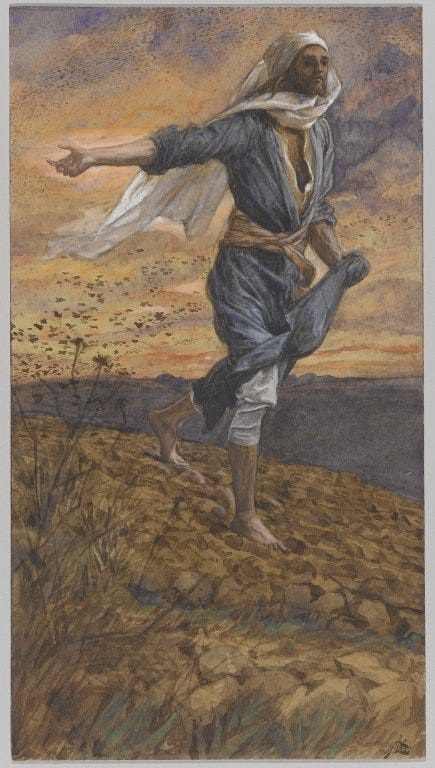
Seed Parables (4:26–32)
Jesus gives two more parables about seed here. In the first, a man scatters seed on the ground, but he does not know how a seed grows from seed to grain (4:27). He goes to bed and gets up, goes to bed and gets up, day after day, and all the while the seed is doing its work in the earth. It grows under the soil, then the first blade, then the ear, then the full grain in the ear, until it is ripe, and Mark closes the parable with a citation: “at once he puts in the sickle, because the harvest has come” (4:29).
That last line comes from Joel 3, which speaks of God’s coming judgment on the nations:
“Let the nations stir themselves up and come up to the Valley of Jehoshaphat; for there I will sit to judge all the surrounding nations. Put in the sickle, for the harvest is ripe” (Joel 3:12–13).
But the harvest here is not judgment on the nations, as it was in Joel. Jesus is quoting Joel and turning its meaning on its head. This harvest is the result of sowing the seed. It is the spreading of the message of the kingdom, not just in Israel but over the face of the known world, and so the harvest, which was once bad news for the nations, is now good news.
The sower does not have to understand how the seed grows. All he has to do is sow. Sowing is how it works in the kingdom of God. We do not have to understand it all or get every detail of God’s grand design to know what we are supposed to be doing. We are simply asked to go and sow, to spread the seed of the kingdom, and let God take care of the rest. We can follow the regular pattern of our lives, going to bed and rising in the morning, so long as we do our part during the day by spreading the seed. As long as we are sowing, we can be assured that the seed will grow and one day the harvest will come.
Jesus ushered in the kingdom of God in a way no one expected, and one of the clearest differences between his reality and the people’s expectations was the kingdom’s size. He had no large army. He had no capital. No base. He did not march on the city. He did not fight a war. He did not overthrow Caesar’s agent. By the standards of the day, Jesus’s kingdom was small, and according to this second parable, smallness is exactly how the kingdom works.
Jesus says:
It is like a grain of mustard seed, which, when sown on the ground, is the smallest of all the seeds on earth, yet when it is sown it grows up and becomes larger than all the garden plants and puts out large branches, so that the birds of the air can make nests in its shade (4:30–32).
Daniel and Ezekiel both use the image of a tree grown so large that birds nest in its branches to describe a great kingdom, one that shelters even those outside its own soil (Ezek 17:23; 31:6; Dan 4:12, 21). Daniel writes:
Its leaves were beautiful and its fruit abundant, and in it was food for all. The beasts of the field found shade under it, and the birds of the heavens lived in its branches, and all flesh was fed from it (Dan 4:12).
Daniel was describing Nebuchadnezzar’s empire, but it is not hard to see the connection between that vision and the kingdom Jesus describes here.
The world runs on a direct correlation between big actions and big rewards: invest a lot, gain a lot; invest a little, gain little. The kingdom of God does not run that way. God can use even the smallest of things as a seed that grows into a tree whose branches reach further than our wildest expectations. So we should not get so caught up in the big acts of faith that we lose sight of the small ones. Not all of us are called to Nepal. All of us are called to witness to our neighbor. Not all of us are called to full-time ministry. All of us are called to be ministers of Christ’s love to the people around us. The size of the seed does not matter, because Jesus is the Lord of the harvest, and that means the harvest will come. Our job is simply to sow.
Who Then Is This? (4:35–41)
In the Hebrew Scriptures, mastery of the sea belongs to YHWH alone. He rules the raging of the sea and stills its waves (Ps 89:9). At creation, he set the limits of the deep, saying to its proud waves, “Thus far shall you come, and no farther” (Job 38:11).
One of the fullest portraits of YHWH and the stormy sea is in Psalm 107. Sailors go down to the sea in ships and see the deeds of the LORD in the deep. A stormy wind rises at his command. The waves lift them up to heaven and down to the depths, their courage melts, and in their distress, they cry out:
Then they cried to the LORD in their trouble, and he delivered them from their distress. He made the storm be still, and the waves of the sea were hushed. Then they were glad that the waters were quiet, and he brought them to their desired haven (Ps 107:28–30).
The pattern is consistent. Storms rise at YHWH’s command, and he alone can still them.
This is the world the disciples inhabit when Jesus tells them to cross to the other side. The storm that rises is no ordinary squall. The waves are breaking into the boat, and the fishermen among them, men who know this lake, are afraid for their lives.
Jesus is asleep in the stern, on the cushion. The detail recalls another sleeping figure in a sinking boat. In Jonah 1, the prophet sleeps below deck while the sailors panic above. The captain wakes him with an urgent plea: arise, call on your god, that we do not perish (Jonah 1:6). The LXX’s verb for "perish" here is the very one the disciples use when they wake Jesus (Mark 4:38). In Jonah's case, the storm was stilled only when the prophet was thrown overboard. The sea was calmed by his “death.” After the calming, the sailors "feared the LORD exceedingly" (Jonah 1:16).
Jesus answers differently. Ultimately, his death will calm the winds and waves of this world, but not right now. In this moment, he simply rises and rebukes the wind. To the sea he says, “Peace! Be still!” (4:39). The verb is the same one Mark used earlier to silence an unclean spirit (Mark 1:25). The sea is treated as a hostile power that obeys his command.
Mark then describes the disciples with the very phrase from Jonah. They “feared a great fear” (Mark 4:41). And they ask the question the whole passage has been driving toward:
“Who then is this, that even the wind and the sea obey him?” (Mark 4:41).
The Hebrew Scriptures have already given the answer time and time again. There is only one who stills the storm and calms the sea.
The Mystery of the Sower (4:1–20)
When Jesus shares the Parable of the Sower, he is not giving a timeless lesson about spiritual openness. He is describing a crisis. In Mark 3, the religious leaders accuse him of casting out demons by the power of Beelzebul (Mark 3:22), and his own family thinks he is out of his mind (Mark 3:21). The message is spreading, but the rejection in ch. 3 shows it faces hard soil. Why?
The weight Mark places on this parable is unmistakable. It is the first substantive parable in all three Synoptic Gospels, and in Mark’s Gospel, which contains only one major parable section (here in ch. 4) and then only one other significant parable (the Wicked Tenants in chapter 12), it is nothing less than load-bearing for the whole Gospel and ministry of Jesus. When Jesus asks his disciples, “Do you not understand this parable? How then will you understand all the parables?” (Mark 4:13), he means it. This parable, like the others, explains what is happening in the ministry of Jesus.
To make sense of this parable, Jesus reaches for a word his disciples would have recognized immediately. He says:
“To you has been given the mystery of the kingdom of God” (Mark 4:11, author’s own translation).1
The Greek word translated as “mystery” here is μυστήριον, the same word the Septuagint uses in Daniel 2 when Nebuchadnezzar has a dream no one can interpret, and Daniel alone receives its meaning from God (Dan 2:18–19, 27–30). Mark signals that this parable is apocalyptic. Like Nebuchadnezzar’s dream, it is a vision whose meaning must be revealed from outside, and it explains real events that are happening or will happen in human history. And just as Daniel’s mystery concerned the coming kingdom that would one day fill the whole earth (Dan 2:44), so Jesus’ mystery concerns the kingdom that is arriving now — silently, against all appearances, like seed falling on the ground.
The seed, Jesus explains, is the word (Mark 4:14). This takes us straight to Isaiah 55, where God promises that his word, like rain and snow falling on the earth, will give “seed to the sower” and will not return to him empty, but will accomplish its purpose. That purpose is the New Exodus, the end of Israel’s long exile, and the return of Yahweh to Zion (Isa 55:10–11). The teaching of Jesus is doing precisely this: scattering the word of return across the landscape of human hearts.
But the harvest is uneven, and this is the parable’s great burden. The problem is not the seed or the sower. The word will not return empty. The problem is the soil. John the Baptist had come before Jesus with one message: “Prepare the way of the Lord” (Mark 1:3, citing Isa 40:3). To prepare the way was to prepare the soil — to repent, to clear the ground of whatever would keep the word from taking root. Many in Israel had not done this. And so when the sower arrived and began to scatter the word, he found paths and rocks and thorns where there should have been good earth.
The parable invites us to ask a hard question — not simply which of the four soils describes us, but what has hardened us. What love, what fear, what idol has compacted the ground so that the word cannot go as deep as it should? John’s ancient call has not expired. We must prepare the way of the Lord.
The ESV uses the word “secret” here. That is, frankly, a bad translation.
“not simply which of the four soils describes us, but what has hardened us.” Love this! Describing the soil makes it a ‘done deal’ but asking that question makes space for change/healing.