

The End of Mark (March 9, 2026)
Few passages in the New Testament raise more questions than the final verses of Mark’s Gospel. The women arrive at the tomb, hear the announcement of the resurrection, receive a commission to tell the disciples, and flee in silence. Then the Gospel stops:
And they said nothing to anyone, for they were afraid. (Mark 16:8)
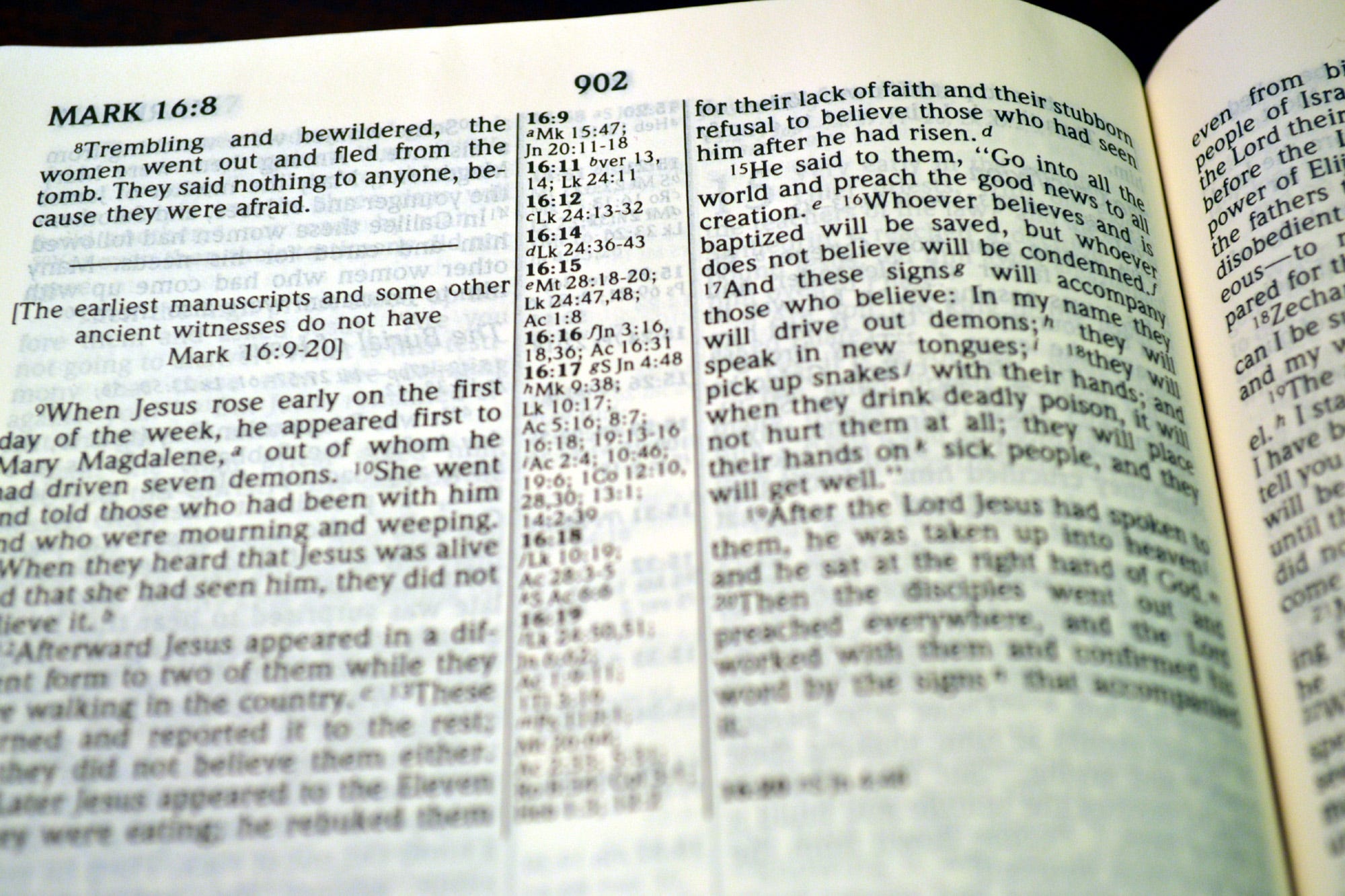
Most modern readers encounter a Bible that continues through verse 20. Still, those additional verses — what scholars call the “longer ending” — are almost certainly not original to Mark, which is why they are usually printed in brackets, as in the image above.
We know this because two of the oldest and most reliable Greek manuscripts, Codex Sinaiticus and Codex Vaticanus, both end at 16:8. Likewise, Eusebius of Caesarea, writing in the early fourth century, noted that the longer ending was absent from nearly every Greek manuscript known to him, and Jerome made the same observation shortly afterward. Furthermore, the vocabulary and sentence rhythms of 16:9–20 differ noticeably from the rest of the Gospel. Therefore, we can say with almost certainty that the longer ending was not part of Mark’s original text; it was added by later scribes.
This question of textual criticism is not merely academic. Mark 16:18 promises that believers will “pick up serpents with their hands” and drink deadly poison without harm. Christians have, over the centuries, taken that verse as a literal divine mandate, and people have died as a result. If I had my way, I wouldn’t print the ending of Mark in any Bible.
So, what should we think about Mark’s ending? Scholars are divided. It’s possible that Mark’s original ending was lost early on, before the manuscript tradition diverged. If that’s the case, we simply do not have it.
But it is also possible that 16:8 is exactly where Mark intended to stop — an open, unsettling ending that leaves the reader with the women’s fear and an unfulfilled commission. If that is the case, the abruptness may be deliberate: Mark has consistently drawn his readers into the narrative, and the silence at the tomb may be one final example of that technique. The story did get out — the church exists — and the ending leaves open the question of how that happened.
We cannot be certain which of these is true. But we can be certain that the longer ending does not answer the question for us.