

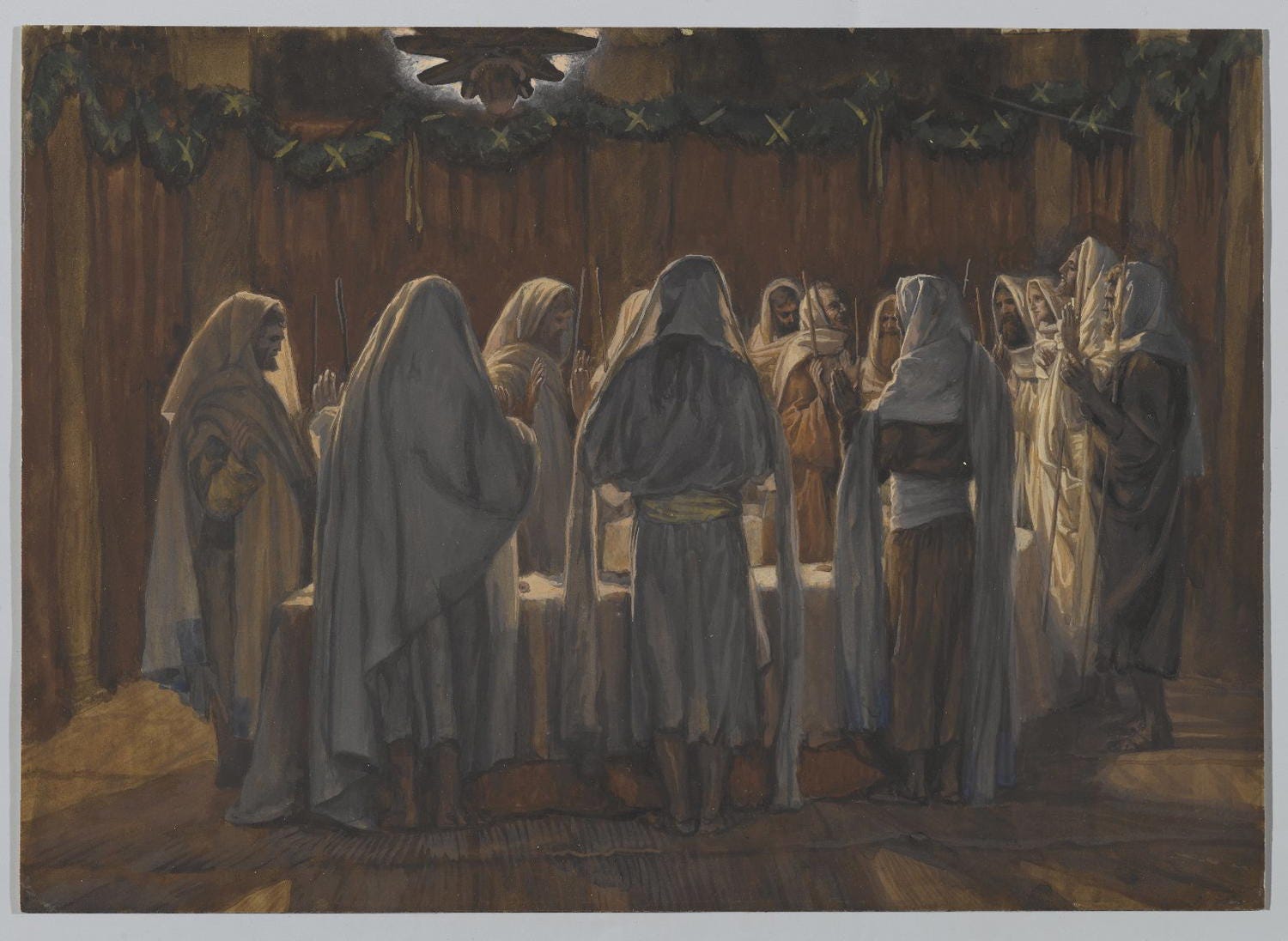
My Blood of the Covenant (March 7, 2026)
Every Passover meal included a built-in liturgy of interpretation. Jewish fathers reclined at the table and guided their children through the meaning of each element: this bread is the bread of affliction our ancestors ate in Egypt, this lamb is the sacrifice whose blood turned aside the destroyer (Exod 12:26–27). The entire evening was centered around a question children were expected to ask: “What do you mean by this service?” (12:26). Nothing was left unexplained.
When Jesus sits down at the Passover table with his disciples, he assumes that interpretive role — and completely redefines the answers.
When he takes the bread, he does not say, “This bread represents affliction.” He says:
“Take; this is my body” (Mark 14:22).
When he lifts the cup, he does not point backward to Egypt. Instead, he says:
“This is my blood of the covenant, which is poured out for many” (14:24).
Conspicuously missing from Mark’s account is any mention of the lamb. The focus of the meal has shifted. Jesus now embodies the entire meaning of the feast.
Luke and Paul both speak of a “new covenant” in Jesus’s blood (Luke 22:20; 1 Cor 11:25) — an echo of Jeremiah’s promise of coming restoration (Jer 31:31–34). Mark’s account doesn’t use the word “new”. Mark’s language references something older and more elemental. The phrase αἷμά μου τῆς διαθήκης (haima mou tēs diathēkēs), “my blood of the covenant,” carries us back not to Jeremiah but to Sinai. When Moses ratified the covenant at the foot of the mountain, he threw the blood of oxen over the people and declared,
“Behold the blood of the covenant that the LORD has made with you in accordance with all these words.” (Exod 24:8)
Mark’s Jesus stands at a new Sinai, sealing a covenant — not in the blood of oxen, but in his own. And “poured out for many” carries its own resonance, recalling the servant of Isaiah who “poured out his soul to death” and “bore the sin of many” (Isa 53:12).
Every Passover before this night was pointing somewhere. Here, at this table, is where it arrives. When you eat the bread and drink the cup, you are not simply remembering Jesus’ death — you are standing at the foot of a mountain, receiving the covenant sealed in his blood.