

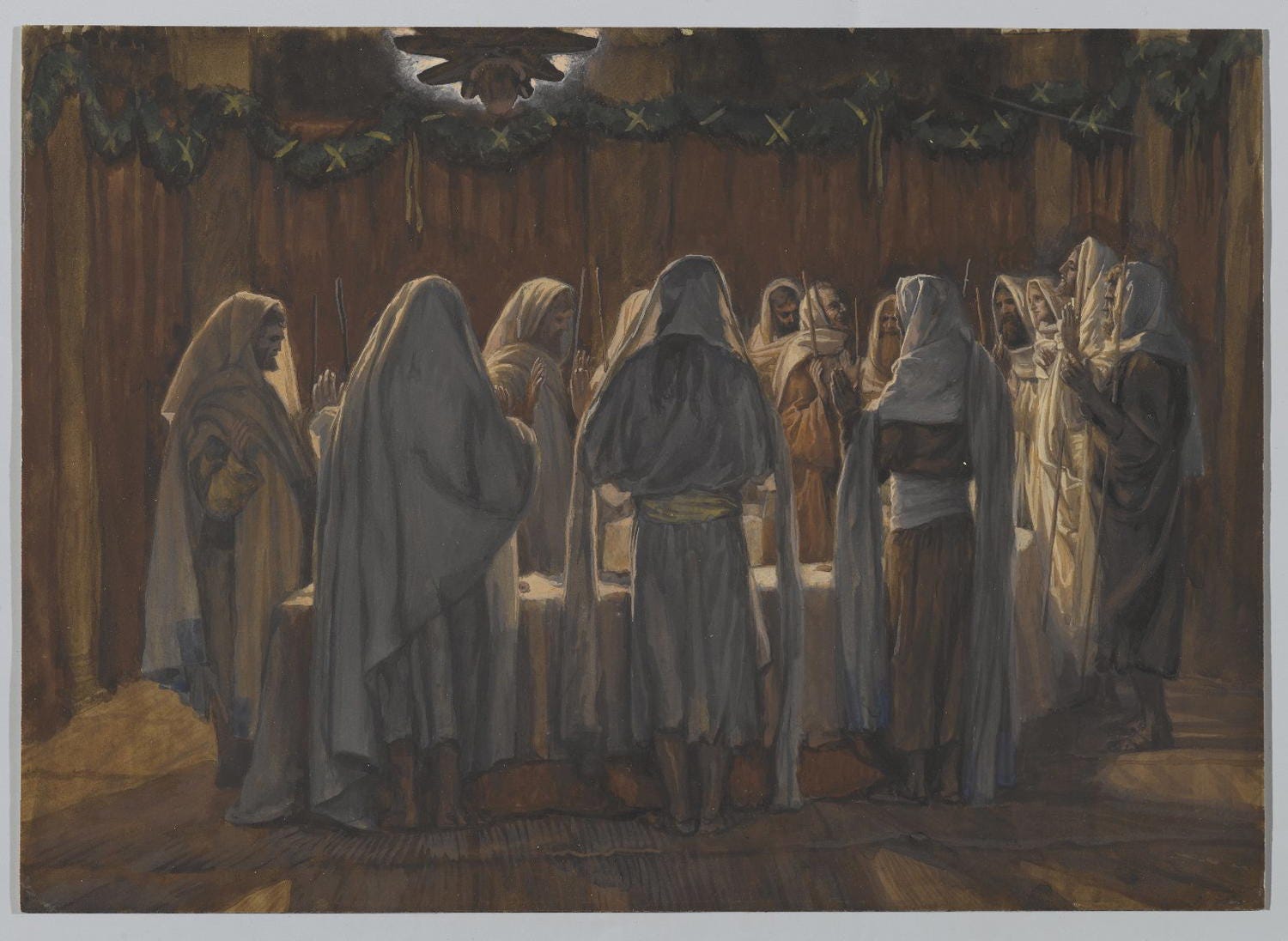
Between Two Plots (14:1–11)
Two days before the Passover, the chief priests and scribes are stuck. They want Jesus arrested, but “not during the feast, lest there be an uproar from the people” (14:1–2). While they wait for their opening, Jesus is reclining at a table in Bethany, in the house of Simon the leper, when a woman breaks open an alabaster flask of pure nard and pours the whole thing over his head. Some of those at the table are indignant: “This ointment could have been sold for more than three hundred denarii and given to the poor” (14:4–5). Jesus tells them, “Leave her alone. She has done a beautiful thing to me,” he says, and explains why: “she has done what she could; she has anointed my body beforehand for burial” (14:6, 8). Then he adds, “wherever the gospel is proclaimed in the whole world, what she has done will be told in memory of her” (14:9).
Mark sets this scene between two plots against Jesus’s life, and both plots speak the same hushed, transactional language. Before the anointing, the chief priests are “seeking how to arrest him by stealth and kill him” (14:1). After it, Judas Iscariot goes to those same chief priests “to betray him,” and “when they heard it, they were glad and promised to give him money” (14:10–11). Mark gives Judas no stated motive, but the timing is exact. The priests cannot find a way to move against Jesus without a riot, and immediately after a woman spends everything she has on him, Judas walks in and gives them one.
The anointing carries a meaning even beyond what’s mentioned in the text. Oil poured on the head means king-making before it means anything else in Israel’s story. Samuel does it to Saul: “Samuel took a flask of oil and poured it on his head... has not the LORD anointed you to be prince over his people Israel?” (1 Sam 10:1). Zadok does it to Solomon: “Zadok the priest took the horn of oil from the tent and anointed Solomon” (1 Kgs 1:39). The title Christ simply transliterates the Greek Χριστός, “the anointed one.” In the one scene in Mark’s Gospel where Jesus actually is the Anointed One in a very literal sense, the coronation and the burial arrive in the same gesture, in oil poured out on Jesus’ head.
Jesus names the burial. He leaves the coronation for his disciples to recognize. In his death, even as his friend and the religious elite are plotting together to use the Roman Empire to put him to death, he is becoming King of the whole world. But do we have eyes to see what was truly happening as Jesus died, or are we still adding things up by worldly standards?
Seated and Coming (14:53–65)
The high priest has heard enough false testimony. None of it agrees, none of it holds, and so he puts the question to Jesus directly:
“Are you the Christ, the Son of the Blessed?” (14:61).
Jesus has been silent throughout the whole proceeding. Now he answers:
“I am, and you will see the Son of Man seated at the right hand of Power, and coming with the clouds of heaven” (14:62).
The high priest tears his robes, and the council condemns Jesus as deserving death (14:63–64). To understand why one sentence produces that verdict, we have to understand what Jesus has just said.
His answer starts with “I am,” εγω ειμι, which, on the surface, is a simple yes. But this is also how God names himself. At the burning bush, he tells Moses, “I am who I am” (Exod 3:14), and in Isaiah, he repeats it again and again, “I am he,” with no predicate at all (Isa 41:4; 43:10; 46:4). Mark has already put the bare phrase in Jesus’ mouth once, when he approaches the disciples across the water and says, “It is I” (εγω ειμι, 6:50), a response that belongs to the God who walks on the waves. Whether the high priest recognizes the divine claim in these first words or only in what follows is unclear, but it is likely part of the overall argument Jesus is making.
Jesus then “sandwiches” two Old Testament passages together. On the outside is the coming of the Son of Man with the clouds of heaven (Dan 7:13–14). On the inside is the one who sits at the right hand of God (Ps 110:1).
In Daniel 7, the prophet watched as thrones were arranged, and the Ancient of Days took his seat. Then:
“Behold, with the clouds of heaven there came one like a son of man, and he came to the Ancient of Days and was presented before him. And to him was given dominion and glory and a kingdom, that all peoples, nations, and languages should serve him” (Dan 7:13–14).
In the Hebrew scriptures and ancient Near Eastern tradition, clouds are not used for human transportation; they belong to God. Yahweh descends in the cloud at Sinai (Exod 34:5), makes the clouds his chariot (Ps 104:3), and rides on a swift cloud into Egypt (Isa 19:1). The figure who comes on the clouds in Daniel 7 is doing what only God does, and he receives what only God can grant: dominion over all nations and an everlasting kingdom.
The middle section of this intertextual sandwich is taken directly from Psalm 110.
The Lord says to my Lord: “Sit at my right hand, until I make your enemies your footstool.” (Ps 110:1).
The Psalmist describes someone seated at God’s right hand, sharing in divine authority. The rabbis later debated how Daniel could refer to multiple thrones, one for the Ancient of Days and another beside it (b. Sanhedrin 38b). The question was already dangerous: who sits next to God?
Jesus addresses both of these texts at the same time. He is the one who sits enthroned beside God and rides the clouds, just as only God can. Along with the “I am” at the start of his response, his purpose is clear. Jesus is using Israel’s scriptural tradition to show that he is Israel’s God.
The high priest understands him perfectly. The tearing of his robes is the gesture prescribed for the moment one hears blasphemy spoken aloud. The council does not condemn Jesus because they have misheard him. They condemn him because they have heard him clearly. A man claiming the throne of God and saying he rides the clouds of heaven was either speaking the truth or committing the gravest blasphemy imaginable, and they had already decided which.
And notice that Jesus says, “And you will see.” Jesus expects his vindication (the Son of Man language) and his exaltation (the Psalm 110 language) to happen during the lifetime of the high priest and not in some distant future.
My Blood of the Covenant (14:22-24)
Every Passover meal included a built-in liturgy of interpretation. Jewish fathers reclined at the table and guided their children through the meaning of each element: this bread is the bread of affliction our ancestors ate in Egypt, this lamb is the sacrifice whose blood turned aside the destroyer (Exod 12:26–27). The entire evening was centered around a question children were expected to ask: “What do you mean by this service?” (12:26). Nothing was left unexplained.
When Jesus sits down at the Passover table with his disciples, he assumes that interpretive role — and completely redefines the answers.
When he takes the bread, he does not say, “This bread represents affliction.” He says:
“Take; this is my body” (Mark 14:22).
When he lifts the cup, he does not point backward to Egypt. Instead, he says:
“This is my blood of the covenant, which is poured out for many” (14:24).
Conspicuously missing from Mark’s account is any mention of the lamb. The focus of the meal has shifted. Jesus now embodies the entire meaning of the feast.
Luke and Paul both speak of a “new covenant” in Jesus’s blood (Luke 22:20; 1 Cor 11:25) — an echo of Jeremiah’s promise of coming restoration (Jer 31:31–34). Mark’s account doesn’t use the word “new”. Mark’s language references something older and more elemental. The phrase αἷμά μου τῆς διαθήκης (haima mou tēs diathēkēs), “my blood of the covenant,” carries us back not to Jeremiah but to Sinai. When Moses ratified the covenant at the foot of the mountain, he threw the blood of oxen over the people and declared,
“Behold the blood of the covenant that the LORD has made with you in accordance with all these words.” (Exod 24:8)
Mark’s Jesus stands at a new Sinai, sealing a covenant — not in the blood of oxen, but in his own. And “poured out for many” carries its own resonance, recalling the servant of Isaiah who “poured out his soul to death” and “bore the sin of many” (Isa 53:12).
Every Passover before this night was pointing somewhere. Here, at this table, is where it arrives. When you eat the bread and drink the cup, you are not simply remembering Jesus’ death — you are standing at the foot of a mountain, receiving the covenant sealed in his blood.
Having spent most of my Christian life in evangelical spaces, your teaching related to “end times” is a new take for me. Can you elaborate more on how (in this current passage) they were able to “see” Jesus “seated in the place of power at God’s right hand?” I find that part a bit puzzling and it runs counter to all the rapture/second coming teaching I’ve heard