

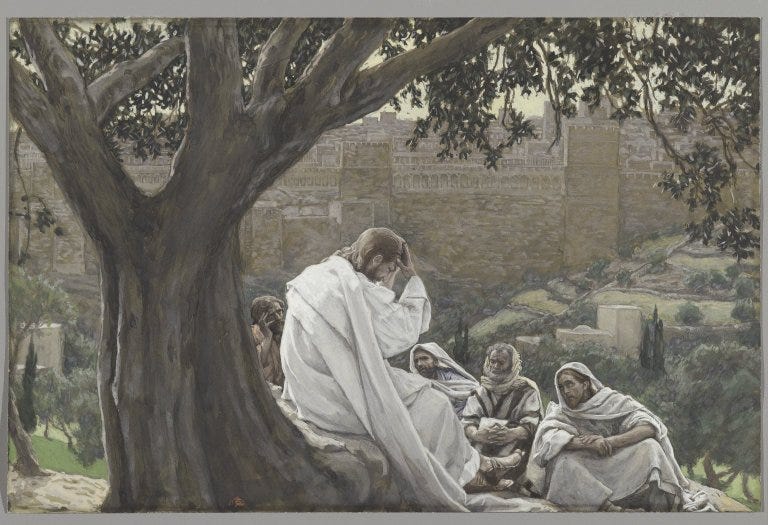
Not One Stone (13:1–4)
Jesus is leaving the temple for the last time. One of his disciples, still admiring the view behind him, draws attention to the stones and the buildings (13:1). Jesus’s reply is total:
“There will not be left here one stone upon another that will not be thrown down” (13:2).
That reply reverses an older promise. When the foundation of the Second Temple was laid, back when “stone was placed upon stone in the temple of the Lord” (Hag 2:15), the prophet Haggai told a discouraged and half-starved people that blessing was finally on its way: the vine, the fig tree, the pomegranate, and the olive tree, all fruitless until then, would be fruitful again because the Lord had begun to bless them (2:19).
Mark has already shown his readers a fig tree that received no such blessing. Jesus found it barren earlier that week and cursed it. This occurred on the same day he drove the money changers from that same temple (11:12–19). The disciples then found it withered the next morning (11:20–21). The unnamed disciple’s exclamation over the temple’s stones, “Look, Teacher” (13:1), deliberately recalls Peter’s exclamation over that withered tree, “Rabbi, look” (11:21). Mark wants the two moments read together. If the temple’s own fig tree failed to flourish, Haggai’s blessing has been reversed rather than merely delayed, and the stones laid up in hope will come down one by one.
Jesus does not explain any of this immediately. He continues his walk out to the Mount of Olives and then sits facing the temple across the valley (13:3). This posture is used for teaching, but also for judgment. Four disciples ask him privately when the destruction of the temple will happen and “what will be the sign when all these things are about to be accomplished” (13:4).
That second question borrows its shape from Daniel’s last vision, where two angelic figures ask how long until “the end of these wonders” (Dan 12:6) and are told that after a fixed period, “all these things would be finished” (12:7). Daniel’s fixed end fell on a specific persecutor within history, not on history itself. Jesus’ disciples are asking a similar question: not about the last day of the world, but about the last days of one particular building.
When reading Mark 13, we should never lose focus on what Jesus explicitly says he’s talking about. Lots of theories have developed to try to explain what Jesus means, especially in some of the more cryptic verses of this chapter, but without fail, they require insisting that what Jesus is actually talking about is different from his opening prediction and the disciples’ question. He predicts the Jerusalem Temple will be destroyed. His disciples ask when this will happen and what signs will precede this traumatic event; the rest of the discourse is Jesus’ answer to their questions.
When the Stars Fall (13:24–27)
When Israel’s prophets wanted to describe the fall of a great power, they used celestial language. Babylon’s coming defeat is announced like this:
“For the stars of the heavens and their constellations will not give their light; the sun will be dark at its rising, and the moon will not shed its light” (Isa 13:10).
Edom’s judgment sounds much the same:
“all the host of heaven shall rot away, and the skies roll up like a scroll” (Isa 34:4).
No one in Jerusalem who heard these words hundreds of years later imagined that the stars had literally fallen from heaven or the sun had literally stopped. They knew a good metaphor when they saw one. These texts were oracles of judgment against the enemies of God’s people, and the falling and failing lights signaled that an empire’s day was over and the current ordering of the world was coming to an end.
Jesus uses this exact language on the Mount of Olives, alluding clearly to Isa 13:10 and 34:4:
“But in those days, after that tribulation, the sun will be darkened, and the moon will not give its light, and the stars will be falling from heaven, and the powers in the heavens will be shaken” (Mark 13:24–25).
The disciples had asked when the temple would be thrown down (13:2–4). Jesus answers in the words Isaiah had spoken over Babylon and Edom. What has changed is the target. The oracles once aimed at Israel’s enemies now fall on the Jerusalem Temple.
Then comes the Son of Man, “coming in clouds with great power and glory” (13:26). The line is from Daniel 7:13, where the one like a son of man does not descend to earth. He ascends to the Ancient of Days and is given a kingdom. His coming is his vindication and enthronement, not a downward descent. He sends out the angels and gathers his elect “from the ends of the earth to the ends of heaven” (13:27), language drawn from Zech 2:6 [2:10 LXX] and Deut 30:4, where God promises to regather his scattered and exiled people. The fall of the old house and the vindication of the Son of Man are one event, which brings about the end of the exile.
Too many people misread these texts as still future prophecies about the end times, ignoring both the context of the disciples’ questions and the clear allusions to the Old Testament. The use of celestial upheaval language is a common prophetic metaphor for the end of an empire and the fall of the city. The striking thing in this text isn’t that the world is ending but that Jesus is taking language once used for Jerusalem’s enemies and applying it to Jerusalem itself.
The Lord of the House (13:34–37)
Jesus concludes his longest discourse in Mark with a short parable.
“It is like a man going on a journey, when he leaves home and puts his servants in charge, each with his work, and commands the doorkeeper to stay awake. Therefore stay awake—for you do not know when the master of the house will come, in the evening, or at midnight, or when the rooster crows, or in the morning—lest he come suddenly and find you asleep. And what I say to you I say to all: Stay awake” (Mark 13:34–37).
The command to stay awake—repeated three times in four verses—can seem like a general call for Christian alertness. But Mark has something much more specific in mind, and understanding it requires going back to the very first verse of his Gospel.
Mark begins with a composite quotation he attributes to Isaiah, but which actually starts with Malachi: “Behold, I send my messenger before your face, who will prepare your way” (Mark 1:2; cf. Mal 3:1). But Mark only quotes the first half of Mal 3:1 in his opening citation. The rest of the verse continues: “and the Lord whom you seek will suddenly come to his temple” (Mal 3:1).
That second half of Malachi 3:1 resurfaces at the end of Mark 13. In my dissertation research on Mark’s Gospel, I discovered that three Greek words from the Septuagint (the Greek translation of the Hebrew Bible) of Malachi 3:1—κύριος (”lord”), ἔρχομαι (”come”), and ἐξαίφνης (”suddenly”)—appear together in the LXX (shorthand for the Septuagint) only in that single verse, and in the entire New Testament they appear together only in Mark 13:35–36. When Jesus says that the master of the house (ὁ κύριος τῆς οἰκίας) will come (ἔρχεται) suddenly (ἐξαίφνης), Mark is not speaking in generalities. He is completing the allusion to Mal 3:1 with which he began his Gospel.
In addition to the above words, the connection is strengthened when we remember that, in Jewish tradition, the Lord’s house and the Lord’s temple are the same. Mark has already made this explicit: when Jesus quotes Isaiah in the temple courts, he calls it “my house” (Mark 11:17; cf. Isa 56:7), and earlier he refers to the tabernacle as “the house of God” (Mark 2:26; cf. 1 Sam 21:1–6). The master returning to his house is the Lord returning to his temple.
This allusion at the end of Mark 13 means that a single promise and threat frame chapters 1–13 of Mark’s Gospel: the Lord is coming to his temple; the people had better be ready. The Gospel begins with the messenger who prepares the way (John the Baptist), and it closes with the arrival of the Lord himself, who has already come to the temple, found it wanting, and predicted its destruction (Mark 11-13, be explicit in 13:1–2). The command to stay awake, then, is not a reminder to maintain spiritual disciplines. It is the urgency appropriate to a specific historical moment: the long promise of Malachi is on the verge of fulfillment. For Malachi, the Lord’s sudden arrival was not a comfort but a reckoning—“But who can endure the day of his coming, and who can stand when he appears?” (Mal 3:2). The Lord of the house has returned. Judgment is on its way. The people had better be awake and alert when it comes.
Looking at these cosmic happenings as a celestial metaphor is so helpful to me. I had read this type of passage literally for so long that when I was first introduced to the idea, it felt shocking and hard to trust that it was the correct interpretation, even though I so readily recognize metaphorical language in other passages and contexts.
For those of us raised with the teaching that God’s word or invitation to us is simple enough for a child to understand, based on Jesus telling us we need to become like little children to enter the kingdom of heaven, it is difficult not to read these passages literally.
I wonder if the prophets and Jesus used this cosmic/celestial metaphorical language for the same reason that Jesus said he spoke in parables: that some people would see and hear, but not recognize and understand God‘s invitation and visitation. His courtship of love feels veiled and strange.
Father, open my eyes, open our hearts to hunger for You, to recognize your presence and invitation to love. Thank you, LORD, for hearing this prayer.