

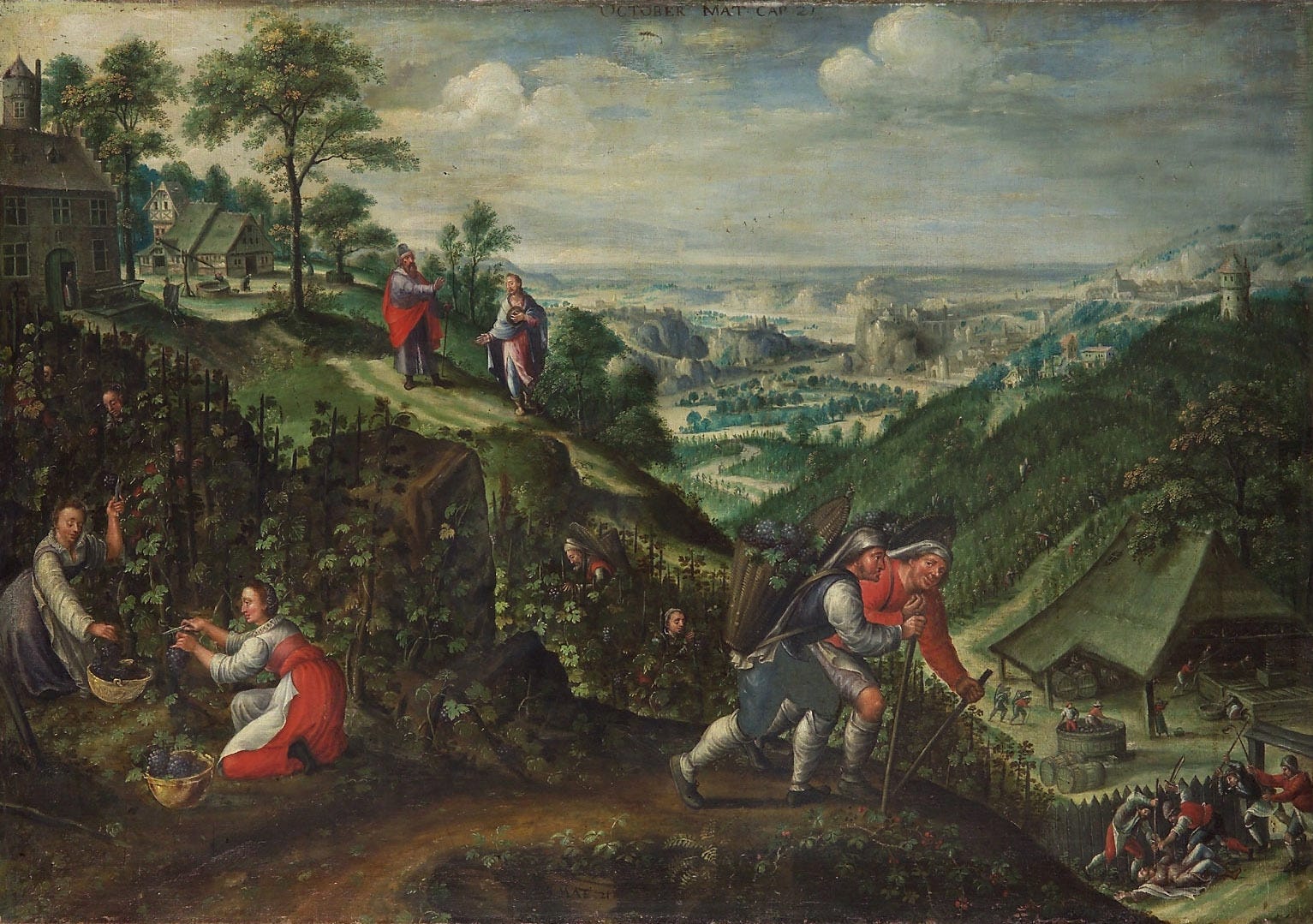
The Wicked Tenants & the Temple (Mar. 5, 2026)
To hear Jesus rightly, we need to start with Isaiah.
Let me sing for my beloved my love song concerning his vineyard: My beloved had a vineyard on a very fertile hill. He dug it and cleared it of stones, and planted it with choice vines; he built a watchtower in the midst of it, and hewed out a wine vat in it; and he looked for it to yield grapes, but it yielded wild grapes. And now, O inhabitants of Jerusalem and men of Judah, judge between me and my vineyard. What more was there to do for my vineyard, that I have not done in it? When I looked for it to yield grapes, why did it yield wild grapes? And now I will tell you what I will do to my vineyard. I will remove its hedge, and it shall be devoured; I will break down its wall, and it shall be trampled down. I will make it a waste; it shall not be pruned or hoed, and briers and thorns shall grow up; I will also command the clouds that they rain no rain upon it. For the vineyard of the Lord of hosts is the house of Israel, and the men of Judah are his pleasant planting; and he looked for justice, but behold, bloodshed; for righteousness, but behold, an outcry! (Isa 5:1–7)
When Jesus begins this parable, his audience would have immediately recognized the scene. The vineyard in Jesus’ parable intentionally echoes the opening of Isaiah’s Song of the Vineyard. In Isaiah, the song ends with judgment — Israel has only produced wild grapes, and the vineyard will be destroyed (Isa 5:5–7).
By the first century, Jewish interpreters had refined the imagery of the Song of the Vineyard in a specific direction. The Targum of Isaiah (a Targum is an Aramaic paraphrase of the Hebrew Bible) keeps the vineyard as Israel but identifies the tower within it as the sanctuary and the winepress as the altar (Tg. Isa. 5:1–2). Jesus is standing in that sanctuary when he tells this story. His listeners, deeply rooted in Isaiah’s tradition, would interpret the parable’s violence not just as a story about Israel in general but as a judgment on this place and the leaders who oversee it, which is exactly why the chief priests and scribes want to arrest him (Mark 12:12).
Jesus has been delivering his judgment against the Temple since he arrived in Jerusalem. He cursed the fig tree, causing it to wither (Mark 11:12–14, 20–21). He drove out the money changers and called the Temple a den of robbers (Mark 11:15–17), referring to Jeremiah’s famous temple sermon (Jer 7:11). Now, standing in the Temple courts, he shares a parable about a vineyard — and every listener familiar with Isaiah’s tradition knows what he’s talking about.
The owner sends servant after servant, each met with violence. The parade of rejected messengers echoes Israel’s long history of silencing its prophets — from Elijah’s flight under Jezebel (1 Kgs 19:1–3) to Jeremiah’s imprisonment (Jer 38:6). But then the parable turns on a single word.
The owner has one more to send: a beloved son (υἱὸν ἀγαπητόν). If you have been reading Mark carefully, you have heard this word before. At the Jordan, the Father’s voice breaks open the sky: “You are my beloved Son” (Mark 1:11). On the mountain of Transfiguration, the cloud speaks again: “This is my beloved Son; listen to him” (Mark 9:7). Now Jesus places that same title at the center of a parable about rejection and death, and no one in Mark’s audience can miss who this son is.
The tenants throw the son outside the vineyard — outside, where crucifixions happen — certain they have won. But Jesus will not let the story end there. He quotes Psalm 118: the stone the builders rejected has become the cornerstone. The one cast outside becomes the foundation of everything. The leaders believe they are securing their inheritance. They are, in fact, sealing their own displacement and the Temple’s doom — and opening the door to something they never imagined.