

With All Your Strength (12:38–44)
A few verses earlier, a scribe had asked Jesus which commandment came first, and Jesus answered with the Shema:
“You shall love the Lord your God with all your heart and with all your soul and with all your mind and with all your strength” (12:30).
The scribe agreed, calling it “much more than all whole burnt offerings and sacrifices” (12:33), and Jesus told him he was “not far from the kingdom of God” (12:34). The question of how to fulfill this command is interesting, and the rabbis read one part quite literally: to love God with all your might, the Mishnah says, means to love him with all your money (Mishnah Berakhot 9:5). According to the rabbis, whatever else the command asks, it asks for what a person owns.
Jesus then turns from that one scribe to the scribes as a class, and the contrast could not be sharper. They walk around in long robes, collect greetings in the marketplace, and take the best seats in the synagogue and the place of honor at feasts (12:38–39). Public religion pays them a return: status, deference, and a seat where everyone can watch them occupy it. The charge then turns from vanity to theft: “they devour widows’ houses and for a pretense make long prayers” (12:40). The long prayer functions less as devotion than as camouflage, covering the extraction of property from the very people the law commands Israel to protect. Their religion has become a way of gaining: gaining honor, gaining deference, and gaining property from those with the least to spare.
Jesus then sits across from the temple treasury and watches (12:41). Many rich people put in large sums. A poor widow puts in two small copper coins, “which make a penny” (12:42), and Jesus tells his disciples that she “has put in more than all those who are contributing to the offering box” (12:43). The reason follows as a single verdict:
“They all contributed out of their abundance, but she out of her poverty has put in everything she had, all she had to live on” (12:44).
If loving God with all your strength means loving him with all you have, she is the one person in this scene who does it, and she does it in silence, watched by no one in the crowd but Jesus.
Two responses to the same command sit side by side in these verses. The scribes know the command. One of them can even state it perfectly and be told he is close to the kingdom. Yet as a class, they turn religion into a means of gain. In contrast, the widow gives everything she has left. We who serve visibly in the church should feel the weight of this text. The widow is not after praise, power, or possessions. She simply fulfills a command that is much easier to preach than to live out.
Not Far from the Kingdom (12:28–34)
A scribe asked Jesus which commandment was most important, and Jesus answered with the words Israel said morning and evening: “Hear, O Israel: The LORD our God, the LORD is one. You shall love the LORD your God with all your heart and with all your soul and with all your might” (Deut 6:4–5). The Shema was to be bound on the wrist, worn on the forehead, and written on the doorposts. It was not one commandment among many but the confession that there is one God who has a claim on the whole person.
Then Jesus joined a second commandment to the first. The scribe asked for one, and Jesus gave him two: “You shall love your neighbor as yourself” (Lev 19:18; 12:31). He does so because the love of God and the love of neighbor are, in effect, a single command. You cannot love the one God with the whole self and hold your neighbor at arm’s length.
In Matthew and Luke, the conversation ends near here, and the questioner is hostile, testing Jesus. Mark tells it differently. Here, the scribe does not walk away. He answers back.
“You are right, Teacher. You have truly said that he is one, and there is no other besides him. And to love him with all the heart and with all the understanding and with all the strength, and to love one’s neighbor as oneself, is much more than all whole burnt offerings and sacrifices” (12:32–33).
The scribe repeats the commandments back, and then he adds something Jesus had not said. Love is worth more than the entire sacrificial system. He is reaching for the prophets, who said the same thing long before. The LORD desires mercy, and not sacrifice (Hos 6:6). Standing in the temple courts, with the smoke of the offerings in the air, the scribe says that what God wants most is not the thing happening all around them. He answers wisely.
So Jesus gives him a verdict found in no other Gospel:
“You are not far from the kingdom of God” (12:34).
Not far, but not in. There is still a distance left to travel. The scribe has every right answer. He has the confession, the two commandments, the prophets, and the proper ranking of love above sacrifice. And yet he is still outside. He has understood much, but not who is standing in front of him.
This is why, in the next verses, Jesus will ask how the Messiah can be both David’s son and David’s Lord (12:35–37). The scribe has rightly judged that God wants love more than sacrifices. He has not yet perceived that the kingdom has arrived in the man in front of him. From the beginning, Jesus announced that the kingdom of God had come near (1:15). Here the kingdom-in-the-person-of-Jesus is nearer than the scribe knows, close enough to speak to him, and the last step is not another right answer but turning to Jesus himself.
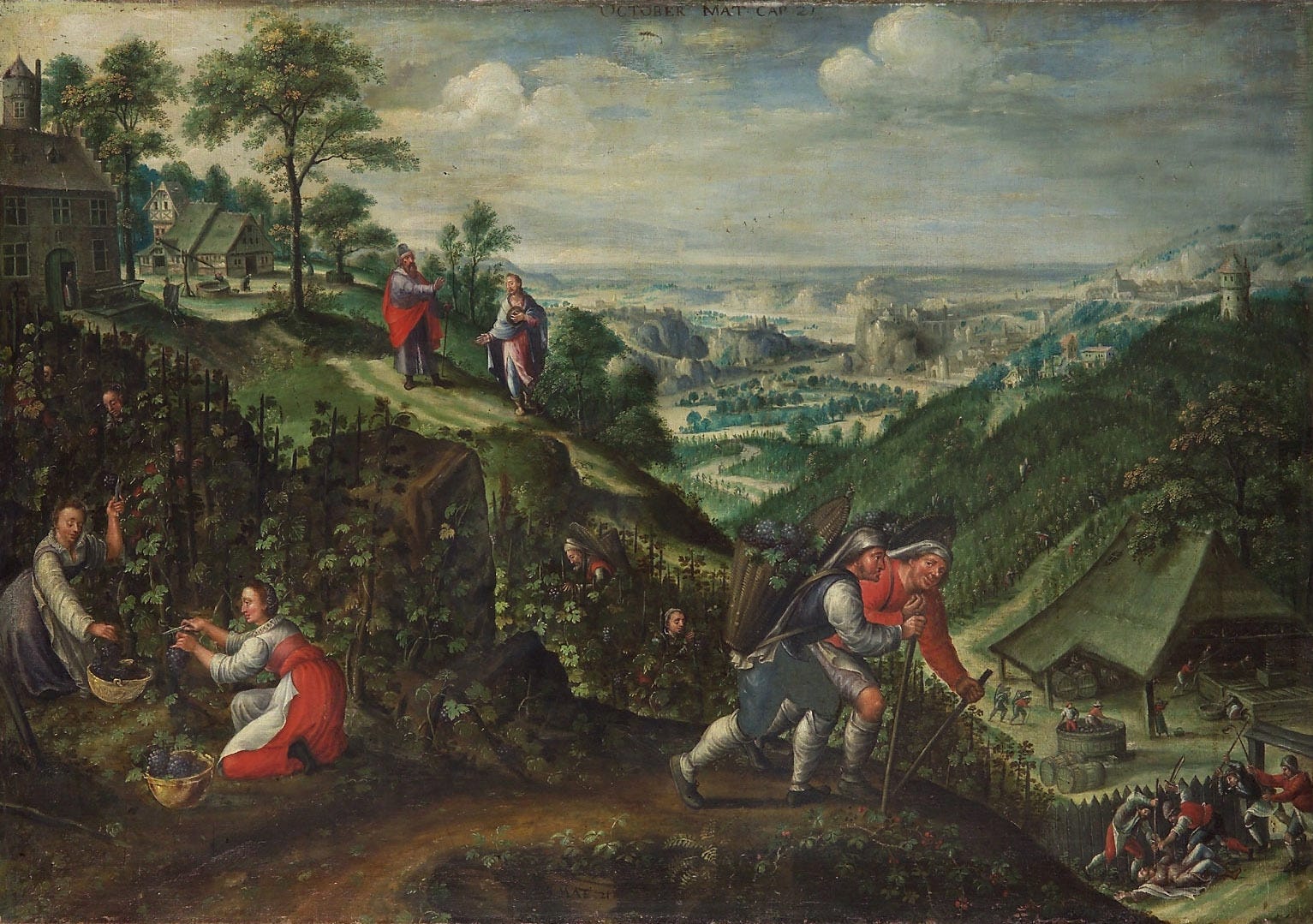
The Wicked Tenants & the Temple (12:1–12)
To hear Jesus rightly, we need to start with Isaiah.
Let me sing for my beloved my love song concerning his vineyard: My beloved had a vineyard on a very fertile hill. He dug it and cleared it of stones, and planted it with choice vines; he built a watchtower in the midst of it, and hewed out a wine vat in it; and he looked for it to yield grapes, but it yielded wild grapes. And now, O inhabitants of Jerusalem and men of Judah, judge between me and my vineyard. What more was there to do for my vineyard, that I have not done in it? When I looked for it to yield grapes, why did it yield wild grapes? And now I will tell you what I will do to my vineyard. I will remove its hedge, and it shall be devoured; I will break down its wall, and it shall be trampled down. I will make it a waste; it shall not be pruned or hoed, and briers and thorns shall grow up; I will also command the clouds that they rain no rain upon it. For the vineyard of the Lord of hosts is the house of Israel, and the men of Judah are his pleasant planting; and he looked for justice, but behold, bloodshed; for righteousness, but behold, an outcry! (Isa 5:1–7)
When Jesus begins this parable, his audience would have immediately recognized the scene. The vineyard in Jesus’ parable intentionally echoes the opening of Isaiah’s Song of the Vineyard. In Isaiah, the song ends with judgment — Israel has only produced wild grapes, and the vineyard will be destroyed (Isa 5:5–7).
By the first century, Jewish interpreters had refined the imagery of the Song of the Vineyard in a specific direction. The Targum of Isaiah (a Targum is an Aramaic paraphrase of the Hebrew Bible) keeps the vineyard as Israel but identifies the tower within it as the sanctuary and the winepress as the altar (Tg. Isa. 5:1–2). Jesus is standing in that sanctuary when he tells this story. His listeners, deeply rooted in Isaiah’s tradition, would interpret the parable’s violence not just as a story about Israel in general but as a judgment on this place and the leaders who oversee it, which is exactly why the chief priests and scribes want to arrest him (Mark 12:12).
Jesus has been delivering his judgment against the Temple since he arrived in Jerusalem. He cursed the fig tree, causing it to wither (Mark 11:12–14, 20–21). He drove out the money changers and called the Temple a den of robbers (Mark 11:15–17), referring to Jeremiah’s famous temple sermon (Jer 7:11). Now, standing in the Temple courts, he shares a parable about a vineyard — and every listener familiar with Isaiah’s tradition knows what he’s talking about.
The owner sends servant after servant, each met with violence. The parade of rejected messengers echoes Israel’s long history of silencing its prophets — from Elijah’s flight under Jezebel (1 Kgs 19:1–3) to Jeremiah’s imprisonment (Jer 38:6). But then the parable turns on a single word.
The owner has one more to send: a beloved son (υἱὸν ἀγαπητόν). If you have been reading Mark carefully, you have heard this word before. At the Jordan, the Father’s voice breaks open the sky: “You are my beloved Son” (Mark 1:11). On the mountain of Transfiguration, the cloud speaks again: “This is my beloved Son; listen to him” (Mark 9:7). Now Jesus places that same title at the center of a parable about rejection and death, and no one in Mark’s audience can miss who this son is.
The tenants throw the son outside the vineyard — outside, where crucifixions happen — certain they have won. But Jesus will not let the story end there. He quotes Psalm 118: the stone the builders rejected has become the cornerstone. The one cast outside becomes the foundation of everything. The leaders believe they are securing their inheritance. They are, in fact, sealing their own displacement and the Temple’s doom — and opening the door to something they never imagined.
I was reminded of a Christian organization’s fundraiser I once attended. In the program handed out, there were listed the names of the “silver, gold, and platinum” donors. I recall sitting there knowing the approximate annual wealth of one of the “platinum” donors so I did a quick calculation. Based on their annual income, their platinum level donation equated to about 1% of their income! Yet others of us in attendance, had we donated a much lesser amount would have been giving more like 5-10% of our weekly income! Sad that not much has changed since Jesus’ day. There is still so much preference and deference to the rich who love being lauded and praised for their giving