

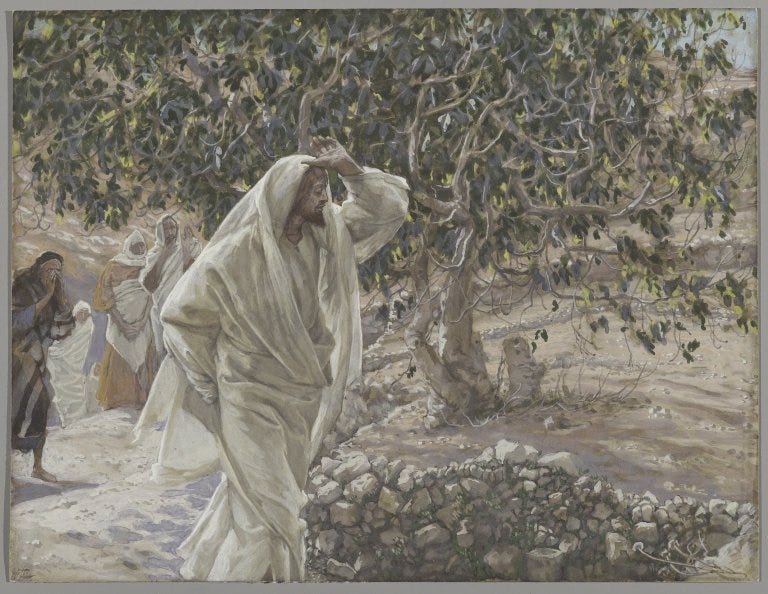
The Fig Tree and the Temple (Mar. 4, 2026)
Mark’s Gospel begins with both a promise and a threat. Combining Malachi 3:1 and Isaiah 40:3, Mark states that a messenger will prepare the way before the Lord comes himself (Mark 1:2–3). For Israel, the Lord’s coming to his temple was the ultimate hope — but Malachi’s vision of that arrival turned the promise of comfort into a threat.
Who can endure the day of his coming, and who can stand when he appears? For he is like a refiner’s fire and like fullers’ soap (Mal 3:2).
The promise of the Lord’s coming carried within it the threat of his judgment. Everything in Mark’s Gospel — the ministry in Galilee, the journey toward Jerusalem, the mounting confrontations with religious authorities — is the narrative unfolding of that double-edged promise. Mark 11 is where it arrives.
When Jesus enters Jerusalem and surveys the temple courts (Mark 11:11), the arrival Malachi anticipated has come. And the verdict is not in Israel’s favor. Israel’s prophets had long used the fig tree as a symbol for the nation under judgment. Micah lamented:
There is no cluster to eat, no first-ripe fig that my soul desires (Mic 7:1).
Jeremiah announced divine judgment in identical terms:
There are no grapes on the vine, nor figs on the fig tree; even the leaves are withered (Jer 8:13).
When Jesus curses the fig tree on his way into Jerusalem, he is entering into this prophetic tradition — acting out what the prophets had spoken in words.
Mark places the temple action (Mark 11:15–19) within the fig tree story, a literary technique he uses throughout the Gospel to encourage mutual interpretation. The cursing of the fig tree is not a prelude to a temple cleansing — it is the key to understanding what the temple action truly signifies. Jesus is not reforming the temple or cleansing its worship; he is condemning it. What he does in those courts is prophetic theater — similar to Isaiah walking naked through Jerusalem (Isa 20:1–6) or Jeremiah smashing a clay jar at the city gate (Jer 19:1–13). The Lord has come to his temple, and he has found it fruitless.
The withered tree that the disciples see the next morning (Mark 11:20–21) serves as Mark’s closing symbol. The fig tree is dead. And for those with ears to hear, so is the temple, which would fall to Roman armies in AD 70, just as Jesus explicitly predicted in Mark 13. The so-called cleansing of the temple is better understood as its final sentencing.