

His Own Authority (11:27–33)
Jesus is walking in the temple again, the same courts where he had overturned the tables the day before. The chief priests, the scribes, and the elders confront him:
“By what authority are you doing these things, or who gave you this authority to do them?” (11:28). “
These things” points to what they had just watched him do in their temple.
Jesus answers with a question of his own:
“Was the baptism of John from heaven or from man? Answer me” (11:30).
Read as a purely rhetorical maneuver, the question appears to be a way of trapping the Sanhedrin between two bad answers and walking away unscathed, but this reading misses the importance the Gospel of Mark has placed on John the Baptist from the very beginning.
Mark opened his Gospel with a quotation from Isa 40:3 and Mal 3:1. Read in their full contexts, these verses together describe a messenger sent to prepare the way of the Lord before he would return suddenly to his own temple (Mark 1:2–3, quoting Isa 40:3 and Mal 3:1). The next verse named John as that messenger (1:4). When Jesus arrives at the Temple in chapter 11, that moment has finally come. The Lord has returned to his Temple.
John himself said only one thing in direct speech in the whole of Mark’s Gospel:
“After me comes he who is mightier than I, the strap of whose sandals I am not worthy to stoop down and untie” (1:7).
His entire recorded testimony pointed forward to Jesus. That is what makes Jesus’ response in verse 30 so powerful. On the surface, he is asking about John, but the entire Gospel has claimed that the identity of John is directly connected to the identity of Jesus. John is the forerunner of the Lord. John was the forerunner of Jesus. Therefore, Jesus is Lord. That’s the argument that Mark’s Gospel has been making since its opening words.
So if the leaders say John’s baptism came from heaven, Jesus will ask why they did not believe him, since believing John meant believing what he said about the one coming after him. If they say it was from man, they risk the crowd, “for they all held that John really was a prophet” (11:32). So they answer, “We do not know” (11:33), because they cannot bring themselves to admit the truth.
Jesus’s opponents wanted to know by what authority he had done “these things.” In other words, they want to know by what authority he had acted so authoritatively and negatively toward the Jerusalem Temple. By connecting his authority to the identity of John as he does in v. 30, Jesus is giving a very simple answer: the authority by which he has done these things is his own. He is the Lord for whom John was the forerunner, and he has returned to his temple at last and found it wanting. Jesus needed no other authority to do what he did and to say what he said. He is the Lord. The authority was his own.
Great Humility (11:1–11)
Two centuries before Jesus rode into Jerusalem, another deliverer entered the city to celebration. The Maccabean revolt had freed Judea from Seleucid rule, and when Simon completed the war his brother Judas had begun, the people received him as a conquering king.
On the twenty-third day of the second month, in the one hundred seventy-first year, the Jews entered [Jerusalem] with praise and palm branches, and with harps and cymbals and stringed instruments, and with hymns and songs, because a great enemy had been crushed and removed from Israel (1 Macc 13:51).
These actions were the script for welcoming a liberator, and Simon decreed that the day be kept yearly with rejoicing. So when crowds spread branches before Jesus and shouted, “Hosanna! Blessed is he who comes in the name of the Lord! Blessed is the coming kingdom of our father David!” (Mark 11:9–10; cf. Ps 118:25–26), the script was being rehearsed again. The crowd was welcoming a new Maccabee. They wanted Judas the hammer (the name Maccabee comes from the Greek word for “hammer”), someone to crush Rome as Simon had crushed the Seleucids.
Jesus recognizes the script but refuses to participate in it. He sends for a colt and rides it into the city (Mark 11:7), and the choice is deliberate. The colt is not the animal for a conquering king. It signified something else, just as Zechariah prophesied.
Behold, your king is coming to you; righteous and having salvation is he, humble and mounted on a donkey, on a colt, the foal of a donkey. I will cut off the chariot from Ephraim and the war horse from Jerusalem; and the battle bow shall be cut off, and he shall speak peace to the nations (Zech 9:9–10).
The crowd proclaims a new king like the Maccabees, but Jesus came to bring peace, and the donkey makes this point. The king of Zechariah 9 disarms Jerusalem rather than arming it. He abolishes the chariot, the war horse, and the bow. The crowd waves branches for a conqueror while their God rides into the city to cut the conqueror’s weapons to pieces.
Mark leaves this unspoken. He never quotes Zechariah; he records the colt and lets the reader who knows the prophecy supply the rest. Then he ends the scene flatly: Jesus entered the temple, looked around at everything, and left, because it was late (Mark 11:11).
No triumph. No coronation. The king has come, and almost no one has understood what kind of king he is.
We have not understood much better. We still want the deliverer who fights our battles and breaks our enemies, and we are slow to want the one who comes low, riding a borrowed colt, on his way to a cross. We are meant to be changed into his image, but usually we try to change him into ours.
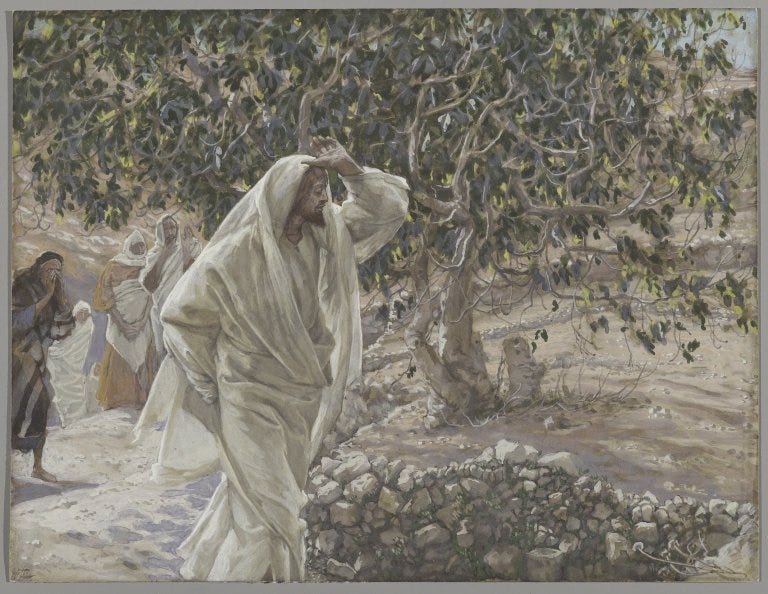
The Fig Tree and the Temple (11:21)
Mark’s Gospel begins with both a promise and a threat. Combining Malachi 3:1 and Isaiah 40:3, Mark states that a messenger will prepare the way before the Lord comes himself (Mark 1:2–3). For Israel, the Lord’s coming to his temple was the ultimate hope — but Malachi’s vision of that arrival turned the promise of comfort into a threat.
Who can endure the day of his coming, and who can stand when he appears? For he is like a refiner’s fire and like fullers’ soap (Mal 3:2).
The promise of the Lord’s coming carried within it the threat of his judgment. Everything in Mark’s Gospel — the ministry in Galilee, the journey toward Jerusalem, the mounting confrontations with religious authorities — is the narrative unfolding of that double-edged promise. Mark 11 is where it arrives.
When Jesus enters Jerusalem and surveys the temple courts (Mark 11:11), the arrival Malachi anticipated has come. And the verdict is not in Israel’s favor. Israel’s prophets had long used the fig tree as a symbol for the nation under judgment. Micah lamented:
There is no cluster to eat, no first-ripe fig that my soul desires (Mic 7:1).
Jeremiah announced divine judgment in identical terms:
There are no grapes on the vine, nor figs on the fig tree; even the leaves are withered (Jer 8:13).
When Jesus curses the fig tree on his way into Jerusalem, he is entering into this prophetic tradition — acting out what the prophets had spoken in words.
Mark places the temple action (Mark 11:15–19) within the fig tree story, a literary technique he uses throughout the Gospel to encourage mutual interpretation. The cursing of the fig tree is not a prelude to a temple cleansing — it is the key to understanding what the temple action truly signifies. Jesus is not reforming the temple or cleansing its worship; he is condemning it. What he does in those courts is prophetic theater — similar to Isaiah walking naked through Jerusalem (Isa 20:1–6) or Jeremiah smashing a clay jar at the city gate (Jer 19:1–13). The Lord has come to his temple, and he has found it fruitless.
The withered tree that the disciples see the next morning (Mark 11:20–21) serves as Mark’s closing symbol. The fig tree is dead. And for those with ears to hear, so is the temple, which would fall to Roman armies in AD 70, just as Jesus explicitly predicted in Mark 13. The so-called cleansing of the temple is better understood as its final sentencing.