

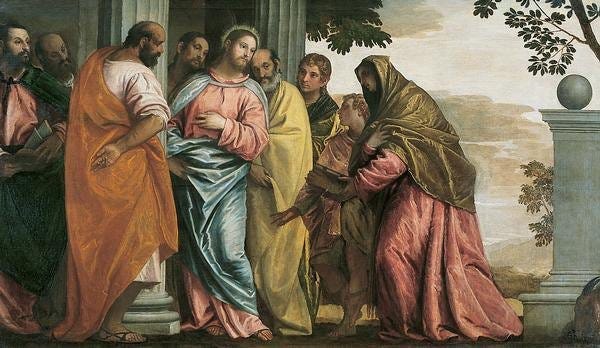
Delivered Over (10:32–34)
On the road to Jerusalem, Jesus takes the twelve aside once more and tells them what awaits him in that city (10:32). Twice already he has tried to communicate this to them, and twice they have failed to understand him (8:31–32; 9:31–32). This time he is more specific.
See, we are going up to Jerusalem, and the Son of Man will be delivered over to the chief priests and the scribes, and they will condemn him to death and deliver him over to the Gentiles. And they will mock him and spit on him, and flog him and kill him. And after three days he will rise (10:33–34).
Jesus doesn’t simply say that these things will happen to him. He says twice, in the same sentence, that he will be delivered over: first handed over, with no one named as the one doing the handing, to the chief priests and scribes; then handed over again, this time by them, to the Gentiles.
Mark’s Greek uses a single verb both times, παραδίδωμι (paradidōmi), “to hand over.” That verb is important. Our English Old Testament does not use “handed over” for Isaiah’s Servant. It says the Lord “has laid on him the iniquity of us all” (53:6), and that the Servant “poured out his soul to death and was numbered with the transgressors” (53:12). But when translating this passage into Greek, the translator uses paradidōmi three times in that one chapter. God himself “handed him over” for the people’s sins (53:6). The Servant’s own soul “was handed over to death.” And in the chapter’s last line, with no one named as the one responsible, he “was handed over” once more (53:12). One clause names God outright. Two others simply say the Servant was handed over and leave the agent unspoken, exactly as Mark’s first clause does for Jesus.
Jesus isn’t merely telling his disciples that he’s going to Jerusalem and that something will happen to him. He’s signaling to them that what is going to happen to him in the city is the fulfillment of Israel’s ancient songs about the Suffering Servant who would be handed over for the salvation of the people. That this Isaianic connection is what Mark intends is made almost certain by the fact that, not many verses later, Jesus will say that the Son of Man has come to give his life as a ransom for many (10:45), another direct allusion to Isaiah 53.
What happened to Jesus in Jerusalem wasn’t chance. It wasn’t bad luck. It was the will of God unfolding in human history for the salvation of the whole world.
Blind Bartimaeus (10:46–52)
At Caesarea Philippi, Peter confessed:
“You are the Christ” (8:29).
To confess that Jesus was the Christ was to confess him as the son of David, the anointed king of David’s house for whom Israel had waited. Peter has the title right, but he doesn’t yet understand what it means. That’s why, as soon as Jesus says the Christ must be handed over, killed, and after three days rise, Peter immediately rebukes him (8:31–32).
The Way-section is intended to clarify what it means that Jesus is the Christ. In this section, Jesus predicts his suffering and death three times (8:31; 9:31; 10:33–34), and three times the disciples fail to understand him. Instead, they argue about rank and authority.
James and John ask for the seats of honor when the glory comes. They are waiting for a conquering king and cannot make room for the one walking ahead of them toward a cross. The whole section drives at one redefinition: the son of David is the one whose messiahship is made of suffering, death, and resurrection. And it makes that claim even as the disciples continue to misunderstand it.
But then, as the road reaches Jericho, a blind beggar shouts the title that no one else in the Gospel has yet spoken of Jesus.
“Jesus, Son of David, have mercy on me!” (Mark 10:47).
Bartimaeus is the first in the Gospel to call Jesus the Son of David out loud. Like the disciples, he may not fully know what the title means, but unlike the disciples, he knows to ask for mercy, not a throne.
To make the contrast between Blind Bartimaeus and the disciples even clearer, when Jesus calls Bartimaeus over, he asks him the same question he had just asked James and John:
“What do you want me to do for you?” (10:51; cf. 10:36).
The words are identical. The answers are not. The brothers, who could see physically, asked to sit at Jesus’ right hand and his left in his glory, not knowing that those places would be filled by two crucified men (15:27). The beggar asks to see. He receives his sight, and then he “followed him on the way” (10:52). The Twelve have walked with Jesus at least since the Way-section began, but they continue to be blind. They need to learn from Bartimaeus and ask Jesus for mercy rather than positions of authority and power, and then their blindness would be healed too.
Baptism and the Cup (10:35–45)
Mark 10:35–45 marks the end of what many readers call Mark’s “Way section,” the lengthy middle part of the Gospel where Jesus is “on the way” to Jerusalem. This section develops the Isaianic quotation with which Mark began his Gospel, clearly showing that Jesus’ journey to the city signals the long-awaited return of YHWH to Zion.
The section is bookended by two miracles where Jesus heals blindness: the blind man at Bethsaida (8:22–26) and Bartimaeus (10:46–52). The Way section then formally begins with Peter’s confession at Caesarea Philippi (8:27–30), and it ends with Jesus responding to James and John’s request. As Jesus is “on the way,” he predicts his suffering and death three times (8:31; 9:31; 10:33–34), and each time the disciples react with similar misunderstandings. They can’t grasp a Messiah whose glory is revealed through a cross, nor can they see discipleship as a cruciform way of life.
That pattern reaches its clearest expression here. James and John come to Jesus with a familiar request:
“Grant us to sit, one at your right hand and one at your left, in your glory” (10:37 ESV).
Their question concerns greatness as the world sees it. They seek power, prestige, privilege, and prosperity.
Jesus knows that his “glory” will come through a Roman cross, and so he says:
“You do not know what you are asking” (10:38a).
He then reinterprets the glory awaiting him in Jerusalem through two images.
“Are you able to drink the cup that I drink, or to be baptized with the baptism with which I am baptized?” (10:38b).
With both symbols, Jesus is discussing his death. The cup probably represents the cup of wrath for the nations (Jer 25:15), and baptism, because it is a salvation-through-water event rather than a salvation-from-water one, strongly suggests that, unlike Israel at the Red Sea, Jesus will enter the waters of death, be covered by them, and then rise again.
Notice how layered this moment is. At the beginning of Mark’s Gospel, Jesus is baptized as his ministry starts (Mark 1:9–11). By the end, he will take a cup and speak of his blood (11:22–24). Here, on the brink of his passion, Jesus gathers the entire mystery of his life, death, and resurrection into a single invitation. If you want to share in my glory, it won’t be through status and power as the world defines them, but through participation in baptism and the cup.
This clearly sacramental statement shapes the entirety of our Christian life.
Baptism and the Eucharist do not stand hand-in-hand with the world’s definition of power and status. They bury it. The sacraments mark us as people whose lives are shaped by another way: the way of self-denial, self-giving, and self-emptying. Jesus makes the contrast explicit while weaving in multiple allusions to Daniel 7:
“You know that those who are considered rulers of the Gentiles lord it over them…. But it shall not be so among you” (Mark 10:42–43).
Greatness in the kingdom of God is not about power or domination (like the trampling beasts rising out of the cosmic sea). Greatness in the kingdom of God is defined by servanthood. And this is true for a simple reason:
“For even the Son of Man came not to be served but to serve, and to give his life as a ransom for many” (10:45, weaving together Dan 7:13-14 and Isa 53:10–12).
James and John wanted power and glory, but a life defined by the sacraments points in another direction.
In the kingdom of God, the way up is the way down.
Jesus knows there is only one road that leads to Easter, and it goes through the cross, which is why he tells his disciples (bringing us all the way back to the beginning of the Way section):
“If anyone would come after me, let him deny himself and take up his cross and follow me” (Mark 8:34).
I am puzzling over this part of verse 32: “And they were on the road, going up to Jerusalem, and Jesus was walking ahead of them. And they were amazed, and those who followed were afraid”. Why would the people following him be afraid? Is it a fear of the cost of discipleship (given what Jesus has just said to the rich young ruler)? Fear of what Jesus’ teachings may bring upon the Jews at large? Something else?
I began to think as I read how much Christian Nationalists mimic what we see in the people and disciples during Jesus’ time on earth. Just like the Jews of Jesus’ day, many are looking for a “savior” to conquer their perceived enemies. They are not looking for the Jesus’ Way where he calls us to come and die!
“24 I tell you the truth, unless a kernel of wheat is planted in the soil and dies, it remains alone. But its death will produce many new kernels—a plentiful harvest of new lives.25 Those who love their life in this world will lose it. Those who care nothing for their life in this world will keep it for eternity.“