

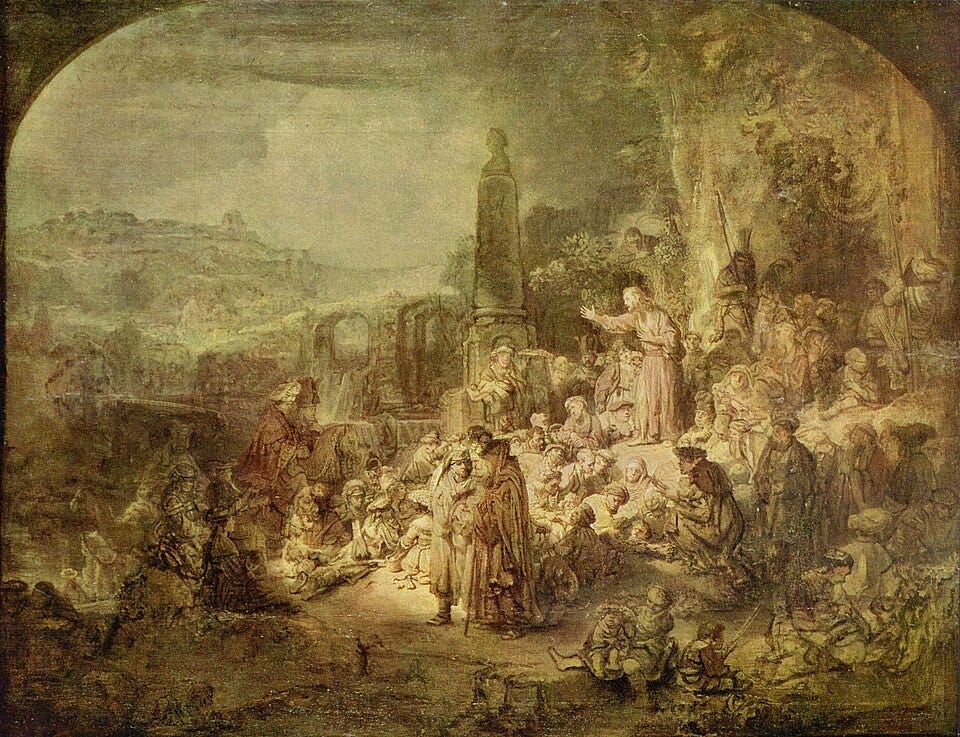
The Beginning of the Gospel (Feb. 22, 2026)
Each Gospel begins differently, and Mark’s begins unlike any other. There is no birth story, no genealogy, and no angelic announcement. Mark starts with a quote from the Scriptures that, upon closer look, is much more powerful than it first seems. If we assume that Mark was the first Gospel written, these are the very first words ever written when someone began telling the story of Jesus.
The beginning of the gospel of Jesus Christ, the Son of God. As it is written in Isaiah the prophet, “Behold, I send my messenger before your face, who will prepare your way, the voice of one crying in the wilderness: ‘Prepare the way of the Lord, make his paths straight’” (Mark 1:1–3).
Mark attributes the quotation to Isaiah, but the opening lines actually come from Mal 3:1.
Behold, I send my messenger, and he will prepare the way before me. And the Lord whom you seek will suddenly come to his temple; and the messenger of the covenant in whom you delight, behold, he is coming, says the Lord of hosts (Mal 3:1).
This attribution is intentional, not an error. It links two passages that already resonate in Jewish scripture. Isaiah 40 announces the end of the exile and God’s return to Zion. Malachi 3 tempers that hope with a warning about what might happen if God finds the people lacking when he returns.
The second half of Mark’s opening citation is from Isa 40:3.
A voice cries: “In the wilderness prepare the way of the Lord; make straight in the desert a highway for our God” (Isa 40:3).
In this passage, the prophet promises that “a voice” will prepare the way of Yahweh—Israel’s God himself—returning at last to his people after their long exile. Mark borrows this promise and applies it directly to John’s preparation of the way for Jesus.
The implication is staggering. If John is preparing the way of the Lord, and John is preparing the way of Jesus, then Jesus is the Lord whose arrival Isaiah announced.
Mark has placed a divine identity claim in the very first paragraph of his Gospel, half-hidden inside an Old Testament citation. Remember this the next time someone tells you that high Christology is only found in the later writings of the New Testament.
Likewise, Malachi’s oracle warns of a messenger sent ahead of Yahweh before he comes suddenly to his temple. The prophet warns that the day of arrival will be a day of reckoning. In Mark, the messenger is John. The one coming to the temple is Jesus. Jesus is the Lord who will suddenly come to this temple, just as he does in ch. 11.
Israel had been waiting a long time. Many believed that God had gone silent—that the exile, in some deep sense, had never truly ended. Into that silence, Mark writes: the beginning of the gospel. The waiting is over. What Isaiah announced as the new exodus, what Malachi warned as judgment—all of it has arrived in the person of Jesus Christ, the Son of God.