

What Moved Him (1:40–45)
A leper’s approach to another person was itself a violation of the Law. Leviticus required a leper to live outside the camp alone and warn others away (Lev 13:45–46). When the leper comes to Jesus, he kneels and says, “If you will, you can make me clean” (1:40); the question he raises is not whether Jesus is able. It is whether Jesus is willing to risk the contact the Law was put in place to prevent.
Mark’s next clause has occupied textual critics for over a century. Nearly every Greek manuscript, including important ones like Sinaiticus, Vaticanus, and Alexandrinus, reads that Jesus was σπλαγχνισθείς (splanchnistheis), “moved with pity,” before he touches the man (1:41). A minority stream, preserved in Codex Bezae and the Old Latin tradition, reads ὀργισθείς (orgistheis) instead, “moved with anger.” The manuscript evidence favors ‘pity’ by an overwhelming margin, and that is the wording that should stand, even though ‘anger’ is the more difficult reading. The variant persists because this same Gospel is willing to say that Jesus once looked at people μετ’ ὀργῆς, “with anger” (3:5), so the emotion itself would not be out of character here.
The manuscript question need not be resolved for the exegetical point to stand. Jesus heals the man, and then Mark writes that Jesus ἐμβριμησάμενος, “sternly charged,” the man (a verb used elsewhere of a horse’s snort) and ἐξέβαλεν, “sent him away,” at once (1:43). Mark used that same verb in the same form one paragraph earlier for Jesus casting demons out of the possessed (ἐξέβαλεν, 1:34), and it shares its root with the verb for the Spirit driving Jesus into the wilderness at the start of the chapter (ἐκβάλλει, 1:12). The man who had once been cast out of his community is now cast out again, not because he is unclean, but because he has been made clean and can return to his family and former life.
But Jesus does not send the leper away without instruction. He tells him to show himself to the priest and “offer for your cleansing what Moses commanded, for a proof to them” (1:44). Jesus is referring to the rite of Leviticus 14 that begins outside the camp with the blood of one bird and the release of a second, and ends, on the eighth day, with further sacrifices before the man is restored to full standing in the community. Jesus heals apart from the law, but he sends the man to be verified by it rather than around it.
The irony lands in the closing verse. Leviticus said the leprous man’s dwelling had to be outside the camp (13:46). Once healed, this man disobeys, talks freely, and spreads the news, and it is Jesus who can no longer enter a town openly but stays in desolate places (1:45). Jesus, not surprisingly given the whole shape of Mark’s Gospel, now takes the place of this leper as he lives in desolate places.
The Torn Heavens (1:9–11)
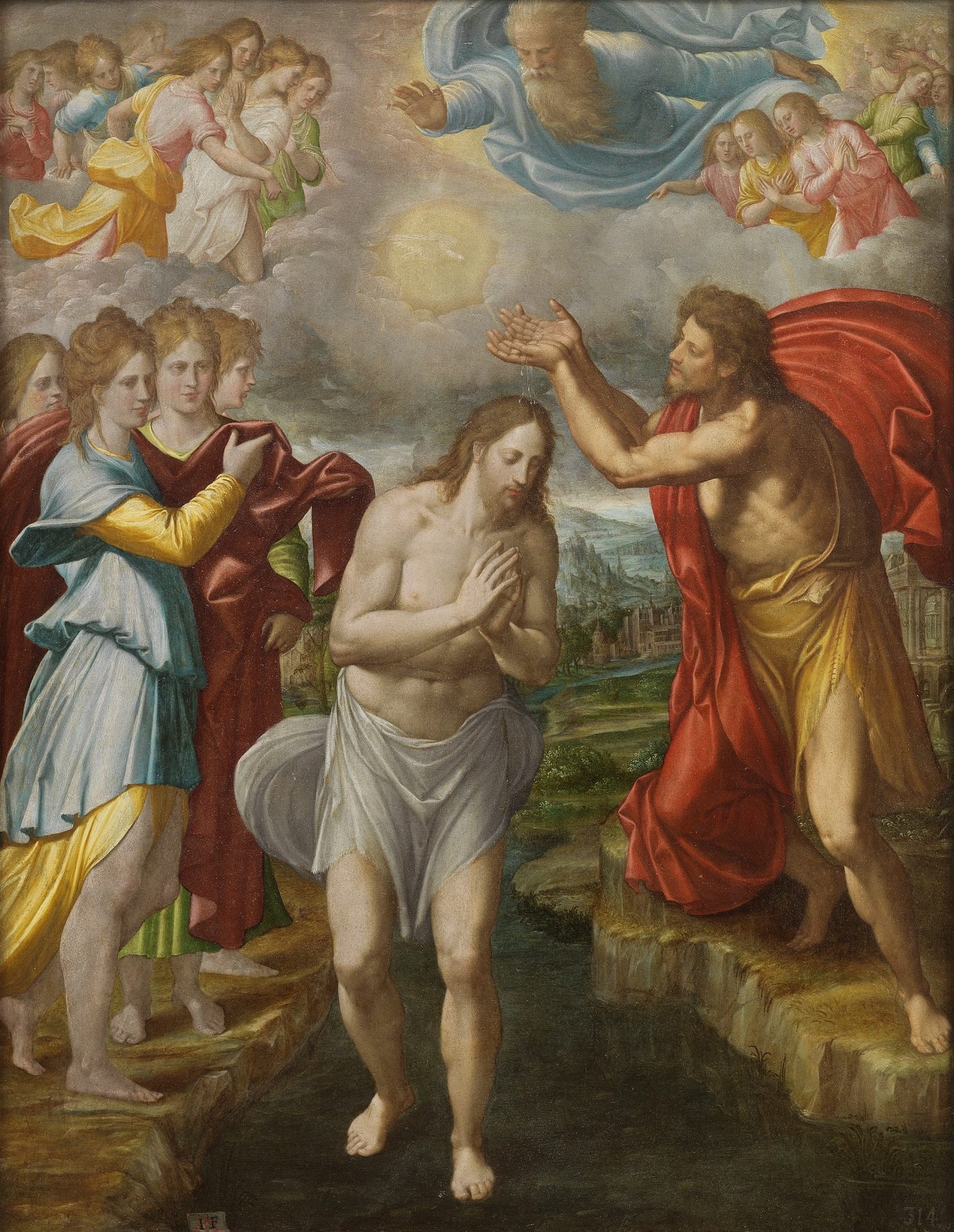
When Jesus comes up out of the water, Mark describes what follows with a word no other evangelist uses:
Immediately he saw the heavens being torn open and the Spirit descending on him like a dove. And a voice came from heaven, “You are my beloved Son; with you I am well pleased” (Mark 1:10–11).
Matthew and Luke both say the heavens were “opened” (ἀνοίγω). Mark says they were “torn” (σχίζω). All three Gospels are alluding to the same text, but Mark’s allusion is more accurate to the Hebrew.
At the end of Isaiah 63, Israel has concluded that God has abandoned them entirely. The final words of the chapter land like a statement of resignation:
We have become like those over whom you have never ruled, like those who are not called by your name (63:19).
Then the prayer breaks open:
Oh that you would rend the heavens and come down, that the mountains might quake at your presence (64:1).
The Hebrew verb is qāra’ — to tear, to rend. The Greek translators rendered it with ἀνοίγω, which may be why Matthew and Luke read as they do, or they may be flattening Mark’s dramatic verb choice. Either way, Mark clearly appears to be reaching back to the Hebrew when he uses σχίζω. The heavens are torn open. Isaiah’s prayer has been answered.
The Spirit descends like a dove, and then the voice from heaven speaks in a composite citation. “You are my Son” draws from Psalm 2:7, the coronation language spoken to the Davidic king on the day of his installation. “With you I am well pleased” (ἐν σοὶ εὐδόκησα) echoes Isaiah 42:1, where the servant is identified as the one on whom God’s Spirit rests and in whom God delights. The royal king and the Isaianic servant are identified as the same person: Jesus of Nazareth.
σχίζω will appear only once more in Mark. At the crucifixion, the temple veil is torn (15:38). The word frames the entire Gospel: the heavens torn at the baptism, the veil torn at the cross. What the baptism announces, the cross delivers.
January 10, 2026 (The Baptism of Christ)
Because today is the First Sunday of Epiphany, which is the traditional Sunday in the West for celebrating the baptism of Jesus, we will take a break from our usual reading sequence. Today, I want us to look at an account of Jesus’ baptism. Mark is my favorite Gospel, so today’s reading is from Mark 1. Since I previously preached on the baptism of Christ (though not specifically from Mark’s Gospel), I’ll link to the sermon here rather than repeat what I already discussed.

Still, I want to share something with you, so here’s an interesting fact. In the Western Church, the Feast of Epiphany emphasizes the revelation of Christ to the Magi from the East. However, in the Eastern Church, the focus is on the revelation of Jesus Christ as the Son of God during his baptism. In fact, in the East, Epiphany is sometimes called “Theophany.” On one hand, we have the revelation to the Gentiles; on the other, the revelation of Jesus’s divinity.
The Western tradition treats this difference by always celebrating the baptism of Christ on the first Sunday after Epiphany, keeping the two closely linked. Both events are explicitly mentioned (along with the miracle at Cana) in our eucharistic prayer during the season of Epiphany. Essentially, instead of choosing one over the other, we celebrate both!