

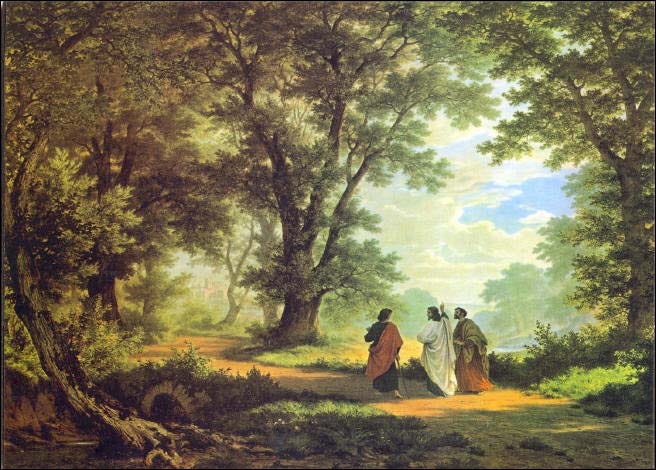
Made Known in the Breaking of the Bread (24:13–35; Easter)
I’m tired. I need to go to bed. I have Easter services in the morning.1
My favorite post-resurrection scene is the Road to Emmaus. Two disciples are walking with Jesus, but they don’t recognize him. When Jesus asks what they are talking about, Cleopas quips that he must be the only person visiting Jerusalem for the Passover who doesn’t know about what happened there. When Jesus asks for more details, Cleopas says hopelessly that he had hoped Jesus was the one to redeem Israel, but apparently that hope came to an end when the Romans crucified him. He adds that there have been reports of angels saying he’s alive and that the tomb is empty, but it doesn’t sound like Cleopas puts much faith in them.
Jesus responds:
“O foolish ones, and slow of heart to believe all that the prophets have spoken! Was it not necessary that the Christ should suffer these things and enter into his glory?” (24:25–26).
Jesus then gives the greatest sermon/Bible study ever. Luke says:
And beginning with Moses and all the Prophets, he interpreted to them in all the Scriptures the things concerning himself (24:27).
The thing is, even after Jesus opens the Scriptures for them, they still don’t recognize him.
The two disciples continue to walk with Jesus. Eventually, they find their way to the table, where Jesus “he took the bread and blessed and broke it and gave it to them” (24:30). This is almost word-for-word what Jesus does at his last Passover with his disciples (cf. Luke 24:31). And in that moment:
“Their eyes were opened, and they recognized him” (24:31).
They didn’t recognize him when he opened up Scripture to them, but as they report later, “he was known to them in the breaking of the bread (24:35).
The Road to Emmaus followed the pattern of early Christian worship. There is the Liturgy of the Word and the Liturgy of the Sacrament. Both are important (and I say this as someone who has spent basically his entire adult life studying Scripture and teaching people), but Christ is made known in the breaking of the bread.
And people try to tell me that it’s not a sacrament, just a meal of remembrance.
Jesus gave the greatest study in Scripture that anyone has ever given (better than I or anyone else reading this will ever give), but they still didn’t recognize him. It was only when he took, blessed, broke, and gave that their eyes were opened, and they recognized their risen Lord.
Happy Easter.
“Be present, be present,
Lord Jesus Christ,
our risen high priest;
make yourself known in the breaking of bread.”
I wrote this at 1:10 am on Easter morning when I was very tired. I’m leaving it here because it reminds me that I am in good company. Ancient scribes copying manuscripts would occasionally leave notes in the margins about their exhaustion, their aching hands, or their longing for rest. For example, one scribe wrote, “Oh my hand.” Another noted that writing “crooks your back, it dims your sight.” The words of Scripture have always come to us through tired human hands.