

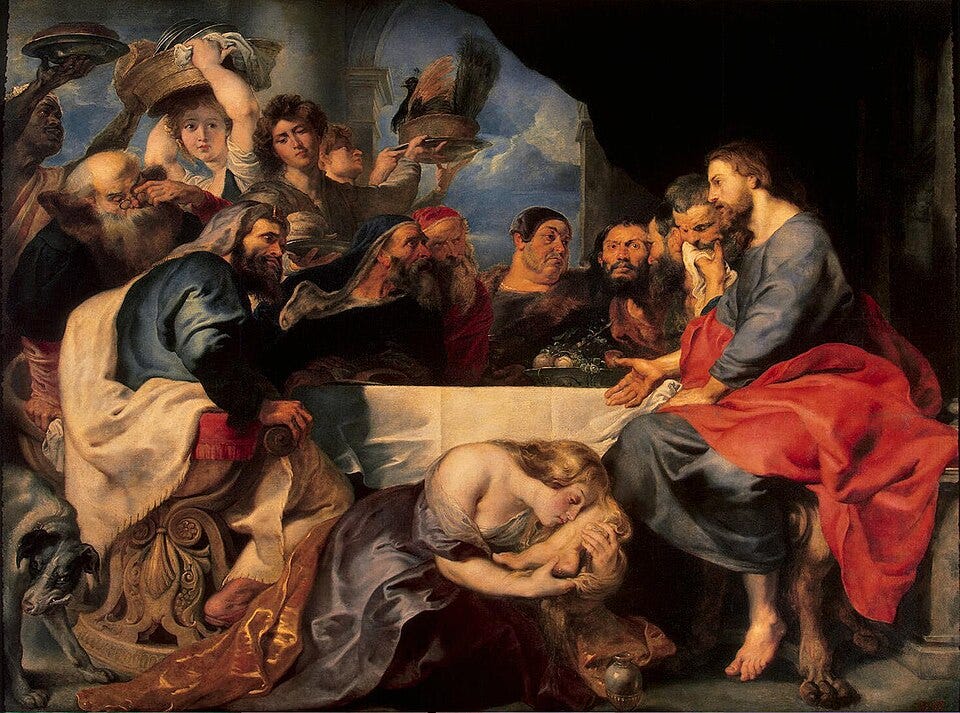
Tears and Ointment (Luke 7:36-50)
The scene is awkward from the start.
A Pharisee invites Jesus to dinner, and an uninvited woman walks in off the street. Luke describes her only as “a woman of the city, who was a sinner” (Luke 7:37). She comes intending to anoint Jesus, but when she finds herself at his feet, she is overwhelmed before she can open the jar. Tears fall first. She wipes them away with her loosened hair, something no respectable woman would do in public, kisses his feet, and finally does what she came for.
Western tradition has long identified the woman as Mary Magdalene, but this identification stems from a single source: a homily by Pope Gregory the Great in 591 (Hom. ev. 33). In that homily, he conflated this unnamed woman, Mary Magdalene (who is introduced just a few verses later in Luke 8:2), and Mary of Bethany (John 12:1–3). Luke offers no indication that they are the same person, and his lack of a name here is almost certainly deliberate.
Simon the Pharisee watches silently and concludes that Jesus cannot be a prophet because he failed to recognize the woman’s character (7:39). The irony is immediate: Jesus demonstrates prophetic insight by reading Simon’s unspoken thoughts, and then shares a parable found only in Luke. Two debtors owe a moneylender: one five hundred denarii, the other fifty. Neither can pay; both are forgiven. Which one loves more? Simon offers the obvious answer, and Jesus turns it back on him.
Then comes 7:47. The Greek word ὅτι (hoti), translated as “for,” can function causally (”because she loved, she is forgiven”) or inferentially (“as proved by the fact that she loved, she is forgiven”). The parable settles the question. The debt is canceled before any love is expressed. Her extravagant devotion is proof that a great debt has already been canceled, not the payment that cancels it.
Jesus enumerates what Simon failed to provide: no water, no kiss, no oil (7:44–46). The omissions were a social failure nearly as striking as the woman’s loosened hair. Those who have reckoned honestly with the size of their debt love extravagantly; those who have not, love little. Simon has not yet looked at his own ledger.
Jesus turns to the woman and says:
“Your sins are forgiven... Your faith has saved you; go in peace” (7:48, 50).
She never speaks. Her whole argument is made in ointment and tears.
I think we see this same spirit of religiosity in so much of America right now — those who’ve known Christ a long time, have forgotten (perhaps?) the great debt they were once forgiven. So now, they have little tolerance for the “sinners” around them. It’s truly sad. And Jesus’ words are proven true — they love little because they believe they have been forgiven little!