

The Generation That Would Not Dance (7:31–35)
Jesus turns from his testimony about John to indict the crowd in front of him.
“To what then shall I compare the people of this generation, and what are they like?” (Luke 7:31).
His answer describes two groups of children playing in the marketplace. One side pipes a wedding tune, and the other refuses to dance. One side wails a funeral dirge, and the other refuses to mourn (7:32). Neither invitation moves them to participate. Despite what they are hearing (and seeing) in the ministry of Jesus, this generation has already decided in advance not to respond.
Jesus then names the two “songs.” John “has come eating no bread and drinking no wine,” and their verdict was “he has a demon” (7:33). The detail about wine is not incidental. Gabriel had already told Zechariah that his son would “not drink wine or strong drink” (Luke 1:15), the same command given to Samson’s mother about the child who would be “a Nazirite to God from the womb to the day of his death” (Judg 13:7; cf. 13:4, 14; Num 6:3). John’s fasting was the visible sign of a consecration announced before he was born. The people say he has a demon because they’ve decided in advance that they didn’t want to listen to him
In contrast, the Son of Man plays the opposite tune. He comes eating and drinking, and they say that he is “a glutton and a drunkard, a friend of tax collectors and sinners” (7:34). John fasted and was called possessed. Jesus feasted and was called dissolute. The two songs could not be further apart, and the crowd dances to neither. John’s diet was never the problem, and neither were Jesus’ dinner companions. The problem is a generation that refused to respond appropriately to the music.
So often we close ourselves off to what God is doing before we ever hear his music, and we typically make excuses for that hard-heartedness. “John had a demon.” “Jesus was a glutton and drunkard.” Our excuses aren’t the same, and they’re typically more subtle. Don’t tune out the music before you’ve even heard it. The task is to be open to what you hear and respond appropriately, rather than closing yourself off to what God is doing in you and in the world around you.
A Great Prophet Has Arisen (7:11-17)
When the prophet Elijah arrived in Zarephath, he met a widow whose only son had died. He took the boy upstairs, stretched himself over him three times, and cried out to the Lord. The boy was restored to life, and Elijah returned him to his mother.
And Elijah took the child and brought him down from the upper chamber into the house and delivered him to his mother. And Elijah said, “See, your son lives.” (1 Kgs 17:23)
In response, the widow says she now knows the man of God is genuine and that the word of the Lord in his mouth is truth (17:24). The raising of a widow’s only son is the sign that confirms Elijah as a prophet.
Luke is familiar with this story, and he expects his readers to be familiar with it too. As Jesus nears the town of Nain, a dead man is being carried out, “the only son of his mother, and she was a widow” (7:12). Each term carries weight. Only son. Mother. Widow. Luke has prepared the scene for an Elijah-like moment, and the funeral at the gate highlights the woman’s plight. She has already lost her husband, and now she has lost her only son, her only means of support in a world that offers no safety for a widow alone.
Jesus shows compassion on her, touches the bier, and speaks. The dead man sits up and starts talking. Then Luke adds a line that clears up any doubt about his intention:
And he gave him to his mother. (7:15)
In Greek, the clause matches the translation of 1 Kings 17:23 exactly. Luke is not just telling a similar story; he is quoting the Elijah account at the exact moment of restoration, linking the two scenes so that the reader cannot miss the connection.
The crowd reaches the obvious conclusion. “A great prophet has arisen among us!” (7:16). They are right, but not quite right enough. Elijah stretched himself over the boy and begged the Lord to act. Jesus simply speaks, and the dead obey. The prophet of Zarephath interceded with God. The one at Nain commands with the authority of God.
This is what the allusion is meant to reveal. Jesus was a prophet, but he was also much more than a prophet. The widow of Zarephath understood that a true prophet’s word is the word of the Lord. At Nain, that word is spoken by the one who needs no intermediary because death already answers to his voice.
Tears and Ointment (7:36-50)
The scene is awkward from the start.
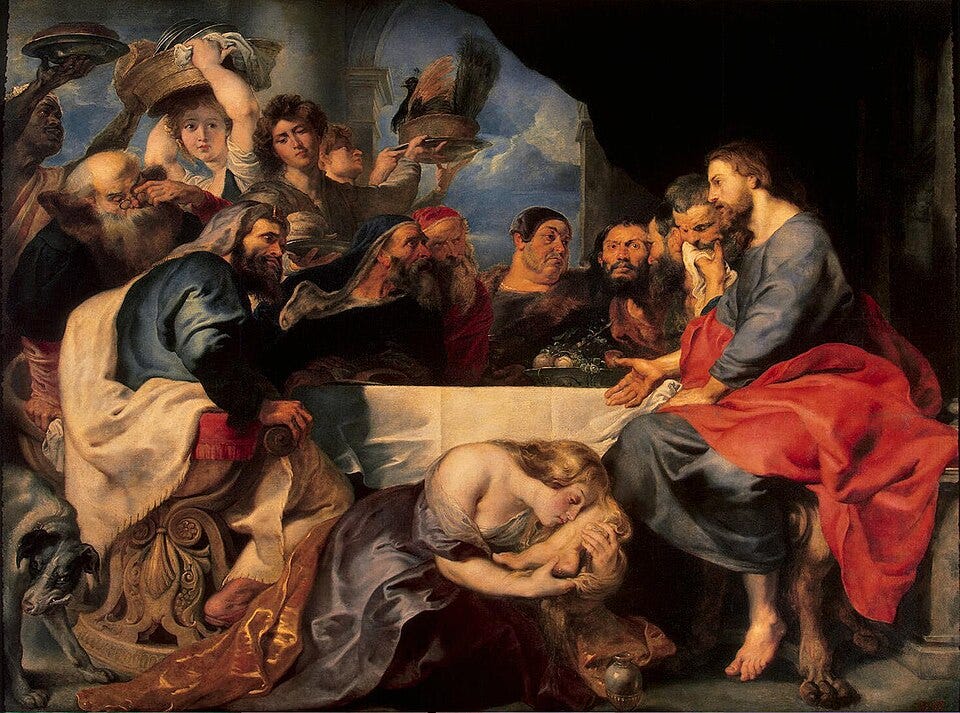
A Pharisee invites Jesus to dinner, and an uninvited woman walks in off the street. Luke describes her only as “a woman of the city, who was a sinner” (Luke 7:37). She comes intending to anoint Jesus, but when she finds herself at his feet, she is overwhelmed before she can open the jar. Tears fall first. She wipes them away with her loosened hair, something no respectable woman would do in public, kisses his feet, and finally does what she came for.
Western tradition has long identified the woman as Mary Magdalene, but this identification stems from a single source: a homily by Pope Gregory the Great in 591 (Hom. ev. 33). In that homily, he conflated this unnamed woman, Mary Magdalene (who is introduced just a few verses later in Luke 8:2), and Mary of Bethany (John 12:1–3). Luke offers no indication that they are the same person, and his lack of a name here is almost certainly deliberate.
Simon the Pharisee watches silently and concludes that Jesus cannot be a prophet because he failed to recognize the woman’s character (7:39). The irony is immediate: Jesus demonstrates prophetic insight by reading Simon’s unspoken thoughts, and then shares a parable found only in Luke. Two debtors owe a moneylender: one five hundred denarii, the other fifty. Neither can pay; both are forgiven. Which one loves more? Simon offers the obvious answer, and Jesus turns it back on him.
Then comes 7:47. The Greek word ὅτι (hoti), translated as “for,” can function causally (”because she loved, she is forgiven”) or inferentially (“as proved by the fact that she loved, she is forgiven”). The parable settles the question. The debt is canceled before any love is expressed. Her extravagant devotion is proof that a great debt has already been canceled, not the payment that cancels it.
Jesus enumerates what Simon failed to provide: no water, no kiss, no oil (7:44–46). The omissions were a social failure nearly as striking as the woman’s loosened hair. Those who have reckoned honestly with the size of their debt love extravagantly; those who have not, love little. Simon has not yet looked at his own ledger.
Jesus turns to the woman and says:
“Your sins are forgiven... Your faith has saved you; go in peace” (7:48, 50).
She never speaks. Her whole argument is made in ointment and tears.
I love the way you help us see the connections between the OT and the NT. I knew both stories but wouldn’t have made that connection on my own! Jesus can call dead things to life — that’s so crucial for us to understand today
I think we see this same spirit of religiosity in so much of America right now — those who’ve known Christ a long time, have forgotten (perhaps?) the great debt they were once forgiven. So now, they have little tolerance for the “sinners” around them. It’s truly sad. And Jesus’ words are proven true — they love little because they believe they have been forgiven little!