

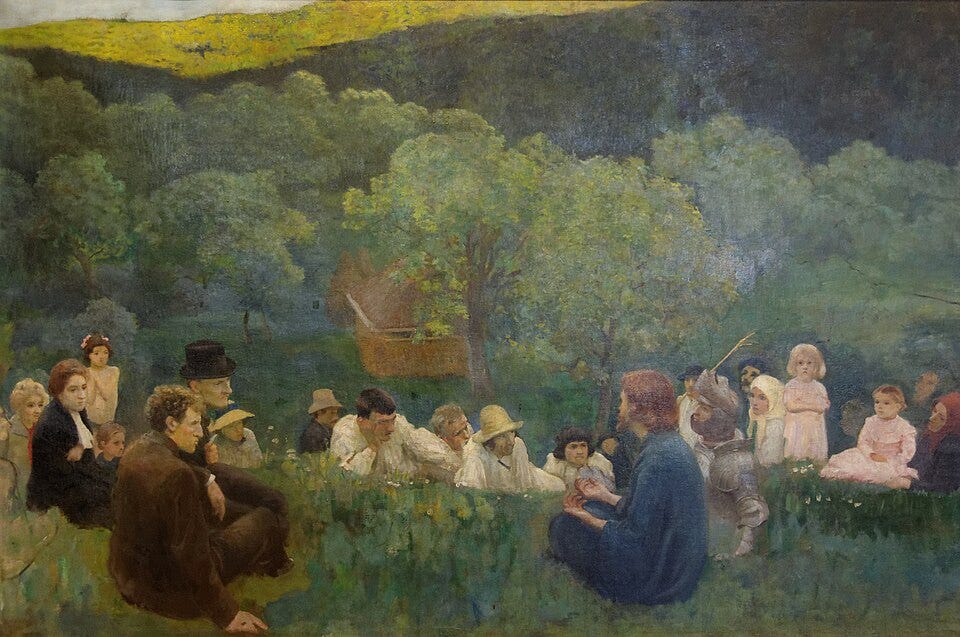
Before the Storm (6:43–49)
How do we know what’s going on inside our hearts? We deceive ourselves far more than we deceive others. So we need a way to check what’s going on inside us. Jesus says:
“No good tree bears bad fruit, nor again does a bad tree bear good fruit, for each tree is known by its own fruit” (6:43–44).
If you want to know what’s going on inside you, take a look at the kind of fruit your life is producing.
“Figs are not gathered from thornbushes, nor are grapes picked from a bramble bush” (6:44) because a plant yields only what its nature determines. Jesus then shifts the image from orchard to speech: “The good person out of the good treasure of his heart produces good, and the evil person out of his evil treasure produces evil, for out of the abundance of the heart his mouth speaks” (6:45).
Jeremiah had already said something like this, from the opposite angle:
“The heart is deceitful above all things, and desperately sick; who can understand it? I the LORD search the heart and test the mind, to give every man according to his ways, according to the fruit of his deeds” (17:9–10).
For Jeremiah, the heart is a locked room, and only God holds the key. Jesus agrees the heart stays hidden, but insists its fruit does not. What God alone can see directly, everyone else can read in what a person says and does.
The gap between a hidden heart and a public fruit makes clear that the next line is an accusation rather than a question:
“Why do you call me ‘Lord, Lord,’ and not do what I tell you?” (Luke 6:46).
The title costs nothing to say. Obedience is the only fruit that confirms it was ever true.
The parable that follows makes the same argument in a different way. Everyone who hears Jesus’s words and does them is like a man who “dug deep and laid the foundation on the rock” (6:48). Matthew’s version of this parable contrasts rock against sand (Matt 7:24–27). Luke’s does not mention sand.
Luke’s failed builder is simply a man who “built a house on the ground without a foundation” (Luke 6:49). The difference between the two builders is not where they built but whether they did the beneath-the-surface work first. When the flood came, the stream revealed whether the foundation had already been laid. The tree does not decide its fruit once it is picked, and the house does not decide whether it holds once the water rises.
Bearing good fruit begins with laying a solid foundation of faith in our hearts. And if our lives aren’t bearing good fruit, it's worth thinking about whether we’ve built our lives on the firm foundation of the gospel or if we’ve built them on other surfaces that will not hold when the storm comes.
Be Merciful (6:27–36)
When Israel asked who their God was, they were given an answer from the cleft of a rock. Moses had asked to see God’s glory, and what passed before him was not a vision but a name, recited aloud: “The LORD, the LORD, a God merciful and gracious, slow to anger, and abounding in steadfast love and faithfulness” (Exod 34:6). The first word in that confession, in the Greek of the Septuagint, is οἰκτίρμων (oiktirmōn), “merciful.” It became the center of how Israel spoke of God. The psalmists return to it; the prophets appeal to it; the whole sacrificial life of the nation rested on the conviction that the God they served was, before all else, merciful.
Israel was supposed to mirror the mercy. The holiness code framed Israel’s obligation to God as an act of imitation: “You shall be holy, for I the LORD your God am holy” (Lev 19:2). The logic is that God’s people should take on the character of the God who claimed them. It’s in this same chapter that we find the command that Jesus is about to stretch past its original limits: “you shall love your neighbor as yourself” (19:18).
Jesus takes up that whole tradition and presses it further than the neighbor:
“But I say to you who hear, Love your enemies, do good to those who hate you, bless those who curse you, pray for those who abuse you” (6:27–28).
The love commanded in Leviticus had a horizon: the neighbor, the member of the covenant community. Jesus removes that horizon. The enemy, the one who hates and curses and strikes, is now the object of the same love. And Jesus grounds the command exactly where Israel grounded its holiness, in the character of God:
“But love your enemies, and do good, and lend, expecting nothing in return, and your reward will be great, and you will be sons of the Most High, for he is kind to the ungrateful and the evil.” (6:35).
Then comes the line that grounds the whole teaching. Where Matthew’s version reads “you therefore must be perfect, as your heavenly Father is perfect” (Matt 5:48), Luke writes, “Be merciful, even as your Father is merciful” (6:36). The word for “merciful” is οἰκτίρμων, the word from the cleft of the rock. Luke has Jesus complete the holiness formula of Leviticus by filling it with the name God spoke to Moses.
We tend to imagine mercy as the response we extend once someone has earned their way back, once the apology has been made and the debt acknowledged. The God of Exodus 34 is merciful to people who have not done that. He is kind to the ungrateful and the evil, and his people are to be like him toward the people we have most reason not to be.
Blessed Are You (6:20–26)
When Jesus begins his Sermon on the Plain, he is not presenting a moral agenda for self-improvement. He looks up toward his disciples, the same people who have just left everything behind to follow him, and declares them blessed (Luke 6:20).
The Greek word is μακάριος (makarios), and it functions more as a statement of status than an invitation. It does not mean “you will become blessed if you develop the right virtues”; it indicates that you are, right now, in a state of divine favor. The people being addressed are the poor, the hungry, those who mourn, and those hated because of the Son of Man (6:20–22).
What makes Luke’s beatitudes unique is their direct address to the second person. Matthew’s version refers to “the poor in spirit” in the third person (Matt 5:3); Luke’s Jesus looks at his disciples and says, “blessed are you who are poor” (Luke 6:20). The poverty highlighted here is social and economic first, then spiritual. Luke has been leading up to this moment since the Magnificat, where Mary sings of a God who fills the hungry with good things and sends the rich away empty (1:52–53).
The four woes that follow mirror the beatitudes with striking accuracy. Wealthy, joyful, cheerful, and well-regarded: these woes are for those who, by every objective measure, seem to be thriving (6:24–26). But the crucial word in verse 24 is the verb ἀπέχετε (apechete), a business term found on ancient papyrus receipts to indicate an account paid in full. The wealthy have already received their comfort. Their account is settled, and there is nothing more to draw from.
The woes are not curses. The Greek interjection οὐαί (ouai) aligns more with “alas” than with a statement of condemnation. Jesus is not delivering damnation but rather announcing an upcoming reversal that will reveal how fragile apparent prosperity truly is. The kingdom of God, as Luke describes it from the very first chapters, is not a slightly improved version of the current order. It is a true inversion of it.
The core question isn’t “have I internalized the right spiritual dispositions?” but something more uncomfortable: which side of the reversal am I on, and why does that question make me uneasy?