

The Old Is Good? (March 14, 2026)
The question that the Pharisees and their scribes raise in 5:33 is a valid one. John’s disciples fast and pray; so do theirs. Why don’t Jesus’s disciples do the same? The contrast is not driven by hostility but by real curiosity about a familiar religious practice.
Jesus responds with three comparisons. Wedding guests don’t fast while the bridegroom is with them. New cloth doesn’t patch old garments. New wine doesn’t go into old wineskins. All these illustrate the same core idea: something truly new has arrived, and new things need new containers or practices.
But then Luke includes a saying that Matthew and Mark omit.
“No one after drinking old wine desires new, for he says, ‘The old is good’” (Luke 5:39).
The word translated as “good” is χρηστός (chrēstos), a term with a sensory aspect: pleasant, agreeable, easy to enjoy. The old wine isn’t just acceptable; it is truly satisfying.
A Greek speaker would have perceived a closer similarity in that word. By the Koine period, due to the vowel shift known as iotacism, χρηστός (chrēstos) and Χριστός (Christos) had become nearly indistinguishable in pronunciation. Suetonius, writing about disturbances among Jews in Rome under Claudius, almost certainly garbles the name of Christ as “Chrestus” precisely because the two words sounded alike to outsiders.
Whether or not Luke is intentionally crafting a pun, any Greek-speaking reader would sense the significance: the very word used to praise the old inadvertently describes what is being rejected. The wine of Israel’s long tradition is chrēstos, good and satisfying. But among them stands the Christos, the Anointed, whom they are not yet ready to desire.
Luke is approaching this with pastoral care. The final verse acts as a serious warning: those who have committed to older movements tend to stick with what they know because it genuinely benefits them. The Pharisees in v. 33 are rooted in a tradition of true piety. Fasting, prayer, and Torah observance: these are not empty rituals but practices that have sustained Israel’s relationship with God for generations. The issue isn’t that the old ways were bad. The issue is that the new has come, and those who have deeply embraced the old will need time before the new becomes appealing.
Where in your own life has something genuinely good made it difficult to recognize something better? The one standing before the Pharisees is not just chrēstos but Christos, and what he is asking is whether you are ready to reach for a new cup.
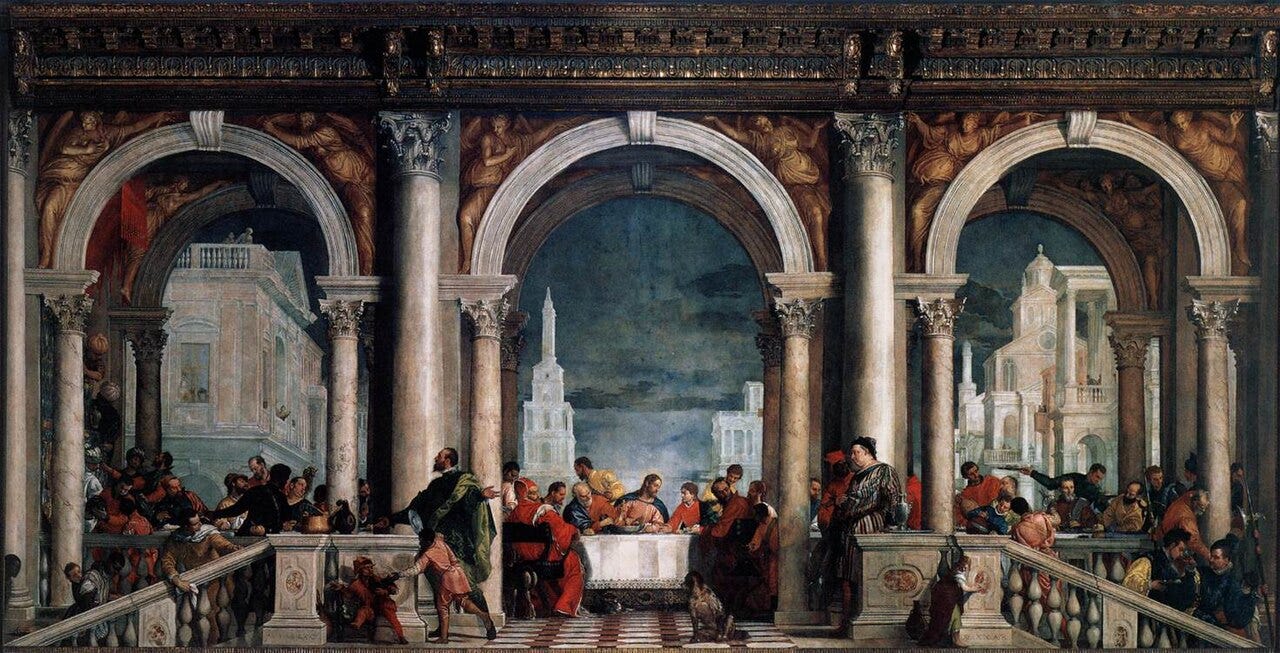
Veronese painted the above image as a Last Supper, was hauled before the Inquisition for filling it with “buffoons, drunken Germans, and dwarfs,” and rather than alter a single figure, changed the title to Feast in the House of Levi. The painting even carries an inscription referencing Luke 5 across the top of the pillars. That backstory is its own small sermon on resistance to authority over what a sacred meal should look like.
I was struck by this part this morning:
“ 4 And when he had finished speaking, he said to Simon, “Put out into the deep and let down your nets for a catch.” 5 And Simon answered, “Master, we toiled all night and took nothing! But at your word I will let down the nets.”
How often have we toiled to overcome some sin or resolve some situation only to have the Lord say to do something that seems fruitless and redundant! May I be like Peter and answer “But at your word!”